. 2017 Oct;143(10):1947-1957.
doi: 10.1007/s00432-017-2408-4. Epub 2017 May 27.

AXL-GAS6 expression can predict for adverse prognosis in non-small cell lung cancer with brain metastases

Affiliations

AXL-GAS6 expression can predict for adverse prognosis in non-small cell lung cancer with brain metastases

Xiaoliang Wu et al. J Cancer Res Clin Oncol. 2017 Oct.

Abstract

Purpose: Patients with non-small cell lung cancer (NSCLC) brain metastases (BM) have poor clinical outcomes. We sought to determine if AXL-GAS6 expression can be used as independent prognostic biomarkers for NSCLC BM.

Methods: We retrospectively studied the medical records of 98 patients diagnosed with advanced metastatic NSCLC from December 2000 to June 2014. Out of a total of 98 patients with NSCLC metastases, 66 patients were identified to have brain metastases. The expressions of AXL and GAS6 were assessed by standard immunohistochemistry and correlated with clinicopathological factors and overall survival (OS) outcomes.

Results: The expression of AXL was positively associated with GAS6 expression (P < 0.001), and tumor differentiation (P = 0.014) in advanced NSCLC with metastases. AXL expression displayed no association with gender, age, smoking history, pathology, T stage, N stage, CEA, and LDH. In univariate analysis, both AXL and GAS6 were found to predict worse OS outcomes (AXL: HR 1.77, 95% CI 1.13-2.79, P = 0.01; GAS6: HR 1.80, 95% CI 1.14-2.84, P = 0.01). In the brain metastasis subgroup, the expression of AXL was positively associated with GAS6 expression (P < 0.001). Both AXL and GAS6 were found to predict worse BM-OS outcomes in univariate analysis (AXL: HR 2.19, 95% CI 1.33-4.10, P = 0.005; GAS6: HR 2.04, 95% CI 1.01-3.71, P = 0.019). In multivariate analysis, high co-expression of AXL/GAS6 was found to be an independent unfavorable risk factor for the overall study population (HR 2.33, 95% CI 1.40-3.87, P = 0.0011) and also in BM (HR 2.76, 95% CI 1.45-5.25, P = 0.001), predicting worse survival outcome.

Conclusions: AXL-GAS6 co-expression represents a potential independent prognostic biomarker for survival outcome in NSCLC BM patients.

Keywords: AXL; Brain metastasis; EMT; GAS6; NSCLC; Prognostic biomarker; Survival.


Conflict of interest statement

Patrick C. Ma is a member of Speaker’s Bureau of Merck and Pfizer, Advisory Board of Caris Center of Excellence Network for Precision Medicine (Caris Life Science) and received contracted clinical research support from Medimmune, Bristol-Myers Squibb, AstraZeneca, EpicentRx, Tesaro, PrECOG, LOXO Oncology, and XCovery.

Figures
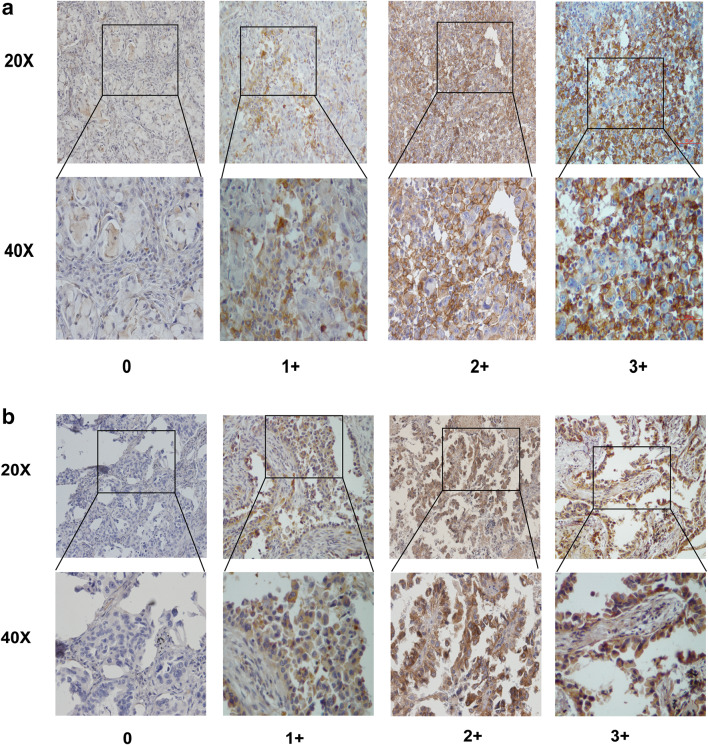
Fig. 1
Fig. 1
AXL and GAS6 expression in NSCLC tumor tissues. a Examples of tumoral staining intensity (0, 1+, 2+, and 3+) of AXL in immunohistochemistry (IHC) analysis. b Examples of tumoral staining intensity (0, 1+, 2+, and 3+) of GAS6 in immunohistochemistry (IHC) analysis
Fig. 2
Fig. 2
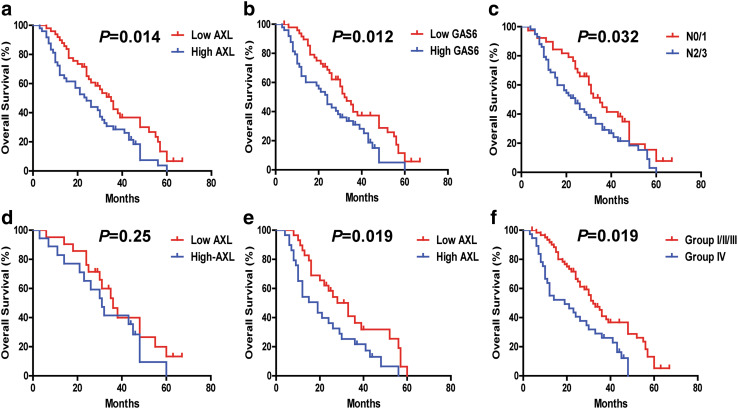
The correlation of NSCLC overall survival (OS) with different clinicopathological characteristics. ac Survival curves were generated using the Kaplan–Meier method, and differences between survival curves were estimated by the log-rank test. AXL, GAS6, and nodal (N) stage have statistically significant correlation with OS differences. d, e The correlation between AXL expression and NSCLC OS in nodal (N) stage group. d N 0/1 stage subgroup (n = 40, P > 0.05). e N 2/3 stage subgroup (n = 58, P < 0.05). f Combined analysis of AXL and GAS6 co-expression and its correlation with NSCLC metastasis overall survival. The association of AXL/GAS6 co-expression with overall survival (log-rank P < 0.05) is shown here. Group I with AXLLow and GAS6Low (n = 37); Group II with AXLHigh and GAS6Low (n = 12); Group III with AXLLow and GAS6High (n = 12); Group IV, AXLHigh and GAS6High (n = 37)
Fig. 3
Fig. 3
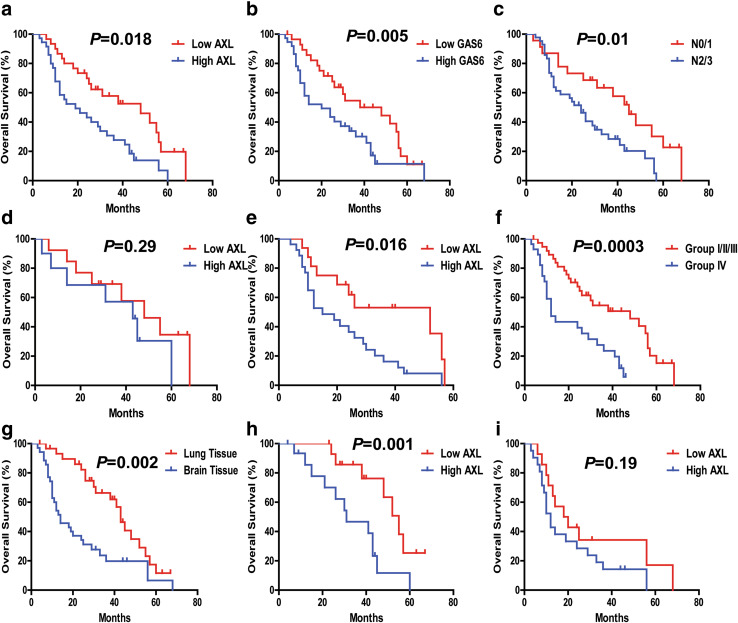
The correlation of NSCLC BM-OS with different clinicopathological characteristics. ac AXL, GAS6, and nodal (N) stage have statistically significant correlation with BM-OS. d, e The correlation between AXL expression and NSCLC BM-OS in N 2/3 stage group (n = 43), P < 0.05. f Combined analysis of AXL and GAS6 co-expression and its correlation with NSCLC BM-OS. The association of AXL/GAS6 high co-expression with overall survival (log-rank P < 0.05) is shown here. Group I with AXLLow and GAS6Low (n = 20); Group II with AXLHigh and GAS6Low (n = 9); Group III with AXLLow and GAS6High (n = 9); Group IV, AXLHigh and GAS6High (n = 26). gi The correlation between AXL expression and NSCLC BM-OS in the lung tissue subgroup and brain tissue subgroup. AXL expression carries a statistically significant BM-OS difference in lung tissue subgroup, and not in brain tissue subgroup

References

    1. Baek MY et al (2016) Epidermal growth factor receptor mutation and pattern of brain metastasis in patients with non-small cell lung cancer. Korean J Intern Med. doi:10.3904/kjim.2015.158 - PMC - PubMed
    1. Barnholtz-Sloan JS, Sloan AE, Davis FG, Vigneau FD, Lai P, Sawaya RE (2004) Incidence proportions of brain metastases in patients diagnosed (1973 to 2001) in the Metropolitan Detroit Cancer Surveillance System. J Clin Oncol 22:2865–2872. doi:10.1200/JCO.2004.12.149 - DOI - PubMed
    1. Chen W et al (2016) Cancer statistics in China, 2015. CA Cancer J Clin 66:115–132. doi:10.3322/caac.21338 - DOI - PubMed
    1. Cohen MH, Johnson JR, Chen YF, Sridhara R, Pazdur R (2005) FDA drug approval summary: erlotinib (Tarceva) tablets. Oncologist 10:461–466. doi:10.1634/theoncologist.10-7-461 - DOI - PubMed
    1. Craven RJ et al (1995) Receptor tyrosine kinases expressed in metastatic colon cancer. Int J Cancer 60:791–797 - DOI - PubMed

MeSH terms

Substances