


Infection Trends in US Nursing Homes, 2006-2013
- PMID: 28552333
- PMCID: PMC5577941
- DOI: 10.1016/j.jamda.2017.04.003
Infection Trends in US Nursing Homes, 2006-2013
Abstract
Objectives: The objectives of this study were to estimate trends in the prevalence of infections in nursing home (NH) residents using 2006-2013 Minimum Data Set (MDS) data, estimate the number of all infections in 2013, and evaluate differences in trends between MDS versions 2.0 and 3.0.
Design: Retrospective study.
Setting: NHs in the United States.
Participants: All NH residents with a quarterly or annual MDS assessment in 2006-2013 (n = 30,366,807 assessments).
Measurements: MDS 2.0 and 3.0 quarterly and annual assessment data (2006-2013) from over 15,000 NHs were used to estimate the 7-day prevalence of multidrug-resistant organism (MDRO) infection, pneumonia, septicemia, viral hepatitis, and wound infection and 30-day prevalence of urinary tract infection (UTI). Admission assessments were excluded. Annual infection counts were estimated using 2013 data. Changes in the prevalence of reported infections over time and differences in trends between MDS 2.0 and 3.0 were examined using tests of linear trends.
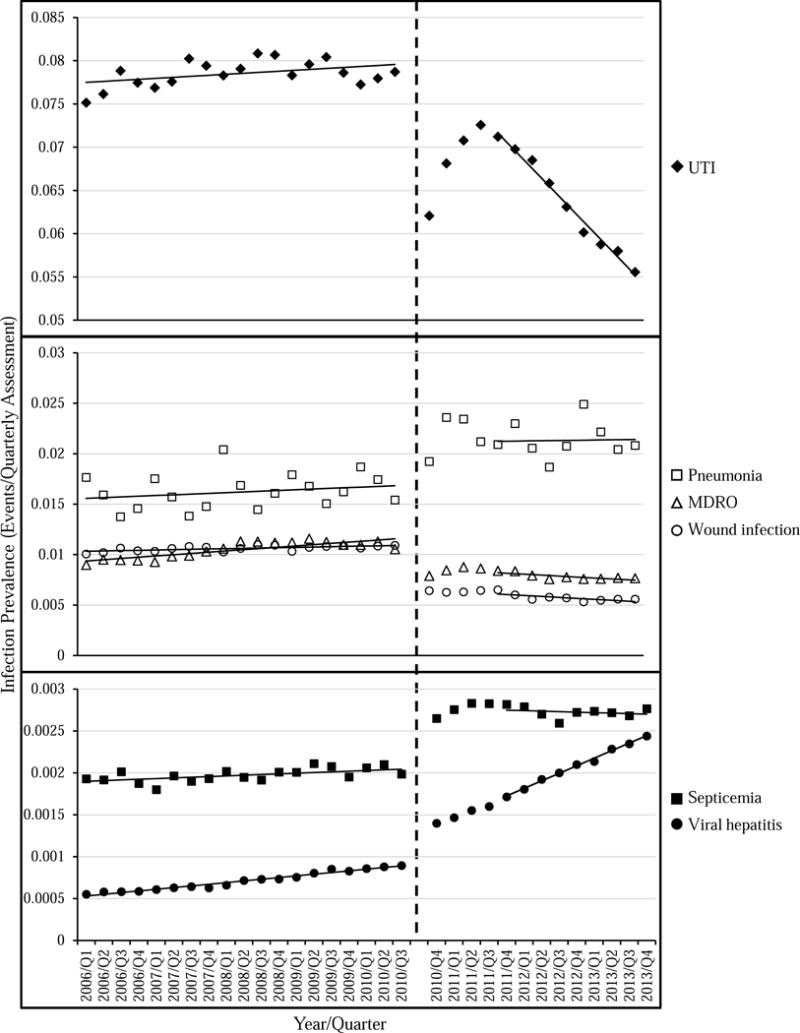
Results: In 2013, there were an estimated 1.13 to 2.68 million infections in NH residents. UTI and pneumonia were the most commonly reported infections in every quarter, ranging from 5.6% to 8.1% and 1.4% to 2.5%, respectively. Prevalence of all infections increased in 2006-2010 (P values < .01). In 2011-2013, prevalence of UTI, MDRO, and wound infections decreased and viral hepatitis increased (P values < .0001). Between MDS 2.0 and 3.0, the prevalence of UTI, MDRO, and wound infections decreased and the prevalence of viral hepatitis increased (P values < .0001).
Conclusion: Infections are a major and persistent problem in NHs. Although MDS data are useful for identifying trends in infection prevalence, revisions in definitions need to be accounted for when evaluating trends over time. Additional research is needed to identify factors that contribute to changes in infection prevalence.
Keywords: Nursing homes; infections; long-term care; minimum data set.
Copyright © 2017 AMDA – The Society for Post-Acute and Long-Term Care Medicine. Published by Elsevier Inc. All rights reserved.
Conflict of interest statement
Figures
References
-
- Strausbaugh LJ, Joseph CL. The burden of infection in long-term care. Infect Control Hosp Epidemiol. 2000 Oct;21(10):674–679. - PubMed
-
- Dwyer LL, Harris-Kojetin LD, Valverde RH, et al. Infections in long-term care populations in the United States. J Am Geriatr Soc. 2013 Mar;61(3):342–349. - PubMed
-
- US Department of Health and Human Services. National Action Plan to Prevent Health Care–Associated Infections: Road Map to Elimination. 2013 http://www.health.gov/hai/pdfs/hai-action-plan-ltcf.pdf. Accessed December 2014.
-
- Centers for Disease Control and Prevention. NHSN e-News, December 2016. 2016 https://www.cdc.gov/nhsn/pdfs/newsletters/nhsn-nl-dec-2016.pdf. Accessed January 20, 2016.
-
- Center for Medicare and Medicaid Services. Medicare and Medicaid Programs; Reform of Requirements for Long-Term Care Facilities. https://www.federalregister.gov/documents/2016/10/04/2016-23503/medicare.... Accessed January 30, 2017. - PubMed
MeSH terms
Grants and funding
LinkOut - more resources
Full Text Sources
Other Literature Sources
Medical
Research Materials
Miscellaneous
