


The PLATINO study: description of the distribution, stability, and mortality according to the Global Initiative for Chronic Obstructive Lung Disease classification from 2007 to 2017
- PMID: 28553101
- PMCID: PMC5441518
- DOI: 10.2147/COPD.S136023
The PLATINO study: description of the distribution, stability, and mortality according to the Global Initiative for Chronic Obstructive Lung Disease classification from 2007 to 2017
Abstract
Background: The Global Initiative for Chronic Obstructive Lung Disease (GOLD) report provides a framework for classifying COPD reflecting the impacts of disease on patients and for targeting treatment recommendations. The GOLD 2017 introduced a new classification with 16 subgroups based on a composite of spirometry and symptoms/exacerbations.
Methods: Data from the population-based PLATINO study, collected at baseline and at follow-up, in three sites in Latin America were analyzed to compare the following: 1) the distribution of COPD patients according to GOLD 2007, 2013, and 2017; 2) the stability of the 2007 and 2013 classifications; and 3) the mortality rate over time stratified by GOLD 2007, 2013, and 2017.
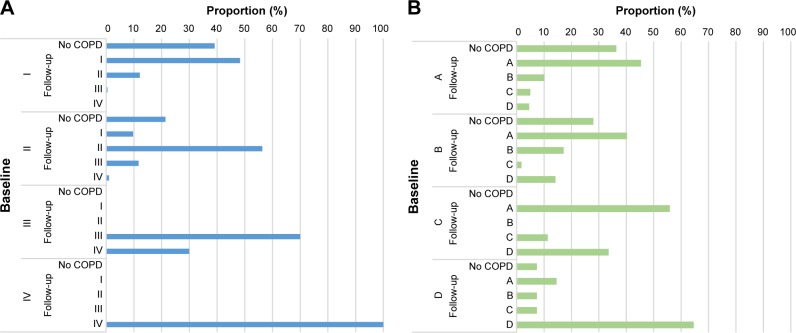
Results: Of the 524 COPD patients evaluated, most of them were classified as Grade I or II (GOLD 2007) and Group A or B (GOLD 2013), with ≈70% of those classified as Group A in GOLD 2013 also classified as Grade I in GOLD 2007 and the highest percentage (41%) in Group D (2013) classified as Grade III (2007). According to GOLD 2017, among patients with Grade I airflow limitation, 69% of them were categorized into Group A, whereas Grade IV patients were more evenly distributed among Groups A-D. Most of the patients classified by GOLD 2007 remained in the same airflow limitation group at the follow-up; a greater temporal variability was observed with GOLD 2013 classification. Incidence-mortality rate in patients classified by GOLD 2007 was positively associated with increasing severity of airflow obstruction; for GOLD 2013 and GOLD 2017 (Groups A-D), highest mortality rates were observed in Groups C and D. No clear pattern was observed for mortality across the GOLD 2017 subgroups.
Conclusion: The PLATINO study data suggest that GOLD 2007 classification shows more stability over time compared with GOLD 2013. No clear patterns with respect to the distribution of patients or incidence-mortality rates were observed according to GOLD 2013/2017 classification.
Keywords: GOLD classification; Latin America; chronic obstructive lung diseases.
Conflict of interest statement
Disclosure All the authors met the authorship criteria set forth by the International Committee for Medical Journal Editors. AMM received fees from GSK for the analysis and reporting of this study and from AstraZeneca for project analyses. KPV, CS, and HM are employees of GSK, and CS and HM hold GSK stocks. FCW, RP-P, GV, JRJ, and MMdeO report no conflicts of interest in this work.
Figures
References
-
- Global Strategy for the Diagnosis, Management and prevention of Chronic, Obstructive Pulmonary Disease, 2017 Report. 2016. [Accessed February 27, 2017]. [cited November, 2016]. Available from: http://goldcopd.org/
-
- Rabe KF, Hurd S, Anzueto A, et al. Global strategy for the diagnosis, management, and prevention of chronic obstructive pulmonary disease: GOLD executive summary. Am J Respir Crit Care Med. 2007;176(6):532–555. - PubMed
-
- Mannino DM, Thorn D, Swensen A, Holguin F. Prevalence and outcomes of diabetes, hypertension and cardiovascular disease in COPD. Eur Respir J. 2008;32(4):962–969. - PubMed
-
- Spruit MA, Polkey MI, Celli B, et al. Predicting outcomes from 6-minute walk distance in chronic obstructive pulmonary disease. J Am Med Dir Assoc. 2012;13(3):291–297. - PubMed
-
- Hogg JC, Chu F, Utokaparch S, et al. The nature of small-airway obstruction in chronic obstructive pulmonary disease. N Engl J Med. 2004;350(26):2645–2653. - PubMed
Publication types
MeSH terms
LinkOut - more resources
Full Text Sources
Other Literature Sources
Medical
