. 2017 May 11:8:290.
doi: 10.3389/fphys.2017.00290. eCollection 2017.

Coherent Multimodal Sensory Information Allows Switching between Gravitoinertial Contexts

Affiliations

Coherent Multimodal Sensory Information Allows Switching between Gravitoinertial Contexts

Marie Barbiero et al. Front Physiol. .

Abstract

Whether the central nervous system is capable to switch between contexts critically depends on experimental details. Motor control studies regularly adopt robotic devices to perturb the dynamics of a certain task. Other approaches investigate motor control by altering the gravitoinertial context itself as in parabolic flights and human centrifuges. In contrast to conventional robotic experiments, where only the hand is perturbed, these gravitoinertial or immersive settings coherently plunge participants into new environments. However, radically different they are, perfect adaptation of motor responses are commonly reported. In object manipulation tasks, this translates into a good matching of the grasping force or grip force to the destabilizing load force. One possible bias in these protocols is the predictability of the forthcoming dynamics. Here we test whether the successful switching and adaptation processes observed in immersive environments are a consequence of the fact that participants can predict the perturbation schedule. We used a short arm human centrifuge to decouple the effects of space and time on the dynamics of an object manipulation task by adding an unnatural explicit position-dependent force. We created different dynamical contexts by asking 20 participants to move the object at three different paces. These contextual sessions were interleaved such that we could simulate concurrent learning. We assessed adaptation by measuring how grip force was adjusted to this unnatural load force. We found that the motor system can switch between new unusual dynamical contexts, as reported by surprisingly well-adjusted grip forces, and that this capacity is not a mere consequence of the ability to predict the time course of the upcoming dynamics. We posit that a coherent flow of multimodal sensory information born in a homogeneous milieu allows switching between dynamical contexts.

Keywords: feedback; gravity; grip force; human centrifuge; internal model; multisensory information; switching.


Figures
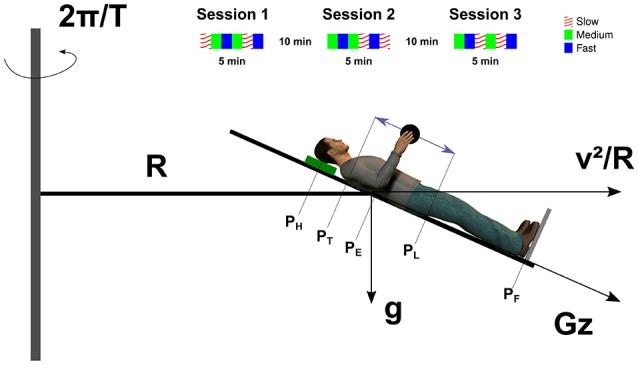
Figure 1
Figure 1
Unscaled sketch of the participant in the SAHC. The leftward gray vertical thin rectangle represents the axis of rotation about which the centrifuge rotates at an angular rate of 2πT. The bed was tilted by −24 degrees and positioned such that the elbow joint (PE) was at distance R from the axis of rotation. The participant was supine on the bed, her/his head resting on a cushion (green rectangle) and the feet supported by a metallic plate (gray line). The vector Gz is the gravitoinertial resultant between the centripetal acceleration (horizontal vector) and the gravitational acceleration (vertical vector). The double arrow represents the trajectory of the object (black disk) in the sagittal plane. The upper inset illustrates a complete experiment composed by three sessions. Each color corresponds to a different pace condition (see legend). Symbols: PH, head; PT, top of trajectory; PE, elbow; PL, lower part of trajectory; and PF, feet.
Figure 2
Figure 2
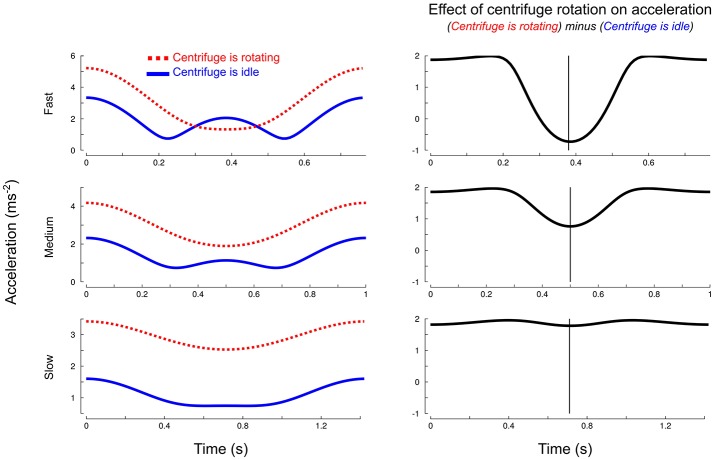
Simulated effects of centrifuge rotation on the magnitude of total object acceleration over time. Left column: total resultant acceleration (||g+v2R+am||, red dotted trace) and resultant acceleration without taking into account the centripetal acceleration (||g+am||, blue solid trace) for each pace (three rows). Right column: magnification of the effects of centrifugation by subtracting ||g+am|| from ||g+v2R+am||. The vertical cursor marks the largest discrepancies between the two accelerations.
Figure 3
Figure 3
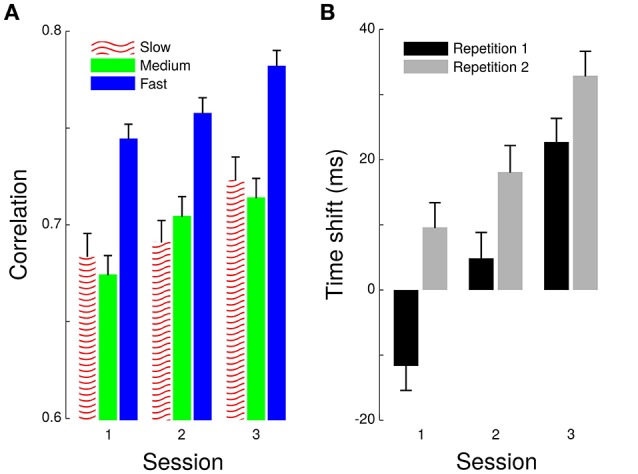
Cross-correlation between grip and load forces. Largest coefficient of correlation between grip and load forces (A) and the time shift for which this condition was fulfilled (B). Correlations are shown across Sessions (x-axis) and separately for each Frequency (see legend). Time-shifts are also depicted across Sessions (x-axis) but separately for Repetition 1 (black bar) and Repetition 2 (gray bar) of frequency.
Figure 4
Figure 4
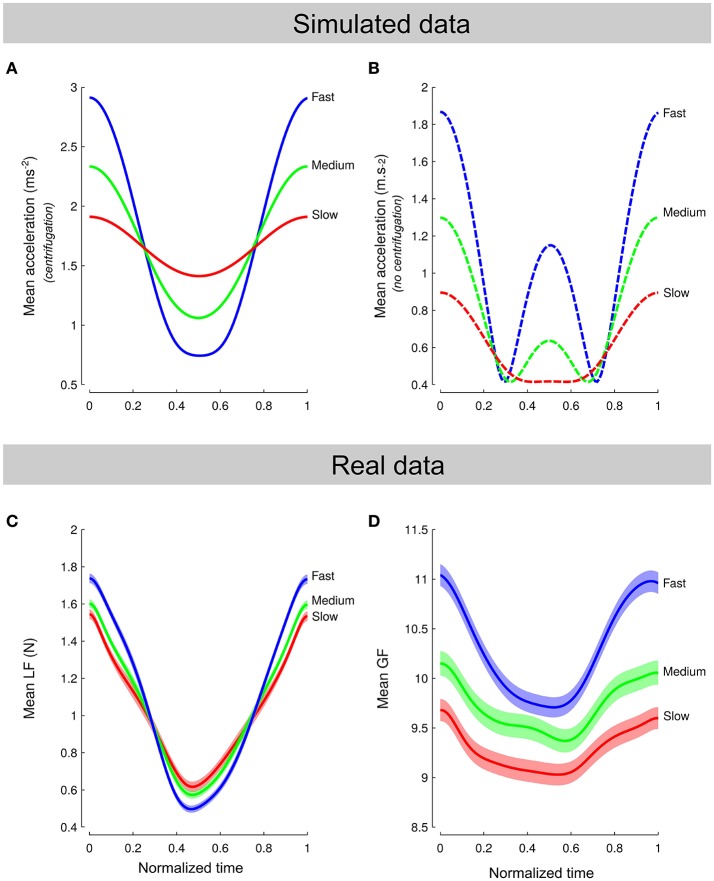
Comparison between model and data. (A,B) Simulated load force over normalized time when the model takes into account the effect of the rotation on the object (A) or not (B). Colored lines correspond to a different frequency. (C,D) Actual averaged load force cycles (C) and grip force cycles (D) normalized across all conditions. Note that the pattern of load forces in (C) span a shorter force amplitude than simulated accelerations in (A) because the object mass was small.
Figure 5
Figure 5
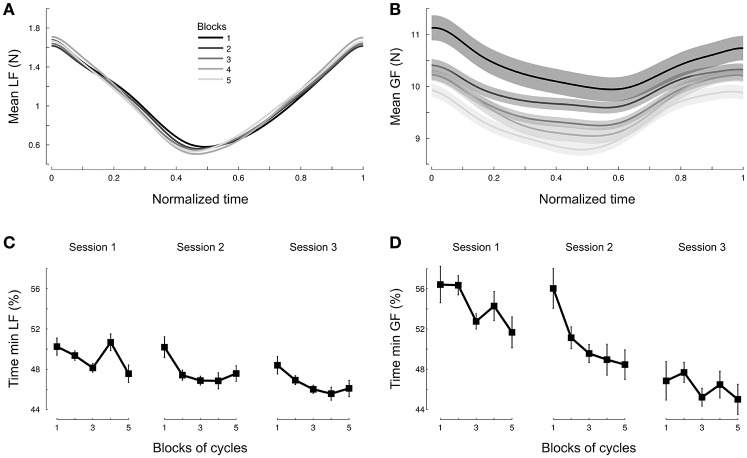
Participants adjust grip force but not load force across cycles. Averaged load force profile during one cycle (A) and averaged grip force profile during one cycle (B) normalized across all conditions and depicted separately for each block of continuous cycles. Blocks 1 to 4 pool 3 cycles together and block 5 includes the last five cycles. The earlier blocks in the trial are depicted in dark gray and late blocks are shown in light gray [see legend in (A)]. The occurrence of minimum load force (C) and grip force (D) within a cycle is plotted as a function of block. The three sessions are shown separately. Time is normalized by cycle length in all panels.

References

    1. Ahmed A. A., Wolpert D. M., Flanagan J. R. (2008). Flexible representations of dynamics are used in object manipulation. Curr. Biol. 18, 763–768. 10.1016/j.cub.2008.04.061 - DOI - PMC - PubMed
    1. Augurelle A. S., Penta M., White O., Thonnard J. L. (2003). The effects of a change in gravity on the dynamics of prehension. Exp. Brain Res. 148, 533–540. 10.1007/s00221-002-1322-3 - DOI - PubMed
    1. Bockisch C. J., Haslwanter T. (2007). Vestibular contribution to the planning of reach trajectories. Exp. Brain Res. 182, 387–397. 10.1007/s00221-007-0997-x - DOI - PubMed
    1. Cole K. J., Johansson R. S. (1993). Friction at the digit-object interface scales the sensorimotor transformation for grip responses to pulling loads. Exp. Brain Res. 95, 523–532. 10.1007/BF00227146 - DOI - PubMed
    1. Conditt M. A., Gandolfo F., Mussa-Ivaldi F. A. (1997). The motor system does not learn the dynamics of the arm by rote memorization of past experience. J. Neurophysiol. 78, 554–560. - PubMed

LinkOut - more resources