Review
. 2017 Jan-Mar;12(1):1-6.
doi: 10.4103/1817-1745.205646.

Neonatal Hypoxic-ischemic Encephalopathy: A Radiological Review

Affiliations
Review

Neonatal Hypoxic-ischemic Encephalopathy: A Radiological Review

Shahina Bano et al. J Pediatr Neurosci. 2017 Jan-Mar.

Abstract

Neonatal hypoxic-ischemic encephalopathy (HIE) is a devastating condition that may result in death or severe neurologic deficits in children. Neuroimaging with cranial ultrasound (US), computed tomography and magnetic resonance imaging are valuable tools in the workup of patients with HIE. The pattern of brain injury depends on the severity and duration of hypoxia and degree of brain maturation. Mild to moderate HI injury results in periventricular leukomalacia and germinal matrix bleed in preterm neonates, and parasagittal watershed infarcts in full-term neonates. Severe HI injury involves deep gray matter in both term and preterm infants. Treatment of HIE is largely supportive. The current article reviews the etiopathophysiology and clinical manifestations of HIE, role of imaging in the evaluation of the condition, patterns of brain injury in term and preterm neonates, the treatment and the prognosis.

Keywords: Computed tomography; cranial ultrasound; hypoxic ischemic encephalopathy; magnetic resonance imaging.


Conflict of interest statement

There are no conflicts of interest.

Figures

Figure 1
Figure 1
Magnetic resonance imaging of brain, fluid attenuation inversion recovery (axial) images in a 5-month old preterm infant showing feature of mild-moderate hypoxic-ischemic injury in form of periventricular leukomalacia seen as periventricular white matter hyperintensity
Figure 2
Figure 2
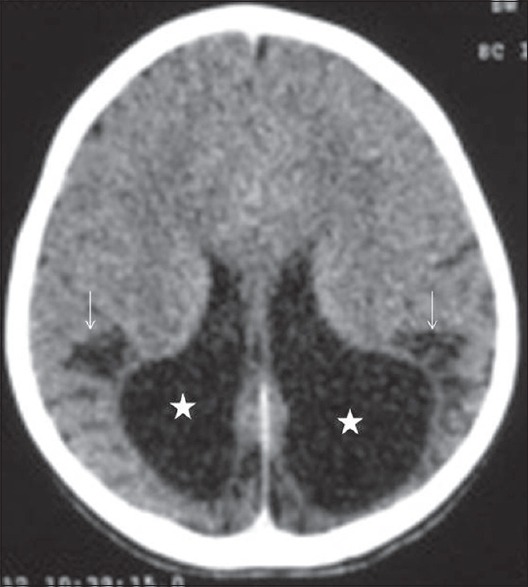
Noncontrast computed tomography head (axial) in a 4-month old preterm infant showing features of mild-moderate hypoxic-ischemic injury in the form of significant loss of periventricular white matter and passive ventriculomegaly with irregular margins
Figure 3
Figure 3
Noncontrast computed tomography head (sagittal), in a 6-month old preterm infant with neonatal hypoxia showing features of periventricular leukomalacia (arrow), passive ventriculomegaly (asterisk) and thinning of corpus callosum (arrow head)
Figure 4
Figure 4
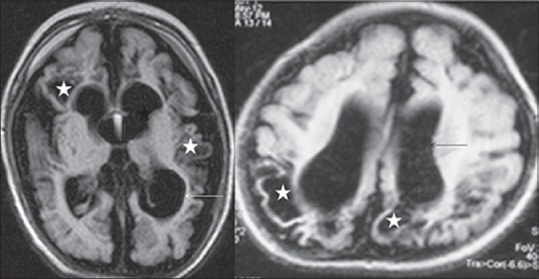
Magnetic resonance imaging brain, fluid attenuation inversion recovery (axial) images, in two different preterm infants showing features of end-stage periventricular leukomalacia in form of multicystic encephalomalacia (asterisk), best appreciated on fluid attenuation inversion recovery image. Passive ventriculomegaly (arrow) and prominent subarachnoid space is also present
Figure 5
Figure 5
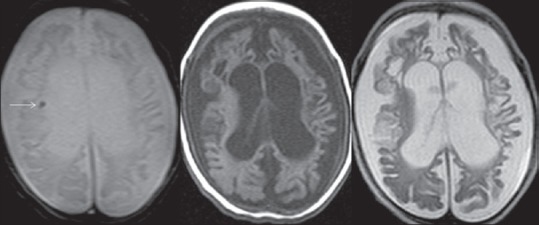
Magnetic resonance imaging brain, Gradient recalled echo and T1/T2 weighted (axial) images, in a 5-month old preterm infant showing subependymal germinal matrix bleed (Grade 1) on gradient recalled echo image (arrow). Note bleed is not evident on T1/T2 weighted images
Figure 6
Figure 6
Noncontrast computed tomography head (axial) in 3-month old preterm infant showing features of both severe and mild-moderate hypoxia-ischemic injury in form of bilateral basal ganglia and thalamic injury (hyperdense basal ganglia and thalami) typical of severe hypoxia (thin arrow); and multicystic encephalomalacia (asterisk) and passive ventriculomegaly (thick arrow) typical of mild-moderate hypoxia. Dystrophic cortical calcification (arrow head) is also present
Figure 7
Figure 7
Noncontrast computed tomography head (axial) in a 4-month old term infant showing features of mild-moderate hypoxic-ischemic injury in form of acute watershed zone infarcts (wedge shaped low density areas) involving bilateral frontal and parieto-occipital region (arrow)
Figure 8
Figure 8
Magnetic resonance imaging brain in 1-year-old term male showing feature of severe hypoxic-ischemic injury involving ventrolateral thalami (arrow head), posterior putamina (thin arrow), and prirolandic cortex (thick arrow), as fluid attenuation inversion recovery hyperintensity
Figure 9
Figure 9
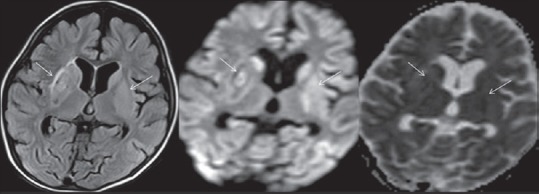
Magnetic resonance imaging brain in 2.5-year-old term male showing feature of severe hypoxic-ischemic injury in the form of acute basal ganglia infarcts appearing hyperintense on fluid attenuation inversion recovery sequence and showing diffusion restriction on diffusion-weighted imaging and corresponding apparent diffusion coefficient mapping (arrow)
Figure 10
Figure 10
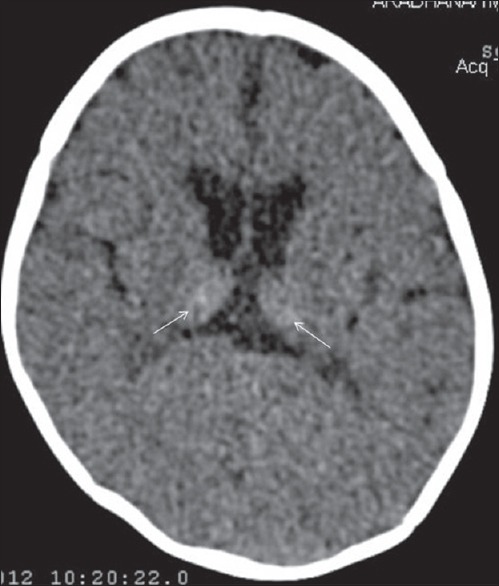
Noncontrast computed tomography head (axial) in 1-month old term infant showing feature of severe hypoxia in form of Primarily thalamic injury (hyperdense thalami) (arrow)
Figure 11
Figure 11
Noncontrast computed tomography head (axial) in a 3-year-old term male showing features of severe hypoxic-ischemic injury in the form of hyperdense basal ganglia (thin white arrow) and thalami (arrow head), loss of periventricular white matter, passive ventriculomegaly with irregular margin (thick black arrow) and atrophy of sensory motor cortex (thick white arrow)
Figure 12
Figure 12
Noncontrast computed tomography head (axial) in a 4-month old term infant showing features of severe global hypoxia in the form of diffuse cerebral edema (asterisk). Thalami and basal ganglia are spared
Figure 13
Figure 13
Noncontrast computed tomography head (axial) in 6-month old term infant showing features of chronic mild-moderate hypoxic-ischemic injury in form of chronic watershed zone infarct involving bilateral parieto-occipital region with areas of cystic encephalomalacia/gliosis (arrow), focal loss of white matter and colpocephaly (dilated occipital horns) (asterisk)

References

    1. Kurinczuk JJ, White-Koning M, Badawi N. Epidemiology of neonatal encephalopathy and hypoxic-ischaemic encephalopathy. Early Hum Dev. 2010;86:329–38. - PubMed
    1. Barkovich AJ, editor. Pediatric Neuroimaging. 4th ed. Philadelphia, PA: Lippincott Williams & Wilkins; 2005. Brain and spine injuries in infancy and childhood; pp. 190–290.
    1. Barkovich AJ, Westmark KD, Bedi HS, Partridge JC, Ferriero DM, Vigneron DB. Proton spectroscopy and diffusion imaging on the first day of life after perinatal asphyxia: Preliminary report. AJNR Am J Neuroradiol. 2001;22:1786–94. - PMC - PubMed
    1. Zarifi MK, Astrakas LG, Poussaint TY, Plessis Ad A, Zurakowski D, Tzika AA. Prediction of adverse outcome with cerebral lactate level and apparent diffusion coefficient in infants with perinatal asphyxia. Radiology. 2002;225:859–70. - PubMed
    1. Ferriero DM. Neonatal brain injury. N Engl J Med. 2004;351:1985–95. - PubMed