


Music therapy for people with schizophrenia and schizophrenia-like disorders
- PMID: 28553702
- PMCID: PMC6481900
- DOI: 10.1002/14651858.CD004025.pub4
Music therapy for people with schizophrenia and schizophrenia-like disorders
Abstract
Background: Music therapy is a therapeutic approach that uses musical interaction as a means of communication and expression. Within the area of serious mental disorders, the aim of the therapy is to help people improve their emotional and relational competencies, and address issues they may not be able to using words alone.
Objectives: To review the effects of music therapy, or music therapy added to standard care, compared with placebo therapy, standard care or no treatment for people with serious mental disorders such as schizophrenia.
Search methods: We searched the Cochrane Schizophrenia Group's Trials Study-Based Register (December 2010 and 15 January, 2015) and supplemented this by contacting relevant study authors, handsearching of music therapy journals and manual searches of reference lists.
Selection criteria: All randomised controlled trials (RCTs) that compared music therapy with standard care, placebo therapy, or no treatment.
Data collection and analysis: Review authors independently selected, quality assessed and data extracted studies. We excluded data where more than 30% of participants in any group were lost to follow-up. We synthesised non-skewed continuous endpoint data from valid scales using a standardised mean difference (SMD). We employed a fixed-effect model for all analyses. If statistical heterogeneity was found, we examined treatment dosage (i.e. number of therapy sessions) and treatment approach as possible sources of heterogeneity.
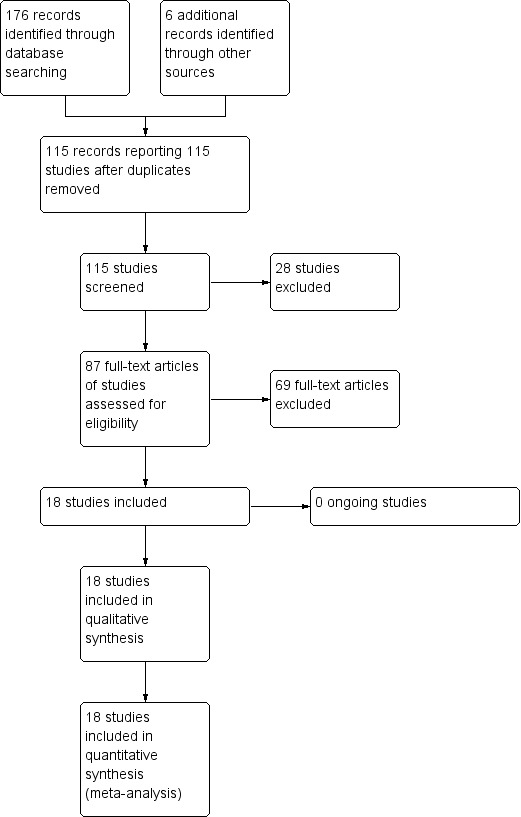
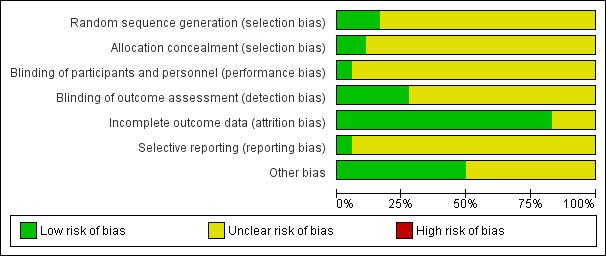
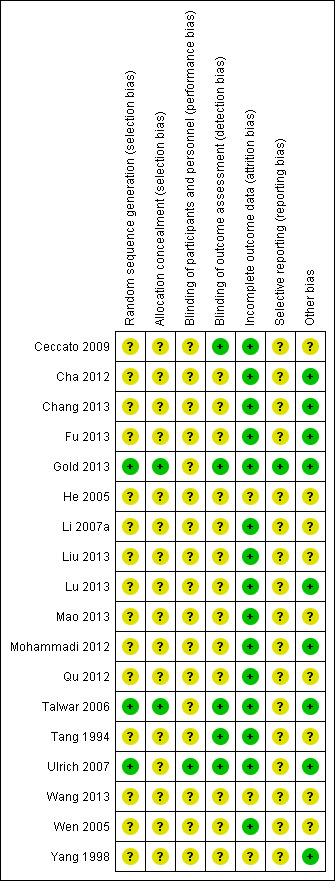
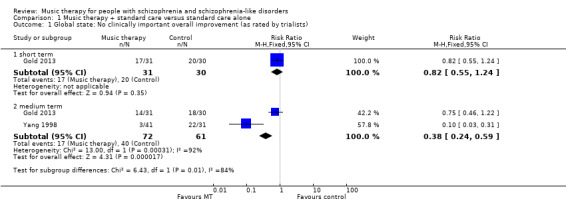
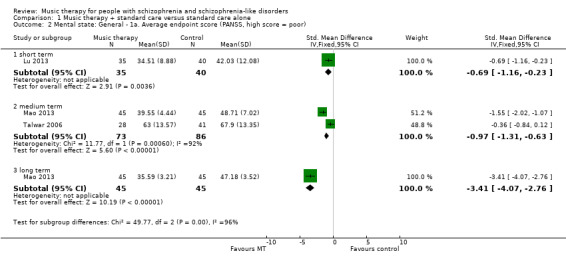
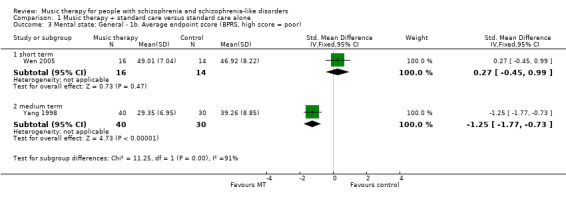
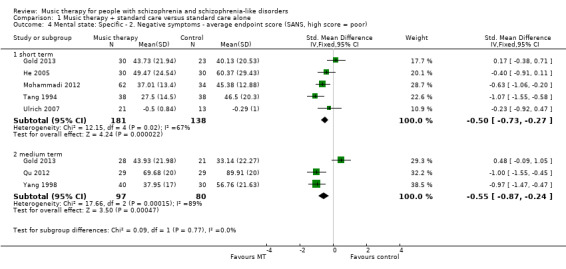
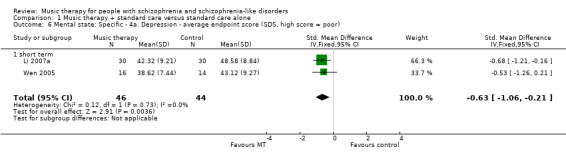
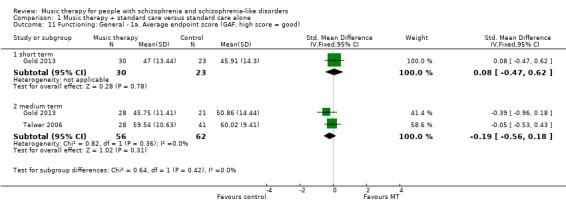
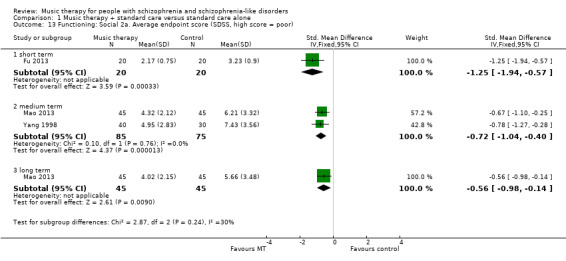
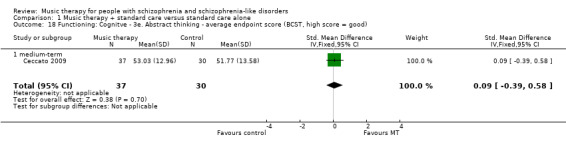
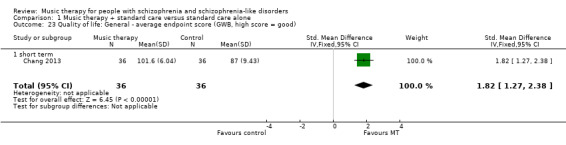
Main results: Ten new studies have been added to this update; 18 studies with a total 1215 participants are now included. These examined effects of music therapy over the short, medium, and long-term, with treatment dosage varying from seven to 240 sessions. Overall, most information is from studies at low or unclear risk of biasA positive effect on global state was found for music therapy compared to standard care (medium term, 2 RCTs, n = 133, RR 0.38 95% confidence interval (CI) 0.24 to 0.59, low-quality evidence, number needed to treat for an additional beneficial outcome NNTB 2, 95% CI 2 to 4). No binary data were available for other outcomes. Medium-term continuous data identified good effects for music therapy on negative symptoms using the Scale for the Assessment of Negative Symptoms (3 RCTs, n = 177, SMD - 0.55 95% CI -0.87 to -0.24, low-quality evidence). General mental state endpoint scores on the Positive and Negative Symptoms Scale were better for music therapy (2 RCTs, n = 159, SMD -0.97 95% CI -1.31 to -0.63, low-quality evidence), as were average endpoint scores on the Brief Psychiatric Rating Scale (1 RCT, n = 70, SMD -1.25 95% CI -1.77 to -0.73, moderate-quality evidence). Medium-term average endpoint scores using the Global Assessment of Functioning showed no effect for music therapy on general functioning (2 RCTs, n = 118, SMD -0.19 CI -0.56 to 0.18, moderate-quality evidence). However, positive effects for music therapy were found for both social functioning (Social Disability Screening Schedule scores; 2 RCTs, n = 160, SMD -0.72 95% CI -1.04 to -0.40), and quality of life (General Well-Being Schedule scores: 1 RCT, n = 72, SMD 1.82 95% CI 1.27 to 2.38, moderate-quality evidence). There were no data available for adverse effects, service use, engagement with services, or cost.
Authors' conclusions: Moderate- to low-quality evidence suggests that music therapy as an addition to standard care improves the global state, mental state (including negative and general symptoms), social functioning, and quality of life of people with schizophrenia or schizophrenia-like disorders. However, effects were inconsistent across studies and depended on the number of music therapy sessions as well as the quality of the music therapy provided. Further research should especially address the long-term effects of music therapy, dose-response relationships, as well as the relevance of outcome measures in relation to music therapy.
Conflict of interest statement
Monika Geretsegger ‐ clinically trained music therapist.
Karin Mössler ‐ clinically trained music therapist and author of an included trial.
Łucja Bieleninik ‐ none.
XiJing Chen ‐ clinically trained music therapist.
Tor Olav Heldal ‐ clinically trained music therapist.
Christian Gold ‐ clinically trained music therapist and author of an included trial.
Figures
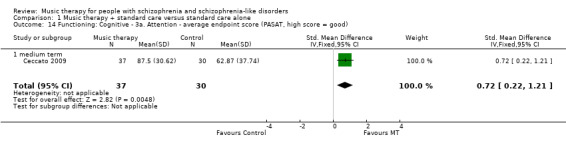
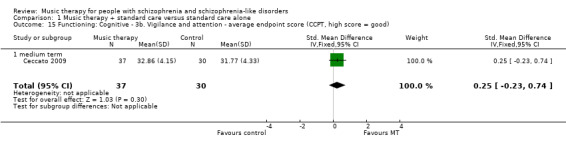
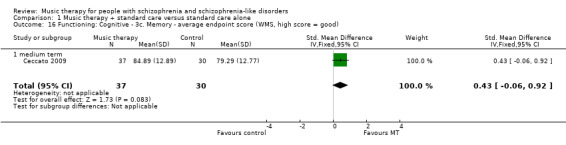
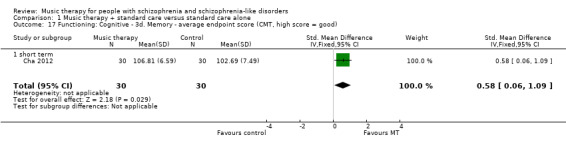
Update of
-
Music therapy for people with schizophrenia and schizophrenia-like disorders.Cochrane Database Syst Rev. 2011 Dec 7;(12):CD004025. doi: 10.1002/14651858.CD004025.pub3. Cochrane Database Syst Rev. 2011. Update in: Cochrane Database Syst Rev. 2017 May 29;5:CD004025. doi: 10.1002/14651858.CD004025.pub4. PMID: 22161383 Updated.
References
References to studies included in this review
Ceccato 2009 {published data only}
-
- Ceccato E. Music therapy in rehabilitation for people with schizophrenia. A multicenter, single blind, randomised controlled trial testing the effectiveness of the STAM protocol (Sound Training Attention and Memory) [Musicoterapia nella riabilitazione cognitiva del paziente schizofrenico. Studio multicentrico randomizzato e controllato in singolo cieco di applicazione del protocollo STAM (Sound Training Attention and Memory)]. Master's thesis 2010.
-
- Ceccato E, Caneva P, Lamonaca D. Music therapy and cognitive rehabilitation in schizophrenic patients. Nordic Journal of Music Therapy 2006;15(2):111‐20.
-
- Ceccato E, Lamonaca D, Caneva PA, Gamba L, Poli R, Agrimi E. A multicentre study to test the effectiveness of the STAM (Sound Training Attention and Memory) protocol in the rehabilitation of patients with schizophrenia: a single blind, randomized control trial [Musicoterapia nella riabilitazione cognitiva del paziente schizofrenico. Studio multicentrico randomizzato controllatoin singolo cieco di applicazione del protocollo STAM (Sound Training Attention and Memory)]. Giornale Italiano di Psicopatologia 2009;15:395‐400.
Cha 2012 {published data only}
-
- Cha ZQ, Li D, Wu QF, Zhang Y, Lu JB, M ZQ. The effect of receptive music therapy on cognitive function of schizophrenia patients in remission [jie shou xing yin yue zhi liao dui jing shen fen lie huan jie qi ren zhi gong neng de ying xiang]. China Health Psychology 2012; Vol. 20, issue 07:1039‐40. [CENTRAL: 20561]
Chang 2013 {published data only}
-
- Chang CH, Liu FF, Xu TH, Jiao TL. A research of music therapy on subjective well‐being and social support for patients with schizophrenia [yin yue zhi liao dui jing shen fen lie huan zhe zhu guan xing fu gan yu she hui zhi chi de xiang guan yan jiu]. National Medicine 2013; Vol. 25, issue 11:25‐7.
Fu 2013 {published data only}
-
- Fu WJ, Zhang LF. The rehabilitation effect of improvisational music therapy on the treatment of social disability in patients with schizophrenia in recovery period [ji xing yan zou shi yin yue zhi liao dui kang fu qi jing shen fen lie huan zhe she hui gong neng que sun de kang fu xiao ying]. Sichuan Mental Health 2013; Vol. 26, issue 03:215‐8.
Gold 2013 {published and unpublished data}
-
- Gold C, Mossler K, Grocke D, Heldal TO, Tjemsland L, Aarre T, et al. Individual music therapy for mental health care clients with low therapy motivation: Multicentre randomised controlled trial. Psychotherapy and Psychosomatics 2013; Vol. 82, issue 5:319‐31. - PubMed
-
- Gold C, Tjemsland L, Tytlandsvik M, Heskestad S, Aarre T, Stige B. Resource‐oriented music therapy for psychiatric patients with low therapy motivation: a randomised controlled trial. www.clinicaltrials.gov 2005. - PMC - PubMed
He 2005 {published data only}
-
- He FR, Liu RK, Ma L. Influence of musical therapy on serum PRL of patients with schizophrenia, type II [yin yue xin li zhi liao dui ‖xing jing shen fen lie huan zhe xue qing cui ru su shui ping de ying xiang]. Shandong Archives of Psychiatry 2005;18(2):78‐9. [CAJ]
Li 2007a {published data only}
-
- Li YM, Ren X, Li CP, Li ZQ. The correct effect of language guided music therapy on patients with schizophrenia [yu yan you dao shi yin yue liao fa dui jing shen fen lie huan zhe de xin li jiao zhi xiao guo]. International Nurses Journal 2007;26(9):917‐8. [CHINESE: Academic Journals]
Liu 2013 {published data only}
-
- Liu SJ, Wu HL, Shi L. The impact of music therapy on cognitive function for patients with chronic schizophrenia in recession [yin yue zhi liao dui jing shen fen lie zheng man xing shuai tui qi huan zhe ren zhi gong neng de ying xiang]. China Rehabilitation 2013; Vol. 28, issue 03:230‐1.
Lu 2013 {published data only}
-
- Lu SF, Lo CH, Sung HC, Hsieh TC, Yu SC, Chang SC. Effects of group music intervention on psychiatric symptoms and depression in patient with schizophrenia. Complementary therapies in medicine 2013; Vol. 21, issue 6:682‐8. - PubMed
Mao 2013 {published data only}
-
- Mao ZQ, Li D, Zhang GF, Cha ZQ, Rong JK. The effects of music therapy on the rehabilitation of patients with chronic schizophrenia [yin yue zhi liao dui man xing jing shen fen lie zheng huan zhe de kang fu xiao guo guan cha]. China Journal of Health Psychology 2013; Vol. 21, issue 01:56‐7.
Mohammadi 2012 {published data only}
-
- Mohammadi AZ, Minhas LS, Haidari M, Panah FM. A study of the effects of music therapy on negative and positive symptoms in schizophrenic patients. German Journal of Psychiatry 2012; Vol. 15, issue 2:56‐62.
Qu 2012 {published data only}
-
- Qu YN, Huang YF, Zhou ZX, Li LH. The rehabilitation care for elderly patients with chronic schizophrenia in long‐term hospitalization [chang qi zhu yuan man xing jing shen fen lie zheng huan zhe lao nian qi de kang fu hu li]. Guide of Chinese Medicine 2012; Vol. 10, issue 09:552‐4.
Talwar 2006 {published and unpublished data}
-
- Crawford M. A pilot randomised controlled trial to examine the effects of individual music therapy among inpatients with schizophrenia and schizophrenia like illness. National Research Register 2004; Vol. 2.
-
- Gold C. Music therapy improves symptoms in adults hospitalised with schizophrenia. Evidence‐Based Mental Health 2007;10(3):77. [CINAHL: 2009752767; MEDLINE: ] - PubMed
-
- Maratos A. A pilot randomised controlled trial to examine the effects of individual music therapy among inpatients with schizophrenia and schizophrenia‐like illnesses. Unpublished study protocol 2004.
-
- Maratos A, Crawford M. Composing ourselves: What role might music therapy have in promoting recovery from acute schizophrenia?. London West Mental Health R&D Consortium's 9th Annual Conference. 2004.
-
- Talwar N, Crawford M, Maratos A. A single blind randomised controlled trial of music therapy in patients with schizophrenia and related psychoses. Thematic Conference of the World Psychiatric Association on "Treatments in Psychiatry: An Update"; 2004 Nov 10‐13; Florence, Italy. 2004.
Tang 1994 {published data only (unpublished sought but not used)}
-
- Tang W, Yao X, Zheng Z. Rehabilitative effect of music therapy for residual schizophrenia: A one‐month randomised controlled trial in Shanghai. British Journal of Psychiatry 1994;165(suppl. 24):38‐44. - PubMed
Ulrich 2007 {unpublished data only}
-
- Ulrich G. De toegevoegde waarde van groepsmuziektherapie bij schizofrene patiënten: Een gerandomiseer onderzoek [The added value of group music therapy with schizophrenic patients: A randomised study]. Heerlen, NL: Open Universiteit, 2005.
-
- Ulrich G. [A randomised study of music therapy for schizophrenia: Study protocol]. Unpublished manuscript 2003.
-
- Ulrich G, Houtmans T, Gold C. The additional therapeutic effect of group music therapy for schizophrenic patients: a randomized study. Acta Psychiatrica Scandinavica 2007;116(5):362‐70. [MEDLINE: ; MEDLINE: ; PsycINFO] - PubMed
-
- Ulrich G, Houtmans T, Lechner L. [English Translation not available] [De toegevoegde waarde van groepsmuziektherapie bij schizofrene patiënten een gerandomiseerd onderzoek]. Dissertation submitted to Open Universiteit Nederland 2005.
Wang 2013 {published and unpublished data}
-
- Wang S. The effects of music therapy on improving social function in patients with chronic schizophrenia [man xing jing shen fen lie huan zhe fu yi yin yue zhi liao dui qi she hui gong neng de gai shan]. The National Medicine 2013; Vol. 25, issue 13:51‐2.
Wen 2005 {published data only}
-
- Wen SR, Cao GY, Zhou HS. The effect of music therapy on the depressive position of patients with schizophrenia [yin yue zhi liao dui jing shen fen lie huan zhe de yi yu zhuang tai de ying xiang]. Chinese Journal of Clinical Rehabilitation 2005;9(8):195.
Yang 1998 {published data only (unpublished sought but not used)}
-
- Yang WY, Li Z, Weng YZ, Zhang HY, Ma B. Psychosocial rehabilitation effects of music therapy in chronic schizophrenia. Hong Kong Journal of Psychiatry 1998;8(1):38‐40.
References to studies excluded from this review
Adler 2005 {published data only}
-
- Adler LE, Cawthra EM, Donovan KA, Harris JG, Nagamoto HT, Olincy A, et al. Improved P50 auditory gating with ondansetron in medicated schizophrenia patients. American Journal of Psychiatry 2005;162(2):386‐8. - PubMed
Apter 1978 {published data only}
-
- Apter A, Sharir I, Tyano S, Wijsenbeek H. Movement therapy with psychotic adolescents. British Journal of Medical Psychology 1978;51:155‐9. - PubMed
Arango 2003 {published data only}
-
- Arango C, Summerfelt A, Buchanan RW. Olanzapine effects on auditory sensory gating in schizophrenia. American Journal of Psychiatry 2003;160(11):2066‐8. - PubMed
Barrowclough 2001 {published data only}
-
- Barrowclough C, Haddock G, Tarrier N, Lewis SW, Moring J, O'Brien R, Schofield N, McGovern J. Randomized controlled trial of motivational interviewing, cognitive behavior therapy, and family intervention for patients with comorbid schizophrenia and substance use disorders. American Journal of Psychiatry 2001;158(10):1706‐13. - PubMed
-
- Haddock G, Barrowclough C, Tarrier N, Moring J, O'Brien R, Schofield N, et al. Cognitive‐behavioural therapy and motivational intervention for schizophrenia and substance misuse. 18‐month outcomes of a randomised controlled trial. British Journal of Psychiatry 2003;183:418‐26. - PubMed
Bean 1964 {published data only}
-
- Bean KL, Moore JR. Music therapy from auditory ink blots. Journal of Music Therapy 1964;1:143‐7.
Bechdolf 2005 {published data only}
-
- Bechdolf A. Psychological intervention for persons at risk of psychosis in the early initial prodromal state. http://www.clinicaltrials.gov.2005.
Brotons 1987 {published data only}
-
- Brotons M. The correlations between content of preferred music and psychiatric diagnosis of criminal offenders and effects of this music on observed behavior. Master's thesis. Tallahassee, FL: Florida State University, 1987.
-
- Brotons M. The correlation between content of preferred music and psychiatric diagnosis of criminal offenders and effects of this music on observed behavior. Thesis 1997. [MEDLINE: ]
Cassity 1976 {published data only}
-
- Cassity MD. The influence of a music therapy activity upon peer acceptance, group cohesiveness, and interpersonal relationships of adult psychiatric patients. Journal of Music Therapy 1976;13:66‐76.
Castilla‐Puentes 2002 {published data only (unpublished sought but not used)}
-
- Castilla RC, Perel JM. Group music therapy and medication compliance: A controlled study on patients with chronic psychotic disorders. World Journal of Biological Psychiatry 2004; Vol. 5, issue Supp 1:152.
-
- Castilla‐Puentes RC, Valero J, Vargas J, Gongora O, Pava C, Perel J. Music therapy and medication compliance in psychotic patients. 155th Annual Meeting of the American Psychiatric Association. 2002 May 18‐23; Philadelphia, Pennsylvania, USA.
Ceccato 2006 {published data only}
-
- Ceccato E, Caneva P, Lamonaca D. Music therapy and cognitive rehabilitation in schizophrenic patients. Nordic Journal of Music Therapy 2006;15(2):111‐20.
-
- Ceccato E, Caneva P, Lamonaca D. Music therapy and cognitive rehabilitation: A pilot study. 6th European Music Therapy Congress. Jyväskylä, Finland, 2004.
Chambliss 1996 {published data only}
-
- Chambliss C, Tyson K, Tracy J. Performance on the purdue pegboard and finger tapping by schizophrenics after mellow and frenetic antecedent music. Perceptual and Motor Skills 1996b;83(3):1161‐2. - PubMed
Cook 1973 {published data only}
-
- Cook M, Freethy M. The use of music as a positive reinforcer to eliminate complaining behavior. Journal of Music Therapy 1973;10:213‐6.
de l'Etoile 2002 {published data only}
-
- l'Etoile SK. The effectiveness of music therapy in group psychotherapy for adults with mental illness. Arts in Psychotherapy 2002;29(2):69‐78.
Drury 1996 {published data only}
-
- Drury V. Cognitive therapy and recovery from acute psychosis: a randomised controlled trial. PhD dissertation submitted to the University of Birmingham 1999.
-
- Drury V, Birchwood M, Cochrane R, MacMillan F. Cognitive therapy and recovery from acute psychosis‐a controlled trial. I. Impact on psychotic symptoms. British Journal of Psychiatry 1996;169(5):593‐601. - PubMed
-
- Drury V, Birchwood M, Cochrane R, MacMillan F. Cognitive therapy and recovery from acute psychosis‐a controlled trial. II. Impact on recovery time. British Journal of Psychiatry 1996;169(5):602‐7. - PubMed
-
- Drury V, Brichwood M, Cochrane R. Cognitive therapy and recovery from acute psychosis: a controlled trial. 3. Five‐year follow‐up. British Journal of Psychiatry 2000;177:8‐14. - PubMed
Gaszner 2009 {published data only}
-
- Gaszner P. Complex therapy of schizophrenia [A szkizofrenia komplex terapiaja]. Neuropsychopharmacologia Hungarica 2009;11(1):41‐5. - PubMed
Glicksohn 2000 {published data only}
-
- Glicksohn J, Cohen Y. Can music alleviate cognitive dysfunction in schizophrenia?. Psychopathology 2000;33:43‐7. - PubMed
Green 1987 {published data only}
-
- Green BL, Wehling C, Talsky GJ. Group art therapy as an adjunct to treatment for chronic outpatients. Hospital and Community Psychiatry 1987;38(9):988‐91. - PubMed
Grocke 2009a {published data only}
-
- Grocke D. The effect of group music therapy on quality of life for participants living with a severe and enduring mental illness. Journal of Music Therapy 2009;XLVI(2):90‐104. - PubMed
Grocke 2014 {published data only}
-
- Grocke D, Bloch S, Castle D, Thompson G, Newton R, Stewart S, et al. Group music therapy for severe mental illness: a randomized embedded‐ experimental mixed methods study. Acta Psychiatrica Scandinavica 2014;130(2):144‐53. - PubMed
Haimov 2012 {published data only}
-
- Haimov I, Bloch B, Reshef A, Vadas L, Kremer I. Effects of individualised acupuncture on sleep latency, anxiety and depression among hospitalised psychiatric patients. Journal of Sleep Research 2012:353.
Hannes 1974 {published data only}
-
- Hannes M, Siegel HD. The short term effect of socializing on performance of schizophrenics in recreational therapy. Journal of Community Psychology 1974;2(1):51‐3. [CN‐00239038]
Hayashi 2002 {published data only}
-
- Hayashi N, Tanabe Y, Nakagawa S, Noguchi M, Iwata C, Koubuchi Y, et al. Effects of group musical therapy on inpatients with chronic psychoses: A controlled study. Psychiatry and Clinical Neurosciences 2002;56(2):187‐93. - PubMed
Hodgson 1996 {published data only}
-
- Hodgson NS. The effects of music therapy on the attendance rate and number of verbal prompts given to elicit attendance of adult psychiatric clients in a day treatment center. Master's thesis. Tallahassee, FL: Florida State University, 1996.
Hogarty 1988 {published data only}
-
- Hogarty GE, McEvoy JP, Munetz M, DiBarry AL, Cather R, Cooley SJ, et al. Dose of fluphenazine, familial expressed emotion, and outcome in schizophrenia. Results of a two‐year controlled study. Archives of General Psychiatry. 1988;45(9):797‐805. - PubMed
Hu 2004 {published data only}
-
- Hu QL, Xue LH, Gao XH. Effect of music‐sport therapy on the insight and behavioral disturbance in patients with schizophrenia [chang gui ying yong yin yue ji ti yu liao fa gai shan jing shen fen lie zheng huan zhe zi zhi li he xing wei zhang ai de zuo yong]. Chinese Journal of Clinical Rehabilitation [Zhongguo lin chuang kang fu] 2004;8(9):1626‐7. [EMBASE: 2004336037]
Hustig 1990 {published data only}
-
- Hustig HH, Tran DB, Hafner RJ, Miller RJ. The effect of headphone music on persistent auditory hallucinations. Behavioural Psychotherapy 1990;18:273‐81.
Ji 2013 {published data only}
-
- Ji JY, Zhang YR. The impact of music therapy and group psychotherapy on psychotic symptoms and social functioning of patients with chronic schizophrenia [yin yue zhi liao he tuan ti xin lin zhi liao dui man xing jing shen fen lie huan zhe jing shen zheng zhuang ji she hui gong neng ying xiang de yan jiu]. Sichuan Mental Health 2013; Vol. 26, issue 1:19‐23.
Johnston 2002 {published data only}
-
- Johnston O, Gallagher AG, MsMahon PJ, King DJ. The efficacy of using a personal stereo to treat auditory hallucinations: Preliminary findings. Behavior Modification 2002;26(4):537‐49. - PubMed
Kallert 2004 {published data only}
-
- Kallert TW, Matthes C, Glöckner M, Eichler T, Koch R, Schützwohl M. Acute psychiatric day hospital treatment:is the effectiveness of this treatment approach still questionable? [Akutpsychiatrische tagesklinische Behandlung: Ein effektivitätsgesichertes Versorgungsangebot?]. Psychiatrische Praxis 2004;31(8):409‐19. - PubMed
Kong 2007 {published data only}
-
- Kong YL. The effects of music therapy on patients with chronic schizophrenia [yin yue zhi liao dui man xing jing shen fen lie huan zhe de kang fu xiao guo de yan jiu]. Shandong Archives of Psychiatry 2007;20(4):225‐6. [CHINESE: Academic Journals]
Krajewski 1993 {published data only}
-
- Krajewski C, Classen W, Boesken S. Comparison of art and cognitive therapy (IPT) with simultaneous cognitive and art therapy for schizophrenic patients regarding the change of cognitive processes. Pharmacopsychiatry 1993;26:171.
Leung 1998 {published data only}
-
- Leung CM, Lee G, Cheung B, Kwong E, Wing YK, Kan CS, et al. Karaoke therapy in the rehabilitation of mental patients. Singapore Medical Journal 1998;39(4):166‐8. - PubMed
-
- Ng WF. Karaoke therapy in the rehabilitation of mental patients (SMJ vol 43 issue 12 December 2002). Singapore Medical Journal 2002;43(12):643; author reply 643‐4. - PubMed
Li 2005 {published data only}
-
- Li M, Wang H, Li Z. Effect of music and sport therapy as assistant treatment for schizophrenia [yin yue ti yu liao fa dui man xing jing shen fen lie zheng de fu zhu zhi liao xiao guo]. Heilongjiang Nursing Journal 2005;11(20):1677‐8. [CAJ]
Li 2007b {published data only}
-
- Li GR, Tang JL, Zhu WR. The application of model Law in the long‐term management of hospitalized patients with schizophrenia [shi fan fa zai chang cheng zhu yuan jing shen fen lie zheng huan zhe guan li zhong de ying yong]. Chinese Journal of Rehabilitation Medicine 2007; Vol. 22, issue 12:1105‐6.
Li 2011 {published data only}
-
- Li JF, Zhang XY. The effects of music therapy on hospitalised patients with chronic schizophrenia: a randomised trial [yin yue zhi liao dui man xing jing shen fen lie zheng zhu yuan huan zhe liao xiao de dui zhao yan jiu]. National Medicine 2011; Vol. 23, issue 19:2459‐60.
Lin 2003 {published data only}
-
- Xiao LL. The effect of music therapy on the recovery stage of different types of psychotic patients [yin yue zhi liao dui hui fu qi bu tong lei xing jing shen bing huan zhe liao xiao de yan jiu]. Journal of the Gannan Medical College 2003;23(2):183‐4.
Luo 2014 {published data only}
-
- Luo C, Yao DZ. The study of the brain network features in refractory schizophrenia [nan zhi xing jing shen fen lie zheng ji qi MECT zhi liao de nao wang luo te zheng yan jiu]. http://apps.who.int/trialsearch/Trial2.aspx?TrialID=ChiCTR‐OPC‐14005339 2014.
Margo 1981 {published data only}
-
- Margo A, Hemsley DR, Slade PD. The effects of varying auditory input on schizophrenic hallucinations. British Journal of Psychiatry 1981;139:122‐7. - PubMed
Martinez 2005 {published data only}
-
- Martinez LRD, Soto HO, Guerrero CL, Verdugo SR, Gasca LR, Collazos MV, et al. A comprehensive rehabilitation for people with schizophrenia in Mexico: The model of the national psychiatry institute Ramón de la Fuente, group III [La rehabilitación integral del paciente esquizofrénico en México: El modelo del instituto nacional de psquiatria Ramón de la Fuente, grupo III]. Salud Mental 2005;28(6):9‐19.
McInnis 1990 {published data only}
-
- McInnis M, Marks I. Audiotape therapy for persistent auditory hallucinations. British Journal of Psychiatry 1990;157:913‐4. - PubMed
Meschede 1983 {published data only}
-
- Meschede HG, Bender W, Pfeiffer H. Music therapy with psychiatric problem patients [Musiktherapie mit psychiatrischen Problempatienten]. Psychotherapie, Psychosomatik, Medizinische Psychologie 1983;33(3):101‐6. - PubMed
Metzner 2010 {published data only}
-
- Metzner S. About being meant: Music therapy with an in‐patient suffering from psychosis. Nordic Journal of Music Therapy 2010;19(2):133‐50.
Moe 2000 {published data only}
-
- Moe T, Roesen A, Raben H. Restitutional factors in group music therapy with psychiatric patients based on a modification of guided imagery and music (GIM). Nordic Journal of Music Therapy 2000;9(2):36‐50.
Morgan 2011 {published data only}
-
- Morgan K, Bartrop R, Telfer J, Tennant C. A controlled trial investigating the effect of music therapy during an acute psychotic episode. Acta Psychiatrica Scandinavica 2011; Vol. 124, issue 5:363‐71. [MEDLINE: ] - PubMed
Muller 2014 {published data only}
-
- Muller W, Haffelder G, Schlotmann A, Schaefers AT, Teuchert‐Noodt G. Amelioration of psychiatric symptoms through exposure to music individually adapted to brain rhythm disorders ‐ a randomised clinical trial on the basis of fundamental research. Cognitive Neuropsychiatry 2014; Vol. 19, issue 5:399‐413. - PubMed
Murow 1997 {published data only}
-
- Murow E, Unikel C. Music therapy and body expression therapy in the rehabilitation of patients with chronic schizophrenia [La musicoterapia y la terapia de expresión corporal en la rehabilitación del paciente con esquizofrenia crónica]. Salud Mental 1997;20(3):35‐40.
Na 2009 {published data only}
-
- Na HJ, Yang S. Effects of listening to music on auditory hallucination and psychiatric symptoms in people with schizophrenia. Journal of Korean Academy of Nursing 2009;39(1):62‐71. - PubMed
Nelson 1991 {published data only}
Ni 2002 {published data only}
-
- Ni JZ, Liu YR. Analysis of music therapy effect on patient with chronic schizophrenia [yin yue liao fa zhi liao jing shen fen lie zheng liao xiao fen xi]. Health Psychology Journal 2002;10(2):145‐6. [CBM: (Chinese Biomedical Literature); CAJ]
Offer 1960 {published data only}
-
- Offer D, Stine D. Function of music in spontaneous art productions. Archives of General Psychiatry 1960; Vol. 3:490‐503. - PubMed
Olbrich 1990 {published data only}
-
- Olbrich R, Mussgay L. Reduction of schizophrenic deficits by cognitive training: an evaluative study. European Archives of Psychiatry & Neurological Sciences 1990;239(6):366‐9. [MEDLINE: ; CN‐00069945] - PubMed
Pavlicevic 1994 {published data only}
-
- Pavlicevic M, Trevarthen C, Duncan J. Improvisational music therapy and the rehabilitation of persons suffering from chronic schizophrenia. Journal of Music Therapy 1994;31(2):88‐104.
Pfeiffer 1987 {published data only (unpublished sought but not used)}
-
- Pfeiffer H, Wunderlich S, Bender W, Elz U, Horn B. Music improvisation with schizophrenic patients ‐ a controlled study in the assessment of therapeutic effects [Freie Musikimprovisation mit schizophrenen Patienten ‐ kontrollierte Studie zur Untersuchung der therapeutischen Wirkung]. Die Rehabilitation 1987;26(4):184‐92. - PubMed
Pierce 2004 {published data only}
-
- Pierce JW. The effect of music therapy and psychoeducation versus psychoeducation for mainstreaming mental health patients into society [Thesis]. Florida: University of Florida, 2004.
Reker 1991 {published data only}
-
- Reker T. Music therapy evaluated by schizophrenic patients. Psychiatrische Praxis 1991;18(6):216‐21. - PubMed
Schmuttermayer 1983 {published data only}
-
- Schmuttermayer R. Possibilities for inclusion of group music therapeutic methods in the treatment of psychotic patients [Möglichkeit der Einbeziehung gruppentherapeutischer Methoden in die Behandung von Psychotikern]. Psychiatrie, Neurologie und Medizinische Psychologie 1983;35(1):49‐53. - PubMed
Silverman 2003a {published data only}
-
- Silverman MJ. Contingency songwriting to reduce combativeness and non‐cooperation in a client with schizophrenia: A case study. The Arts in Psychotherapy 2003a;30(1):25‐33.
Silverman 2009 {published data only}
-
- Silverman MJ. The effect of single‐session psychoeducational music therapy on verbalizations and perceptions in.psychiatric patients. Journal of Music Therapy 2009;46(2):105‐31. - PubMed
Silverman 2011a {published data only}
-
- Silverman MJ. The effect of songwriting on knowledge of coping skills and working alliance in psychiatric patients: a randomized clinical effectiveness study. Journal of Music Therapy 2011; Vol. 48, issue 1:103‐22. - PubMed
Silverman 2011b {published data only}
-
- Silverman MJ. Effects of a single‐session assertiveness music therapy role playing protocol for psychiatric inpatients. Journal of Music Therapy 2011; Vol. 48, issue 3:370‐94. - PubMed
Silverman 2011c {published data only}
-
- Silverman MJ. Effects of music therapy on psychiatric patients' proactive coping skills: two pilot studies. Arts in Psychotherapy 2011; Vol. 38, issue 2:125‐9.
Silverman 2013 {published data only}
-
- Silverman MJ. Effects of music therapy on self‐ and experienced stigma in patients on an acute care psychiatric unit: a randomized three group effectiveness study. Archives of Psychiatric Nursing 2013;27:223–30. - PubMed
Silverman 2014a {published data only}
-
- Silverman MJ. Effects of a live educational music therapy intervention on acute psychiatric inpatients’ perceived social support and trust in the therapist: a four‐group randomized effectiveness study. Journal of Music Therapy 2014;51(3):228–49. - PubMed
Silverman 2014b {published and unpublished data}
-
- Silverman, MJ. Effects of family‐based educational music therapy on acute care psychiatric patients and their family members: an exploratory mixed‐methods study. Nordic Journal of Music Therapy 2014;23(2):99‐122.
Silverman 2016 {published data only}
-
- Silverman MJ. Effects of educational music therapy on illness management knowledge and mood state in acute psychiatric inpatients: a randomized three group effectiveness study. Nordic Journal of Music Therapy 2016;25(1):57‐75. [DOI: 10.1080/08098131.2015.1008559] - DOI
Skelly 1952 {published data only}
-
- Skelly CG, Haslerud GM. Music and the general activity of apathetic schizophrenics. Journal and the General Activity of Apathetic Schizophrenics 1952;47:188‐92. - PubMed
Song 1994 {published data only}
-
- Song Y, Cheng X, Fan Z. An analysis of effects of operative music therapy on emotion and social interaction of patients with chronic schizophrenia. Chinese Journal of Rehabilitation 1994;9(4):178‐9, 180‐1.
Steinberg 1991 {published data only}
-
- Steinberg R, Kimming V, Raith L, Gunther W, Bogner J, Timmermann T. Music psychopathology: the course of musical expression during music therapy with psychiatric inpatients. Psychopathology 1991;24:121‐9. - PubMed
Su 1999 {published data only}
-
- Su L, Fan Z, Qu Y. The effect of dance therapy for chronic schizophrenic patient [dui man xing jing shen bing huan zhe fu yi wu dao zhi liao de liao xiao guan cha]. Chinese Journal of Psychiatry 1999;32(3):167‐9.
Su 2005 {published data only}
-
- Su H, Zhang HD, Du XS. The synergistic effects of comprehensive rehabilitation on the negative symptoms of patients with schizophrenia [zong he xing kang fu zhi liao dui man xing fen lie zheng yin xing zheng zhuang de zeng xiao zuo yong]. Sichuan Mental Health 2005;18(3):172‐3. [CAJ]
Tan 2009 {published data only}
-
- Tan S, Yizhuang Z. Computerized cognitive remediation therapy for patients with schizophrenia, a multicenter randomized controlled study. ChiCTR‐TRC‐00000249.
Tang 2002 {published data only}
-
- Tang HYi, Zhang XY, Wu LM. The comparison study of brain function curer as a adjuvant therapy for schizophrenia patients [nao gong neng bao jian yi fu zhu zhi liao jing shen fen lie zheng de dui zhao yan jiu]. Chinese Journal of Nervous and Mental Diseases 2002;28(1):53‐4.
Thaut 1989 {published data only}
-
- Thaut MH. The influence of music therapy interventions on self‐rated changes in relaxation, affect, and thought in psychiatric prisoner‐patients. Journal of Music Therapy 1989;26:155‐66.
Troice 2003 {published data only}
-
- Troice EM, Sosa JJS. The musical experience as a curative factor in music therapy with patients with chronic schizophrenia. Salud Mental 2003;26(4):47‐58.
Vadas 2012 {published data only}
-
- Vadas L, Bloch B, Reshef A, Kremer I, Haimov I. The effects of acupuncture on sleep quality and emotional measures among psychiatric ward inpatients. Journal of Molecular Neuroscience 2012; Vol. 48:S119.
Valencia 2006 {published data only}
-
- Valencia M, Murow E, Rascón ML. Comparison of three methods of intervention in schizophrenia: psychosocial therapy, music therapy, and multiple therapies. [Comparación de tres modalidades de intervención en esquizofrenia: terapi psicosocial, musicoterapia y terapias múltiples]. Revista Latinoamericana de Psicologia 2006;38(3):535‐49.
Wahass 1997 {published data only}
-
- Wahass S, Kent G. The modification of psychological interventions for persistent auditory hallucinations to an Islamic culture. Behavioural and Cognitive Psychotherapy 1997;25:351‐64.
Wang 2002a {published data only}
-
- Wang H, Wang D, Zhou XH. The observation of the effect of music therapy on 50 chronic schizophrenia patients. [yin yue zhi liao dui 50 li man xing jing shen fen lie zheng de kang fu xiao guo guan cha]. Harbin Medical Journal 2002;22(1):33‐4.
Wang 2002b {published data only}
-
- Wang Aw, Shi F, Dong X. Influence of traditional pentatonic music on brain electrical activity mapping of schizophrenics [wu yin yue qu dui jing shen fen lie zheng nao dian huo dong de ying xiang]. Chinese Mental Health Journal 2002;16(7):494‐5.
Wang 2005 {published data only}
-
- Wang Yi‐Yun, Wang Qiu‐Yan, Cheng Ai‐Ping, Li Shui‐Xiang. The effects of music therapy on the rehabilitation of patients with chronic schizophrenia [yin yue liao fa zai man xing jing shen fen lie zheng kang fu zhi liao zhong de zuo yong]. Journal of Qiqihar Medical 2005;26(9):1011‐2. [CAJ]
-
- Wang Yi‐Yun, Wang Qiu‐Yan, Cheng Ai‐Ping, Li Shui‐Xiang. The effects of music therapy on the rehabilitation of patients with chronic schizophrenia [yin yue liao fa zai man xing jing shen fen lie zheng kang fu zhi liao zhong de zuo yong]. Chinese Journal of Behavioral Medical Science 2005;14(9):810.
Wang 2006 {published data only}
-
- Wang HM, Zhang DM. The influence of music therapy on patients' social function with chronic schizophrenia [yin yue liao fa dui man xing jing shen fen lie huan zhe de she hui gong neng de ying xiang]. Practice Nursing Care and Study Journal 2006;3(1):7‐8.
Wang 2007 {published data only}
-
- Wang Z, Li X. Comparative study of the music therapy on the negative symptoms of schizophrenia with native risperidone [yin yue zhi liao he bing guo chan li pei tong zhi liao jing shen fen lie zheng yin xing zheng zhuang dui zhao yan jiu]. Chinese Journal of Health Psychology 2007;15(2):155‐6. [CHINESE: Academic Journals]
Warren 1980 {published data only}
-
- Warren J. Paried‐associate learning in chronic institutionalised subjects using synthesized sounds, nonsense syllables, and rhythmic sounds. Journal of Music Therapy 1980;17(1):16‐25.
Wu 2000 {published data only}
-
- Wu LR. The effect of musical therapy on chronic schizophrenics rehabilitation [yin yue liao fa zai man xing jing shen fen lie zheng kang fu zhi liao zhong de zuo yong]. Modern Rehabilitation 2000;4(4):550‐1.
Wu 2003 {published data only}
-
- Wu Y, Zhao F. Effect of music and dance on recovery of schizophrenia [yin yue wu dao dui jing shen fen lie zheng kang fu de ying xiang]. Health Psychology Journal 2003;11(3):207‐8.
Xiao 2005 {published data only}
-
- Xiao LR, Pei XY, Wang CY. The effect factors of rehabilitation measures on the self‐managing ability and social ability of patients with schizophrenia. [yin xing jing shen fen lie huan zhe zi li he she hui neng li hui fu cuo shi ji ying xiang yin su]. Chinese Journal of Clinical Rehabilitation 2005;9(20):225. [CAJ]
Yang 2005 {published data only}
-
- Yang RL, Lv HX, Lou F. The effect of group psychotherapy on the recovery of patients with chronic schizophrenia [xin li xiao zu zhi liao de man xing jing shen fen lie zheng huan zhe de kang fu zuo yong]. Occupation and Health 2005;21(6):936. [CAJ]
Zhang 2003a {published data only}
-
- Zhang ML. The effect of active and receptive music therapy on patients with chronic schizophrenia [zhu bei dong yin yue zhi liao dui man xing jing shen fen lie zheng liao xiao fen xi]. Health Psychology Journal 2003;11(5):370‐1.
Zhang 2003b {published data only}
-
- Zhang Y. Effect of music therapy and behavioral therapy on schizophrenia patients. China Clinical Rehabilitation 2003;7(5):857.
Zhang 2005 {published data only}
-
- Zhang HJ. The effects of music therapy and physiotherapy on the negative symptoms of schizophrenia [yin ti liao fa dui jing shen fen lie yin xing zheng zhuang huan zhe de ying xiang]. Practical Journal of Medicine and Pharmacy 2005;22(9):832. [CAJ]
Zhang 2010 {published data only}
-
- Zhang HQ, Ma XJ, Zhao LL, Feng B, Tang ZS. The effects of music therapy in combination with electric convulsive treatment for patients with refractory schizophrenia [yin yue zhi liao lian he wu chou chu dian xiu ke zhi liao nan zhi xing jing shen fen lie zheng liao xiao fen xi]. China Practical Medicine 2010; Vol. 5, issue 32:212‐3.
Zhang 2013 {published data only}
-
- Zhang GP. The effects of behavioral modification training and music therapy on improving symptoms and social life function in patients with chronic schizophrenia [xing wei jiao zhi xun lian lian he yin yue zhi liao dui man xing jing shen fen lie huan zhe ji she hui sheng huo gong neng de gai shan zuo yong]. Practical Cardio‐Cerebral Pulmonary Vascular Disease 2013; Vol. 21, issue 9:85‐6.
Zhao 2013 {published data only}
-
- Zhao SQ, Wang JY, Li YF, L R, Liu J. The application of music appreciation for patients with schizoprenia in early rehabilitation [yin yue shang xi zai jing shen fen lie zheng zao qi kang fu zhi liao zhong de ying yong]. China Practical Medicine 2013; Vol. 8, issue 10:201‐2.
Zhou 2003 {published data only}
-
- Zhou B, Xu XB, Yang GZ. The effect of music therapy on the negative symptoms of patients with schizophrenia [yin yue liao fa dui jing shen fen lie zheng yin xing zheng zhuang de liao xiao fen xi]. Ningxia Medical Journal 2003;25(4):247‐8.
Zhou 2006 {published data only}
-
- Zhou YP, Shou YQ, Tang WZ. Comparative study of the rehabilitative effect of different types of receptive music therapy on patients with schizophrenia [bu tong gan shou shi yin yue liao fa dui jing shen fen lie zheng huan zhe de kang fu zuo yong]. Shanghai Nursing Journal 2006;6(6):12‐4.
Zhu 2002 {published data only}
-
- Zhu Y, Jin X. Effect of music treatment on memory decrease of patients with schizophrenia caused by clozapine [yin yue zhi liao mu dan ping suo zhi ji yi li xia jiang de dui zhao yan jiu]. Chinese Journal of Rehabilitation Theory and Practice 2002;8(11):684‐6. [CAJ; CBM]
Zincir 2011 {published data only}
-
- Zincir SB, Semiz UB, Yenel A, Basotlu E, Bilici M, Tulay C. Effects of group musical therapy on inpatients with schizophrenia: a preliminary study. Klinik Psikofarmakoloji Bulteni 2011:S191.
Additional references
Addington 1992
-
- Addington D, Addington J, Maticka‐Tyndale E, Joyce J. Reliability and validity of a depression rating scale for schizophrenics. Schizophrenia Research 1992;6:201‐8. - PubMed
Allison 2002
-
- Allison PD. Missing Data. Series: Quantitative Applications in the Social Sciences. Thousand Oaks, CA: Sage, 2002.
Altman 1996
Andreasen 1982
-
- Andreasen NC. Negative symptoms in schizophrenia: Definition and reliability. Archives of General Psychiatry 1982;39:784‐8. - PubMed
Andreasen 1984
-
- Andreasen NC. Scale for the Assessment of Positive Symptoms (SAPS). Iowa City, IA, University of Iowa 1984.
Andritzky 1996
-
- Andritzky W. Alternative treatment in psychiatric and psychotherapy facilities in Germany [Unkonventionelle Heilweisen in psychiatrischen und psychosomatischen Kliniken in Deutschland]. Gesundheitswesen 1996;58(1):21‐30. - PubMed
Ansdell 2010a
-
- Ansell G, Davidson J, Magee WL, Meehan J, Procter S. From "This F***ing life" to "that's better"...in four minutes: an interdisciplinary study of music therapy's "present moments" and their potential for affect modulation. Nordic Journal of Music Therapy 2010;19(1):3‐28.
Ansdell 2010b
-
- Ansdell G, Meehan J. "Some light at the end of the tunnel": Exploring users' evidence for the effectiveness of music therapy in adult mental health settings. Music and Medicine 2010;2(1):29‐40.
APA 2013
-
- American Psychiatric Association. Diagnostic and Statistical Manual of Mental Disorders (DSM‐5). 5th Edition. Arlington, VA: American Psychiatric Association, 2013.
Atkinson 1994
-
- Atkinson C, Greenfield T. Client Satisfaction Questionnaire ‐ 8 and Service Satisfaction Scale 30. Psychological Testing: Treatment Planning and Outcome Assessment. San Francisco, CA: Lawrence Erlbaum, 1994.
Berg 1948
-
- Berg EA. A simple objective technique for measuring flexibility in thinking. Journal of General Psychology 1948;39:15‐22. - PubMed
Bland 1997
Boissel 1999
-
- Boissel JP, Cucherat M, Li W, Chatellier G, Gueyffier F, Buyse M, et al. The problem of therapeutic efficacy indices. 3. Comparison of the indices and their use [Apercu sur la problematique des indices d'efficacite therapeutique, 3: comparaison des indices et utilisation. Groupe d'Etude des Indices D'efficacite]. Therapie 1999;54(4):405‐11. [PUBMED: 10667106] - PubMed
Boutron 2008
-
- Boutron I, Moher D, Altman DG, Schulz KF, Ravaud P. Extending the CONSORT statement to randomized trials of nonpharmacologic treatment: explanation and elaboration. Annals of Internal Medicine 2008;148(4):295‐309. - PubMed
Bruscia 1998
-
- Bruscia KE. Defining Music Therapy. 2nd Edition. Gilsum, NH: Barcelona Publishers, 1998.
Cohen 1988
-
- Cohen J. Statistical Power Analysis for the Behavioral Sciences. 2nd Edition. Hillsdale, NJ: Lawrence Erlbaum, 1988.
Davey Smith 1997
-
- Davey Smith G, Egger M. Meta‐analyses of randomised controlled trials. Lancet 1997;350(9085):1182. - PubMed
Deeks 2000
-
- Deeks J. Issues in the selection for meta‐analyses of binary data. Proceedings of the 8th International Cochrane Colloquium; 2000 Oct 25‐28; Cape Town. Cape Town: The Cochrane Collaboration, 2000.
Divine 1992
-
- Divine GW, Brown JT, Frazier LM. The unit of analysis error in studies about physicians' patient care behavior. Journal of General Internal Medicine 1992;7(6):623‐9. - PubMed
Donner 2002
-
- Donner A, Klar N. Issues in the meta‐analysis of cluster randomized trials. Statistics in Medicine 2002;21:2971‐80. - PubMed
Duggan 2005
Egger 1997
Elbourne 2002
-
- Elbourne D, Altman DG, Higgins JPT, Curtina F, Worthingtond HV, Vaile A. Meta‐analyses involving cross‐over trials: methodological issues. International Journal of Epidemiology 2002;31(1):140‐9. - PubMed
Fazio 1977
-
- Fazio AF. A concurrent validational study of the NCHS General Well‐Being Schedule. National Center for Health Statistics. Hyattsville, MD, 1977. - PubMed
Furukawa 2006
-
- Furukawa TA, Barbui C, Cipriani A, Brambilla P, Watanabe N. Imputing missing standard deviations in meta‐analyses can provide accurate results. Journal of Clinical Epidemiology 2006;59(7):7‐10. - PubMed
Gold 2004
-
- Gold C. The use of effect sizes in music therapy research. Music Therapy Perspectives 2004;22(2):91‐5.
Gold 2009
-
- Gold C, Solli HP, Krüger V, Lie SA. Dose‐response relationship in music therapy for people with serious mental disorders: Systematic review and meta‐analysis. Clinical Psychology Review 2009;29(3):193‐207. - PubMed
Gronwall 1977
-
- Gronwall MD. Paced auditory serial‐addition task: a measure of recovery from concussion. Perceptual & Motor Skills 1977;44:367‐73. - PubMed
Gulliford 1999
-
- Gulliford MC. Components of variance and intraclass correlations for the design of community‐based surveys and intervention studies: data from the Health Survey for England 1994. American Journal of Epidemiology 1999;149:876‐83. - PubMed
Hamilton 1960
Hamilton 2000
-
- Hamilton M. Hamilton Rating Scale for Depression (Ham‐D). In: American Psychiatric Association, editor(s). Handbook of Psychiatric Measures. Washington, DC: American Psychiatric Association, 2000.
Heaton 1993
-
- Heaton R. Wisconsin Card Sorting Test Manual, Revised and Expanded. Psychological Assessment Resources, Inc.. Odessa, FL, 1993.
Higgins 2003
Higgins 2008
-
- Higgins JPT, Green S. Cochrane Handbook for Systematic Reviews of Interventions. Chichester, UK: Wiley‐Blackwell, 2008.
Higgins 2011
-
- Higgins JPT, Green S (editors). Cochrane Handbook for Systematic Reviews of Interventions Version 5.0.2 [updated September 2011]. The Cochrane Collaboration, 2011. Available from www.cochrane‐handbook.org..
Honigfeld 1965
-
- Honigfeld G, Gillis RD, Klett CJ. Nurses' observation scale for inpatient evaluation: a new scale for measuring improvement in chronic schizophrenia. Journal of Clinical Psychology 1965;21:65‐71. - PubMed
Jauhar 2015
-
- Jauhar S, McKenna PJ, Radua J, Fung E, Salvador R, Laws KR. Cognitive‐behavioural therapy for the symptoms of schizophrenia: systematic review and meta‐analysis with examination of potential bias. British Journal of Psychiatry 2015;204:20‐9. - PubMed
Jones 2012
Kay 1986
-
- Kay SR, Opler LA, Fiszbein A. Positive and Negative Syndrome Scale (PANSS) Manual. North Tonawanda, NY: Multi‐Health Systems, 1986.
Kay 1987
-
- Kay SR, Fiszbein A, Opler LA. The positive and negative syndrome scale (PANSS) for schizophrenia. Schizophrenia Bulletin 1987;13(2):261‐76. - PubMed
Lawton 1969
-
- Lawton MP, Brody EM. Assessment of older people: Self‐maintaining and instrumental activities of daily living. Gerontologist 1969;9(3):179‐86. - PubMed
Lee 2001
-
- Lee S. From diversity to unity. The classification of mental disorders in 21st‐century China. Psychiatric Clinics of North America 2001;24(3):421‐31. - PubMed
Leucht 2005
-
- Leucht S, Kane JM, Kissling W, Hamann J, Etschel E, Engel RR. What does the PANSS mean?. Schizophrenia Research 2005;79(2‐3):231‐8. [PUBMED: 15982856] - PubMed
Leucht 2005a
-
- Leucht S, Kane JM, Kissling W, Hamann J, Etschel E, Engel R. Clinical implications of brief psychiatric rating scale scores. British Journal of Psychiatry 2005;187:366‐71. [PUBMED: 16199797] - PubMed
Leucht 2007
Maranto 1993
-
- Maranto CD. Music Therapy: International Perspectives. Pipersville, PA: Jeffrey, 1993.
Marshall 2000
-
- Marshall M. Unpublished rating scales: a major source of bias in randomised controlled trials of treatments for schizophrenia. British Journal of Psychiatry 2000;176:249‐52. - PubMed
Miyar 2012
Moher 2010
Mössler 2011a
-
- Mössler K. “I am a psychotherapeutically oriented music therapist.” Theory construction and its influence on professional identity formation under the example of the Viennese School of Music Therapy. Nordic Journal for Music Therapy 2011;20(2):155‐84.
Nelson 1976
-
- Nelson HE. A modified card sorting test sensitive to frontal lobe defects. Cortex 1976;12:313‐24. - PubMed
Oerter 2001
-
- Oerter U, Scheytt‐Holzer N, Kächele H. Music therapy in psychiatry: State of implementation and of research [Musiktherapie in der Psychiatrie: Versorgungslage und Stand der Forschung]. Nervenheilkunde 2001;20(8):428‐33.
Okpokoro 2014
Overall 1962
-
- Overall JE, Gorham DR. The brief psychiatric rating scale. Psychological Reports 1962;10:799‐812.
Overall 1988
-
- Overall JE, Gorham DR. The Brief Psychiatric Rating Scale (BPRS): recent developments in ascertainment and scaling. Psychopharmacology Bulletin 1988;24:97‐9. - PubMed
Pharoah 2010
Ren 2013
Rolvsjord 2001
-
- Rolvsjord R. Sophie learns to play her songs of tears: A case study exploring the dialectics between didactic and psychotherapeutic music therapy practices. Nordic Journal of Music Therapy 2001;10(1):77‐85.
Rosvold 1956
-
- Rosvold HE, Mirsky AF, Sarason I, Bransome ED, Beck LH. A continuous performance test of brain damage. Journal of Consulting and Clinical Psychology 1956;20:343‐50. - PubMed
Ruddy 2005
Ruddy 2007
Saggino 1983
-
- Saggino A. Literature review on the Wechsler Memory Scale as a clinical and research tool. [Rassegna della letterature sulla Wechsler Memory Scale come strumento clinico e di ricerca]. Bollettino di Psicologia Applicata 1983;165:37‐44.
Sarason 1983
-
- Sarason IG, Levine HM, Basham RB. Assessing social support: The Social Support Questionnaire. Journal of Personality and Social Psychology 1983;44:127‐39.
Schünemann 2011
-
- Schünemann HJ, Oxman AD, Vist GE, Higgins JPT, Deeks JJ, Glasziou P, et al. Chapter 12: Interpreting results and drawing conclusions. In Higgins JPT, Green S (editors), Cochrane Handbook for Systematic Reviews of Interventions Version 5.1.0 (updated March 2011). The Cochrane Collaboration, 2011. Available from www.cochrane‐handbook.org.
Silverman 2003b
-
- Silverman MJ. The influence of music on the symptoms of psychosis: A meta‐analysis. Journal of Music Therapy 2003b;40(1):27‐40. - PubMed
Solli 2008
-
- Solli HP. "Shut up and play!" Improvisational use of popular music for a man with schizophrenia. Nordic Journal of Music Therapy 2008;17(1):67‐77.
Spitzer 2000
-
- Spitzer RL, Gibbon M, Endicott J. Global assessment scale (GAS), global assessment of functioning (GAF) scale, social and occupational functioning assessment scale (SOFAS). In: American Psychiatric Association, editor(s). Handbook of Psychiatric Measures. Washington, DC: American Psychiatric Association, 2000.
Stern 2010
-
- Stern D. The issue of vitality. Nordic Journal of Music Therapy 2010;19(2):88‐102.
Tombaugh 2006
-
- Tombaugh TN. A comprehensive review of the Paced Auditory Serial Addiction Test (PASAT). Archives of Clinical Neuropsychology 2006;21:53‐76. - PubMed
Trevarthen 2000
-
- Trevarthen C, Malloch S. The dance of wellbeing: defining the musical therapeutic effect. Nordic Journal of Music Therapy 2000;9(2):3‐17.
Tönnies 1996
-
- Tönnies S, Plöhn S, Krippendorf U. Skalen zur psychischen Gesundheit. Heidelberg, Germany: Roland Asanger Verlag, 1996.
Ukoumunne 1999
-
- Ukoumunne OC, Gulliford MC, Chinn S, Sterne JAC, Burney PGJ. Methods for evaluating area‐wide and organisation‐based intervention in health and health care: a systematic review. Health Technology Assessment 1999;3(5):1‐75. - PubMed
Wigram 1999
-
- Wigram T, Backer J. Clinical Applications of Music Therapy in Psychiatry. London: Jessica Kingsley Publishers, 1999.
Wigram 2002
-
- Wigram T. Indications in music therapy: Evidence from assessment that can identify the expectations of music therapy as a treatment for autistic spectrum disorder (ASD). Meeting the challenge of evidence based practice. British Journal of Music Therapy 2002;16(1):5‐28.
Wu 1998
-
- Wu WY. Social Disability Screening Schedule‐Chinese version. In: Zhang MY editor(s). Handbook of Rating Scales in Psychiatry. Changsha: Hunan Science and Technology Press, 1998:163‐6.
Xia 2009
-
- Xia J, Adams CE, Bhagat N, Bhagat V, Bhoopathi P, El‐Sayeh H, et al. Loss to outcomes stakeholder survey: the LOSS study. Psychiatric Bulletin 2009;33(7):254‐7.
Xu 1986
-
- Xu SL, Wu ZY. The construction of the Clinical Memory Test. Acta Psychologica Sinica 1986;18(1):100‐8.
Zhang 2003
-
- Zhang MY. Mental Assessment Manual (jing shen ping ding shou ce). Human Scientific and Technical Publishers, 2003:35‐9.
References to other published versions of this review
Gold 2003
Gold 2005a
Publication types
MeSH terms
LinkOut - more resources
Full Text Sources
Other Literature Sources
Medical
