


Asian Americans and disproportionate exposure to carcinogenic hazardous air pollutants: A national study
- PMID: 28554161
- PMCID: PMC5523857
- DOI: 10.1016/j.socscimed.2017.05.042
Asian Americans and disproportionate exposure to carcinogenic hazardous air pollutants: A national study
Abstract
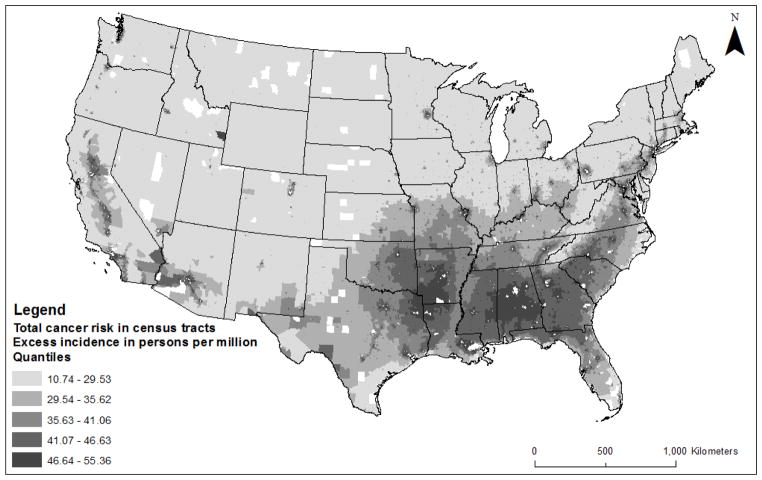
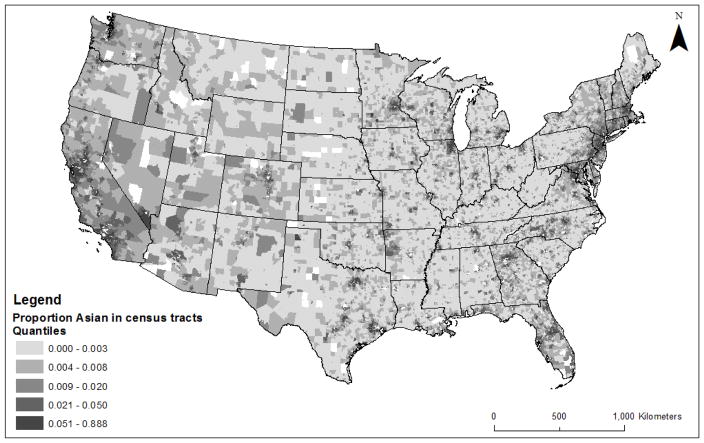
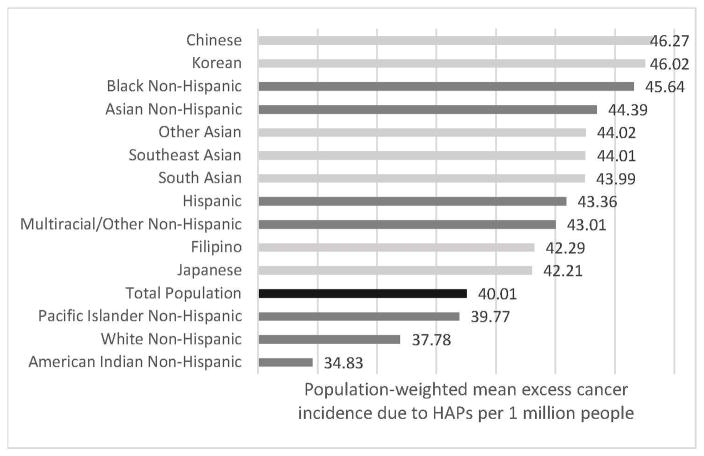
Studies have demonstrated disparate exposures to carcinogenic hazardous air pollutants (HAPs) in neighborhoods with high densities of Black and Hispanic residents in the US. Asians are the fastest growing racial/ethnic group in the US, yet they have been underemphasized in previous studies of environmental health and injustice. This cross-sectional study investigated possible disparities in residential exposure to carcinogenic HAPs among Asian Americans, including Asian American subgroups in the US (including all 50 states and the District of Columbia, n = 71,208 US census tracts) using National Air Toxics Assessment and US Census data. In an unadjusted analysis, Chinese and Korean Americans experience the highest mean cancer risks from HAPs, followed by Blacks. The aggregated Asian category ranks just below Blacks and above Hispanics, in terms of carcinogenic HAP risk. Multivariate models adjusting for socioeconomic status, population density, urban location, and geographic clustering show that an increase in proportion of Asian residents in census tracts is associated with significantly greater cancer risk from HAPs. Neighborhoods with higher proportions (as opposed to lower proportions) of Chinese, Korean, and South Asian residents have significantly greater cancer risk burdens relative to Whites. Tracts with higher concentrations of Asians speaking a non-English language and Asians that are US-born have significantly greater cancer risk burdens. Asian Americans experience substantial residential exposure to carcinogenic HAPs in US census tracts and in the US more generally.
Keywords: Asian Americans; Environmental injustice; Hazardous air pollutants.
Copyright © 2017 Elsevier Ltd. All rights reserved.
Figures
References
-
- Asian Pacific Environmental Network. Richmond. 2012 Retrieved from http://apen4ej.org/what-we-do/organizing/Richmond/
-
- Bolin B, Grineski S, Collins T. Geography of Despair: Environmental Racism and the Making of South Phoenix, Arizona, USA. Human Ecology Review. 2005;12(2):155–167.
-
- CDC. Leading Causes of Death by Age Group, Race/Ethnicity Males, United States, 2010. 2010 Retrieved from https://www.cdc.gov/men/lcod/2010/lcodrace_ethnicitymen2010.pdf.
MeSH terms
Substances
Grants and funding
LinkOut - more resources
Full Text Sources
Other Literature Sources
