


Basal late sodium current is a significant contributor to the duration of action potential of guinea pig ventricular myocytes
- PMID: 28554967
- PMCID: PMC5449569
- DOI: 10.14814/phy2.13295
Basal late sodium current is a significant contributor to the duration of action potential of guinea pig ventricular myocytes
Abstract
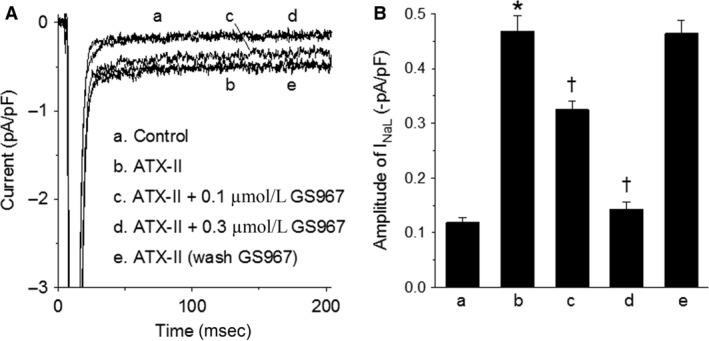
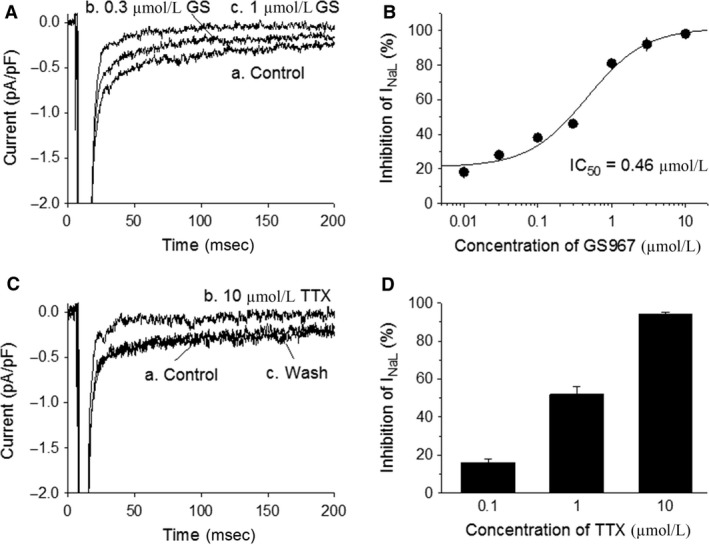
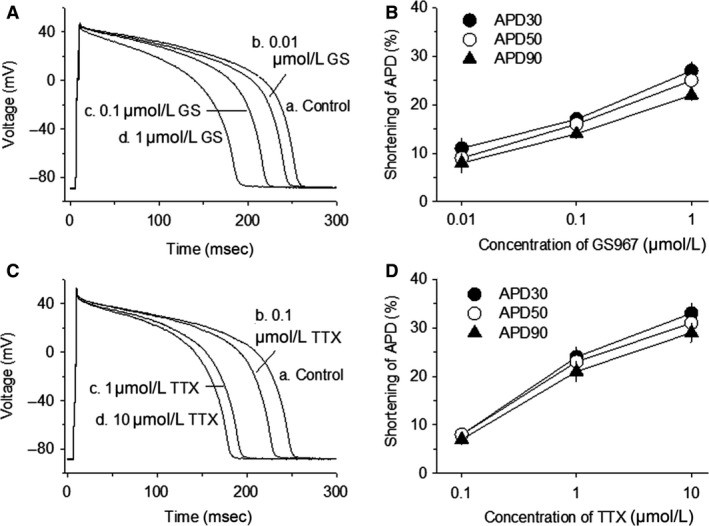
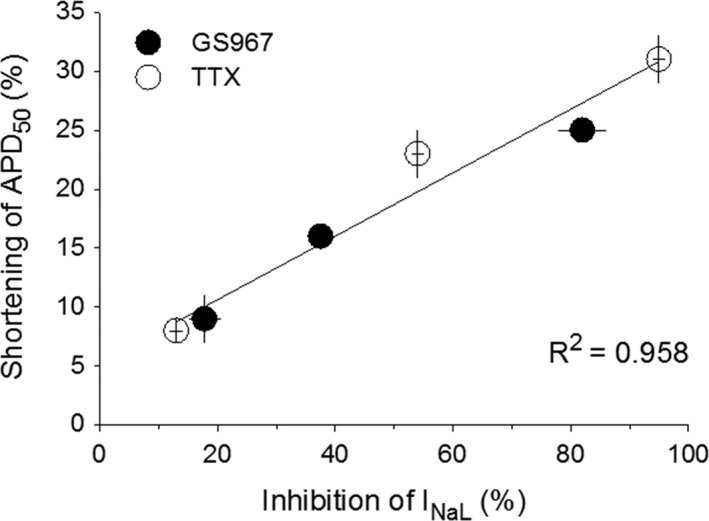
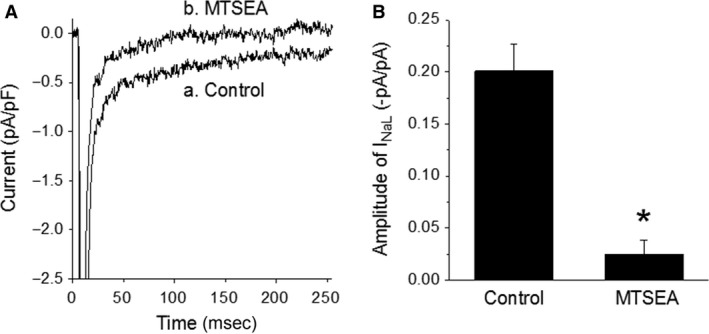
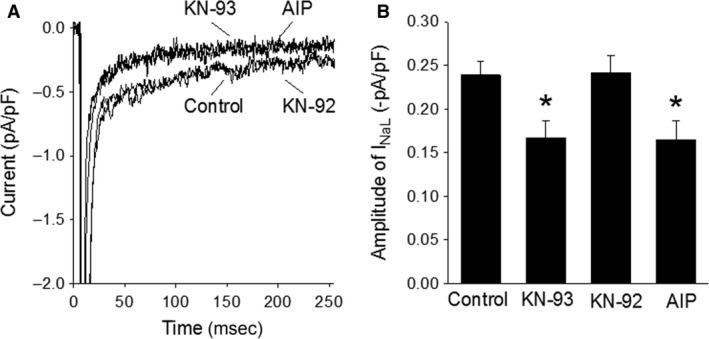
In cardiac myocytes, an enhancement of late sodium current (INaL) under pathological conditions is known to cause prolongation of action potential duration (APD). This study investigated the contribution of INaL under basal, physiological conditions to the APD Whole-cell INaL and the APD of ventricular myocytes isolated from healthy adult guinea pigs were measured at 36°C. The INaL inhibitor GS967 or TTX was applied to block INaL The amplitude of basal INaL and the APD at 50% repolarization in myocytes stimulated at a frequency of 0.17 Hz were -0.24 ± 0.02 pA/pF and 229 ± 6 msec, respectively. GS967 (0.01-1 μmol/L) concentration dependently reduced the basal INaL by 18 ± 3-82 ± 4%. At the same concentrations, GS967 shortened the APD by 9 ± 2 to 25 ± 1%. Similarly, TTX at 0.1-10 μmol/L decreased the basal INaL by 13 ± 1-94 ± 1% and APD by 8 ± 1-31 ± 2%. There was a close correlation (R2 = 0.958) between the percentage inhibition of INaL and the percentage shortening of APD caused by either GS967 or TTX MTSEA (methanethiosulfonate ethylammonium, 2 mmol/L), a NaV1.5 channel blocker, reduced the INaL by 90 ± 5%, suggesting that the NaV1.5 channel isoform is the major contributor to the basal INaL KN-93 (10 μmol/L) and AIP (2 μmol/L), blockers of CaMKII, moderately reduced the basal INaL Thus, this study provides strong evidence that basal endogenous INaL is a significant contributor to the APD of cardiac myocytes. In addition, the basal INaL of guinea pig ventricular myocytes is mainly generated from NaV1.5 channel isoform and is regulated by CaMKII.
Keywords: Action potential duration; Ca2+/calmodulin‐dependent protein kinase II; NaV1.5 channel; late sodium current; ventricular myocytes.
© 2017 The Authors. Physiological Reports published by Wiley Periodicals, Inc. on behalf of The Physiological Society and the American Physiological Society.
Conflict of interest statement
Y. Song received a research grant from Gilead Sciences; L. Belardinelli was an employee of Gilead Sciences at the time of this study.
Figures
References
-
- Belardinelli, L. , Liu G., Smith‐Maxwell C., Wang W.‐Q., El‐Bizri N., Hirakawa R., et al. 2013. A novel, potent, and selective inhibitor of cardiac late sodium current suppresses experimental arrhythmias. J. Pharmacol. Exp. Ther. 344:23–32. - PubMed
-
- Belardinelli, L. , Giles W. R., Rajamani S., Karagueuzian H. S., and Shryock J. C.. 2015. Cardiac late Na+ current: proarrhythmic effects, roles in long QT syndromes, and pathological relationship to CaMKII and oxidative stress. Heart Rhythm 12:440–448. - PubMed
-
- Coraboeuf, E. , Deroubaix E., and Coulombe A.. 1979. Effect of tetrodotoxin on action potentials of the conducting system in the dog heart. Am. J. Physiol. 236:H561–H567. - PubMed
MeSH terms
Substances
LinkOut - more resources
Full Text Sources
Other Literature Sources
Miscellaneous
