Review
. 2017 May 15:8:559.
doi: 10.3389/fimmu.2017.00559. eCollection 2017.

Under Pressure: Interactions between Commensal Microbiota and the Teleost Immune System

Affiliations
Review

Under Pressure: Interactions between Commensal Microbiota and the Teleost Immune System

Cecelia Kelly et al. Front Immunol. .

Abstract

Commensal microorganisms inhabit every mucosal surface of teleost fish. At these surfaces, microorganisms directly and indirectly shape the teleost immune system. This review provides a comprehensive overview of how the microbiota and microbiota-derived products influence both the mucosal and systemic immune system of fish. The cross talk between the microbiota and the teleost immune system shifts significantly under stress or disease scenarios rendering commensals into opportunists or pathogens. Lessons learnt from germ-free fish models as well as from oral administration of live probiotics to fish highlight the vast impact that microbiota have on immune development, antibody production, mucosal homeostasis, and resistance to stress. Future studies should dissect the specific mechanisms by which different members of the fish microbiota and the metabolites they produce interact with pathogens, with other commensals, and with the teleost immune system.

Keywords: commensals; evolution; fish; immunity; microbiota; mucosal immunity; teleost.


Figures
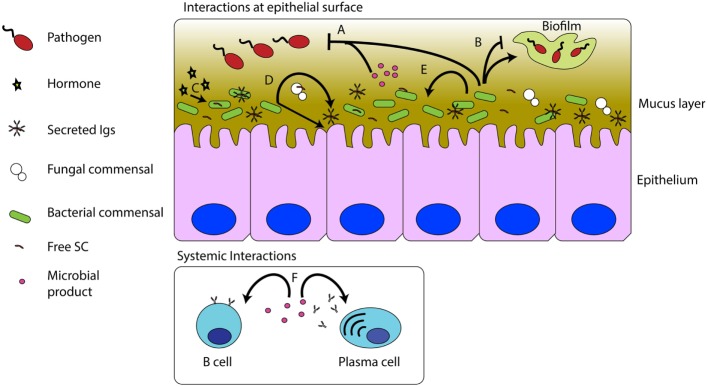
Figure 1
Figure 1
Interactions between commensal microbes, pathogens, and the host immune system. Commensal bacteria and their products can inhibit pathogenic infections (A). Commensal microbes can promote or inhibit biofilm formation (B). Host hormones, such as cortisol, can be sensed by, and have effects on commensals (C). The presence of the microbiota stimulates S-Ig production and epithelial turnover (D). Commensal microbes and their products can affect other commensal microbes (E). Commensal products, such as sphingolipids, can modulate B cell numbers and antibody titers in mucosal and systemic compartments (F).
Figure 2
Figure 2
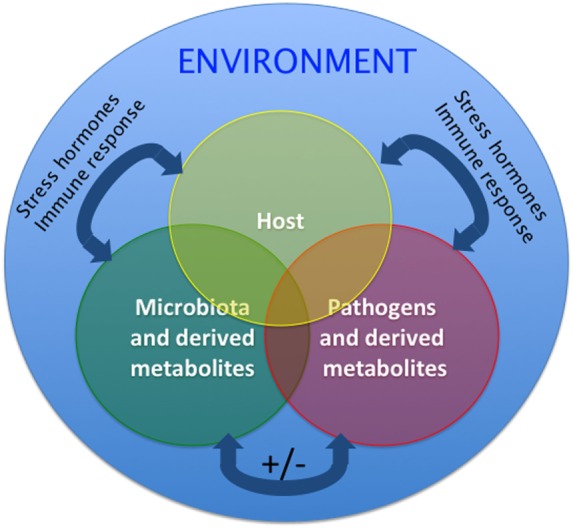
Proposed model of the host–pathogen–microbiota interactions in aquatic animals such as teleost fish. Two-way and three-way interactions among host, pathogen, and microbiota are possible and are overall affected by the environment. Interactions can be positive (synergistic) or negative (inhibitory). Additionally, the host microbial communities and host physiology modify the environment where the fish live. These interactions are, therefore, likely different in laboratory settings, aquaculture settings, and the wild. Homeostatic interactions form a delicate equilibrium. Under stress conditions, host, commensals, and pathogens can produce stress hormones that are molecularly conserved, will be released and alter the interactions of the triangle, likely resulting in decreased immune responses and outgrowth of opportunists and pathogens. Similarly, during the course of immune responses, release of immune molecules from host, commensals, and pathogens will shift the equilibrium of this triangle. The mechanisms by which teleost regain homeostasis following perturbations are largely unknown.

References

    1. Brooks AW, Kohl KD, Brucker RM, van Opstal EJ, Bordenstein SR. Phylosymbiosis: relationships and functional effects of microbial communities across host evolutionary history. PLoS Biol (2016) 15(1):e1002587. 10.1371/journal.pbio.2000225 - DOI - PMC - PubMed
    1. Lowrey L, Woodhams DC, Tacchi L, Salinas I. Topographical mapping of the rainbow trout (Oncorhynchus mykiss) microbiome reveals a diverse bacterial community with antifungal properties in the skin. Appl Environ Microbiol (2015) 81(19):6915–25. 10.1128/AEM.01826-15 - DOI - PMC - PubMed
    1. Llewellyn MS, McGinnity P, Dionne M, Letourneau F, Thonier F, Carvalho GR, et al. The biogeography of the Atlantic salmon (Salmo salar) gut microbiome. ISME J (2015) 10:1280–4. 10.1038/ismej.2015.189 - DOI - PMC - PubMed
    1. Gajardo K, Rodiles A, Kortner TM, Krogdahl A, Bakke AM, Merrifield DL, et al. A high-resolution map of the gut microbiota in Atlantic salmon (Salmo salar): a basis for comparative gut microbial research. Sci Rep (2016) 6:30894. 10.1038/srep30893 - DOI - PMC - PubMed
    1. Larsen AM, Bullard SA, Womble M, Arias CR. Community structure of skin microbiome of gulf killifish, Fundulus grandis, is driven by seasonality and not exposure to oiled sediments in a Louisiana salt marsh. Microb Ecol (2015) 70(2):534–44. 10.1007/s00248-015-0578-7 - DOI - PubMed

LinkOut - more resources