


doi: 10.3389/fgene.2017.00058.
eCollection 2017.
Amyloid β Modification: A Key to the Sporadic Alzheimer's Disease?
Affiliations
- PMID: 28555154
- PMCID: PMC5430028
- DOI: 10.3389/fgene.2017.00058
Item in Clipboard
Amyloid β Modification: A Key to the Sporadic Alzheimer's Disease?
Front Genet.
.
No abstract available
Keywords: Aging; Sporadic Alzheimer's disease; beta amyloid; post-translational Modifications (PTM); proteinopathies; proteostasis.
Figures
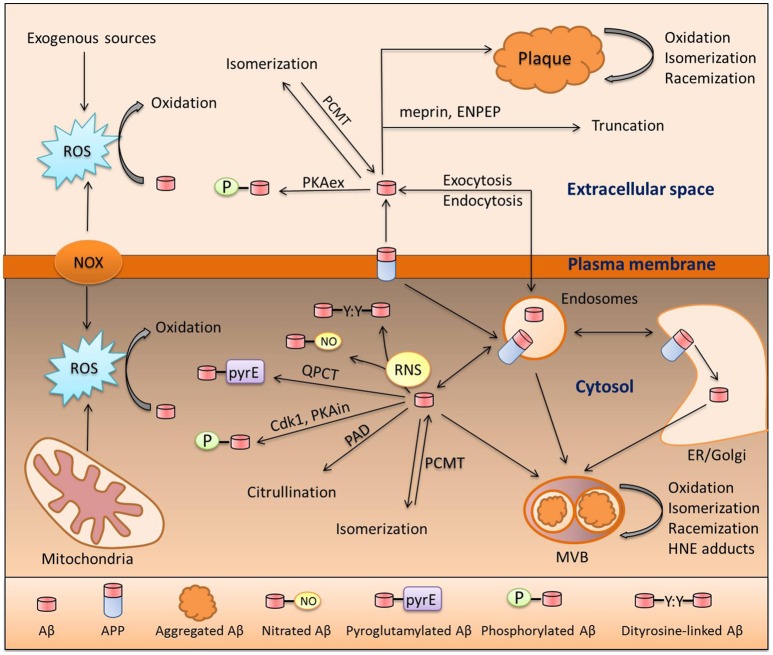
Pathways of Aβ modification. Aβ is a product of amyloid precursor protein (APP) cleavage at the plasma membrane or inside the cell in the endosomal compartment or ER/Golgi. These two pools exchange Aβ via endo- and exocytosis. Aβ in both of these pools can undergo oxidation due to interaction with reactive oxygen species (ROS) produced by NADPH-oxidase (NOX), the mitochondrial respiratory chain, or exogenous sources. Reactive nitrogen species (RNS) produced by nitric oxide synthase (NOS) isoforms also interact with Aβ which, results in nitration of the Tyr10 residue or formation of covalently linked dimers of Aβ. Extracellular Aβ is phosphorylated by extracellular protein kinase A (PKAex) and intracellular Aβ is subjected to phosphorylation by both intracellular PKA (PKAin) and cdc2 kinase (Cdk1). An exclusive modification of intracellular Aβ is citrullination by peptidyl arginyl deiminase (PAD). Aspartic residues of Aβ are prone to spontaneous isomerization or racemization, and this isomerization can be reversed by protein carboxyl methyltransferase 1 (PCMT1). In amyloid deposits (plaques or multivesicular bodies [MVB]), Aβ undergoes oxidative damage which leads to the formation of adducts with 4-hydroxynonenal (HNE); a product of lipid peroxidation. Aminopeptidase A (ENPEP) and meprin can truncate Aβ. Lastly, amyloid beta can be pyroglutamylated at the E3 and E11 sites by glutaminyl-peptide cyclotransferase (QPCT).
References
LinkOut - more resources
Full Text Sources
Other Literature Sources
