


Small and Smaller-sRNAs and MicroRNAs in the Regulation of Toxin Gene Expression in Prokaryotic Cells: A Mini-Review
- PMID: 28556797
- PMCID: PMC5488031
- DOI: 10.3390/toxins9060181
Small and Smaller-sRNAs and MicroRNAs in the Regulation of Toxin Gene Expression in Prokaryotic Cells: A Mini-Review
Abstract
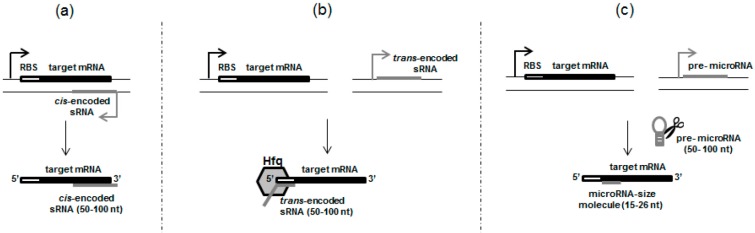
Non-coding small RNAs (sRNAs) have been identified in the wide range of bacteria (also pathogenic species) and found to play an important role in the regulation of many processes, including toxin gene expression. The best characterized prokaryotic sRNAs regulate gene expression by base pairing with mRNA targets and fall into two broad classes: cis-encoded sRNAs (also called antisense RNA) and trans-acting sRNAs. Molecules from the second class are frequently considered as the most related to eukaryotic microRNAs. Interestingly, typical microRNA-size RNA molecules have also been reported in prokaryotic cells, although they have received little attention up to now. In this work we have collected information about all three types of small prokaryotic RNAs in the context of the regulation of toxin gene expression.
Keywords: microRNAs; non-coding small RNAs; prokaryotes; toxin gene expression.
Conflict of interest statement
The authors declare no conflict of interest.
Figures
References
-
- Gottesman S., McCullen C.A., Guillier M., Vanderpool C.K., Majdalani N., Benhammou J., Thompson K.M., FitzGerald P.C., Sowa N.A., FitzGerald D.J. Cold Spring Harbor Symposia on Quantitative Biology. Volume 71. Cold Spring Harbor Laboratory Press; Cold Spring Harbor, NY, USA: 2006. Small RNA regulators and the bacterial response to stress; pp. 1–11. - PMC - PubMed
Publication types
MeSH terms
Substances
LinkOut - more resources
Full Text Sources
Other Literature Sources
