. 2017 Oct;152(2):276-286.
doi: 10.1111/imm.12767. Epub 2017 Jul 10.

Mammalian target of rapamycin complex 1 signalling is essential for germinal centre reaction

Affiliations

Mammalian target of rapamycin complex 1 signalling is essential for germinal centre reaction

Bingshou Li et al. Immunology. 2017 Oct.

Abstract

The mammalian target of rapamycin (mTOR) is a serine-threonine kinase that has been shown to be essential for the differentiation and function of various immune cells. Earlier in vitro studies showed that mTOR signalling regulates B-cell biology by supporting their activation and proliferation. However, how mTOR signalling temporally regulates in vivo germinal centre B (GCB) cell development and differentiation into short-lived plasma cells, long-lived plasma cells and memory cells is still not well understood. In this study, we used a combined conditional/inducible knock-out system to investigate the temporal regulation of mTOR complex 1 (mTORC1) in the GCB cell response to acute lymphocytic choriomeningitis virus infection by deleting Raptor, a main component of mTORC1, specifically in B cells in pre- and late GC phase. Early Raptor deficiency strongly inhibited GCB cell proliferation and differentiation and plasma cell differentiation. Nevertheless, late GC Raptor deficiency caused only decreases in the size of memory B cells and long-lived plasma cells through poor maintenance of GCB cells, but it did not change their differentiation. Collectively, our data revealed that mTORC1 signalling supports GCB cell responses at both early and late GC phases during viral infection but does not regulate GCB cell differentiation into memory B cells and plasma cells at the late GC stage.

Keywords: B cell; cell differentiation; gene regulation.


Figures

Figure 1
Figure 1
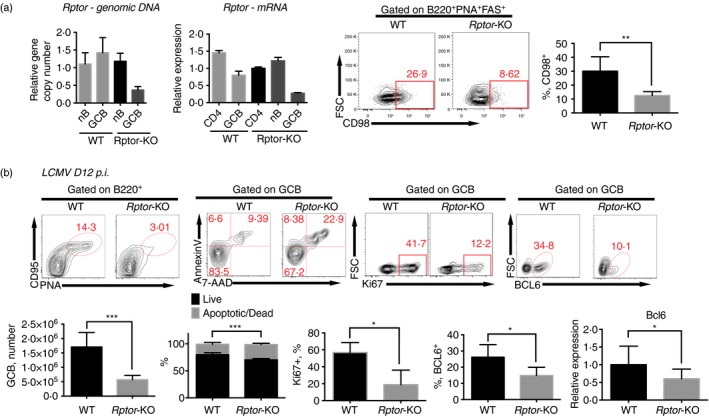
Mammalian target of rapamycin complex 1 (mTORC1) signalling sustains B‐cell responses to lymphocytic choriomeningitis virus (LCMV) infection. (a) Quantification of Rptor genomic DNA (left) and mRNA (middle left) copy number by quantitative PCR in sorted lymphocytes as indicated; staining of CD98 in germinal centre B (GCB) (PNA + CD95+ B220+) cells (middle right) and frequency of CD98+ population in GCB cells (right) from wild‐type C57BL/6J (WT) and Aicda‐Cre‐Rptor flox (RptorKO) mice 8 days after infection with the Armstrong strain of LCMV. (b) Flow cytometry of B220+ B cells (top, left) and PNA + CD95+ B220+ GCB cells (top, middle and right); and quantification of PNA + CD95+ B220+ GCB cell number, apoptotic/dead cell frequency, Ki67+ frequency and BCL6+ frequency in PNA + CD95+ B220+ GCB cells (bottom, left, middle left and middle) in spleens from WT and RptorKO mice on day 12 after LCMV infection. Quantification of frequency and total number per spleen of indicated subsets and quantification of Bcl6 mRNA in GCB cells in the indicated mice (bottom middle right and right). *P < 0·05 **P < 0·005 ***P < 0·002 (unpaired two‐tailed t‐test). Data are representative of three independent experiments with three to six mice per group (error bars, SEM). [Colour figure can be viewed at wileyonlinelibrary.com]
Figure 2
Figure 2
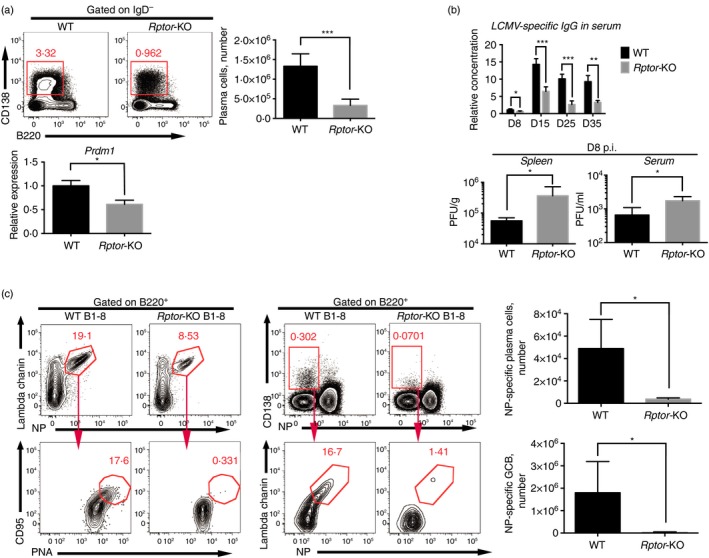
Mammalian target of rapamycin complex 1 (mTORC1) supported plasma cell differentiation and humoral response against acute lymphocytic choriomeningitis virus (LCMV) infection. (a) Flow cytometry of IgD lymphocytes (top left), CD138+ B220mi/lo plasma cell total number (top right), and quantification of Prdm1 in plasma cells from wild‐type (WT) and RptorKO mice on day 12 after LCMV infection. (b) Quantification of LCMV‐specific IgG in serum of RptorKO and WT mice after the indicated post‐infection time (top). The concentrations were normalized to that of WT mice on post‐infection day 8. Quantification of LCMV titres in spleens and serum of RptorKO and WT mice on post‐infection day 8 (bottom). (c) Flow cytometry of B220+ B cells and quantification of 4‐hydroxy‐3‐nitrophenylacetyl (NP)‐specific GCB (NP + Ig‐λ + PNA + CD95+ B220+) cells and NP‐specific plasma cells (NP + Ig‐λ + CD138+ B220mi/lo) among total cell number in spleens from wild‐type B1‐8hi (WT B1‐8) and Aicda‐Cre‐Rptor flox B1‐8hi (Rptor‐KO B1‐8) mice on day 8 after LCMV infection. *P < 0·05 **P < 0·005 ***P < 0·002 (unpaired two‐tailed t‐test). Data are representative of three independent experiments with three to six mice per group (error bars, SEM). [Colour figure can be viewed at wileyonlinelibrary.com]
Figure 3
Figure 3
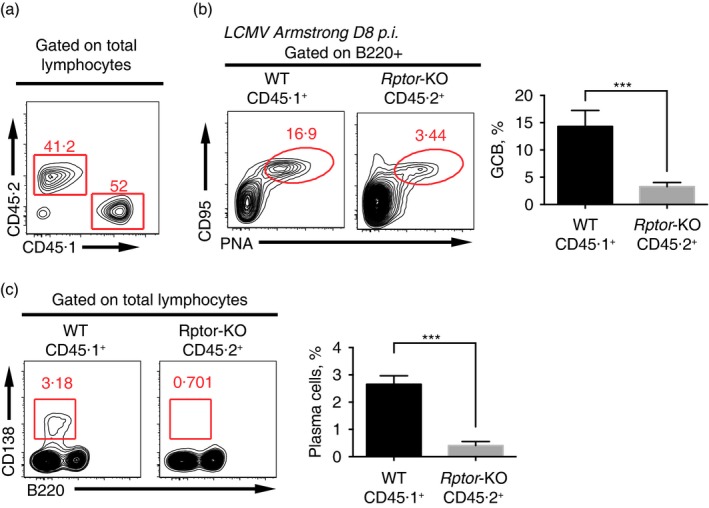
Germinal centre B (GCB) cell‐intrinsic mammalian target of rapamycin complex 1 (mTORC1) signalling regulated the GCB cell response. (a) Flow cytometry of total lymphocytes in spleens of non‐infected chimeras generated with a mixture of wild‐type (CD45.1+) and Aicda‐Cre‐Rptor flox (CD45.2+) bone marrow cells. The numbers above the outlined areas indicate the percentages of CD45.1+ and CD45.2+ cells. (b) Flow cytometry of B220+ B cells in the LCMV‐infected chimeras in (a), assessed at day 8 after infection of the host with lymphocytic choriomeningitis virus (LCMV), and a summary of GCB cell frequency in B cells of CD45.1+ and CD45.2+ origin. (c) Flow cytometry of lymphocytes in the LCMV‐infected chimeras in (a), assessed at day 8 after infection of the host with LCMV, and a summary of plasma cell frequency in lymphocytes of CD45.1+ and CD45.2+ origin. ***P < 0·002 (unpaired two‐tailed t‐test). Data are representative of three independent experiments with three to six mice per group (error bars, SEM). [Colour figure can be viewed at wileyonlinelibrary.com]
Figure 4
Figure 4
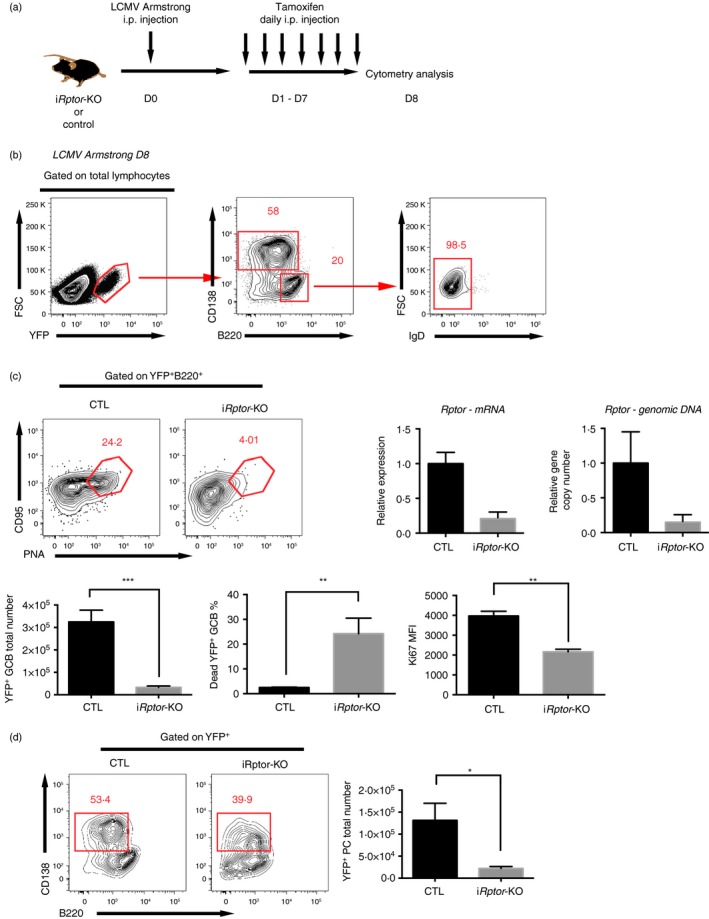
Temporal deletion of mammalian target of rapamycin complex 1 (mTORC1) signalling in early germinal centre (GC) development resulted in an impaired early humoral response. (a) Experimental set‐up for early GC induction of Rptor deletion. AicdaERT2Cre‐YFP/Rptor flox (iR ptorKO) or control AicdaERT2Cre‐YFP (CTL) mice were infected with the Armstrong strain of lymphocytic choriomeningitis virus (LCMV) and subsequently treated daily with tamoxifen via intraperitoneal injection during days 1–7 post‐infection. (b) Flow cytometry of lymphocytes in spleens of the CTL mice treated as described in (a) (left). The numbers above the outlined areas indicate the percentages of CD138+ plasma cells and B220+ B cells among YFP + cells (middle), and the percentage of IgD B cells among YFP + B220+ B cells (right). (c) Flow cytometry of YFP + B220+ B cells (top left), quantification of Rptor genomic DNA and mRNA in sorted YFP + B220+ CD95+ PNA + GCB cells (top right), quantification of total YFP + B220+ CD95+ PNA + GCB cell number per spleen and quantification of viability dye‐labelled dead GCB cell frequency and Ki67 in YFP + B220+ CD95+ PNA + GCB cells (bottom) in the spleens of the CTL and iR ptorKO mice treated as described in (a). (d) Flow cytometry of YFP + cells and quantification of total YFP + B220mi/lo CD138+ plasma cell number in the spleen of the CTL and iR ptorKO mice treated as described in (a). *P < 0·05 **P < 0·005 ***P < 0·002 (unpaired two‐tailed t‐test). Data are representative of three independent experiments with three to six mice per group (error bars, SEM).
Figure 5
Figure 5
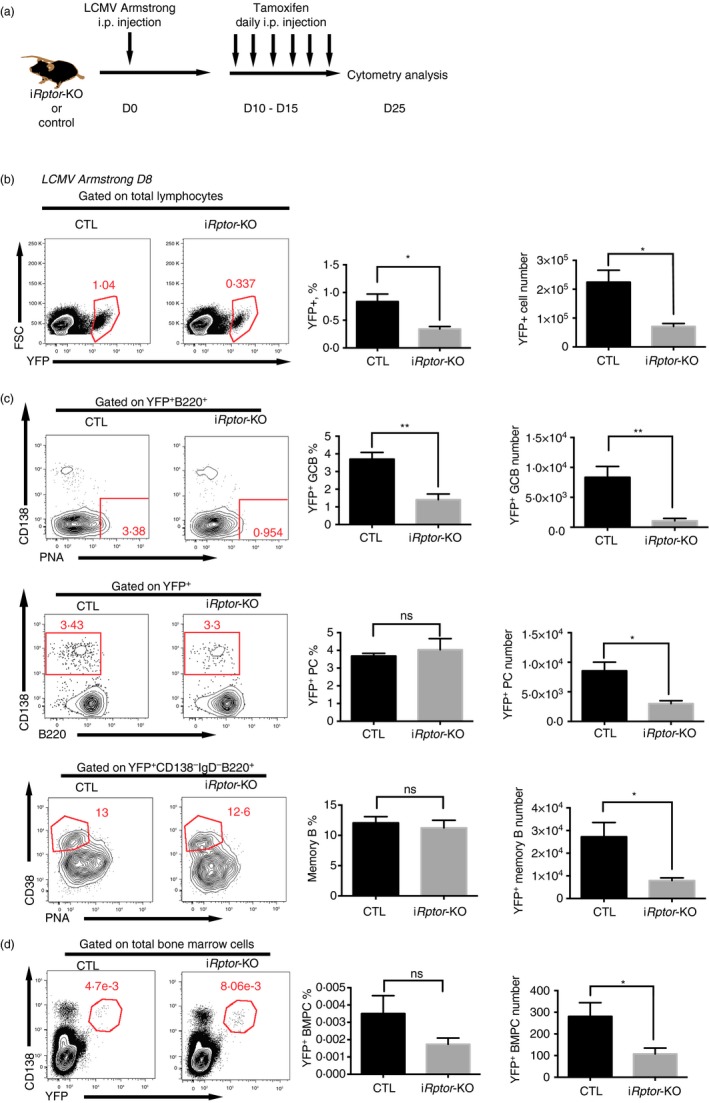
Late mammalian target of rapamycin complex 1 (mTORC1) signalling supported the post‐germinal centre (GC) humoral response by maintaining the GCB cell population. (a) Experimental set‐up for late GC induction of Rptor deletion. AicdaERT2Cre‐YFP/Rptor flox (iR ptorKO) or control AicdaERT2Cre‐YFP (CTL) mice were infected with the Armstrong strain lymphocytic choriomeningitis virus (LCMV) and subsequently treated daily with tamoxifen via intraperitoneal injection during days 10–15 post‐infection. (b) Flow cytometry of lymphocytes and quantification of YFP + lymphocyte frequency and number in the spleens of the CTL and iR ptorKO mice treated as described in (a). (c) Flow cytometry of YFP + B220+ B cells and quantification of YFP + B220+ CD95+ PNA + GCB cell frequency and number (top); flow cytometry of YFP + cells and quantification of YFP + B220mi/lo CD138+ plasma cell frequency and total number (middle), and flow cytometry of YFP + CD138 IgD B220+ cells and quantification of YFP + CD138 IgD B220+ CD38+ PNA memory cell frequency and total number (middle) in the spleens of the CTL and iR ptorKO mice treated as described in (a). (d) Flow cytometry of YFP + CD138+ plasma cells and quantification of YFP + CD138+ plasma cell frequency and total number in the bone marrow of the CTL and iR ptorKO mice treated as described in (a). *P < 0·05 **P < 0·005 (unpaired two‐tailed t‐test). Data are representative of three independent experiments with three to six mice per group (error bars, SEM). [Colour figure can be viewed at wileyonlinelibrary.com]

References

    1. Zhang S, Readinger JA, DuBois W, Janka‐Junttila M, Robinson R, Pruitt M et al Constitutive reductions in mTOR alter cell size, immune cell development, and antibody production. Blood 2011; 117:1228–38. - PMC - PubMed
    1. Plotkin SA, Orenstein AW, Offit PA. Vaccines, 6th edn. Amsterdam, Netherlands: Elsevier Inc., 2012.
    1. Zhang S, Pruitt M, Tran D, Du Bois W, Zhang K, Patel R et al B cell‐specific deficiencies in mTOR limit humoral immune responses. J Immunol 2013; 191:1692–703. - PMC - PubMed
    1. Victora GD, Nussenzweig MC. Germinal centers. Annu Rev Immunol 2012; 30:429–57. - PubMed
    1. Neuberger MS, Lanoue A, Ehrenstein MR, Batista FD, Sale JE, Williams GT. Antibody diversification and selection in the mature B‐cell compartment. Cold Spring Harb Symp Quant Biol 1999; 64:211–6. - PubMed

MeSH terms

Substances

LinkOut - more resources