


The Prevalence of Posttraumatic Stress Disorder in Primary Care: A Systematic Review
- PMID: 28557811
- PMCID: PMC5498253
- DOI: 10.1097/HRP.0000000000000136
The Prevalence of Posttraumatic Stress Disorder in Primary Care: A Systematic Review
Abstract
Learning objectives: After participating in this activity, learners should be better able to:• Determine the prevalence of clinician-diagnosed posttraumatic stress disorder (PTSD) in primary care patients• Identify the prevalence of questionnaire-ascertained PTSD symptoms in primary care patients OBJECTIVE: Determine the prevalence of clinician-diagnosed PTSD and questionnaire-ascertained PTSD symptoms in primary care patients.
Methods: A systematic review of the literature using the PRISMA method, searching MEDLINE, CINAHL, Cochrane Database, PsycINFO, EMBASE, Google Scholar, and relevant book chapter bibliographies. Studies that reported on the prevalence, including point or lifetime prevalence, of PTSD ascertained using diagnostic interviews or self-report questionnaires, or from administrative data, among patients seen in primary care were deemed eligible for inclusion. We abstracted data on the PTSD assessment tool, the mean questionnaire scores/cutoff scores, the time period of PTSD symptoms, and PTSD prevalence reported.
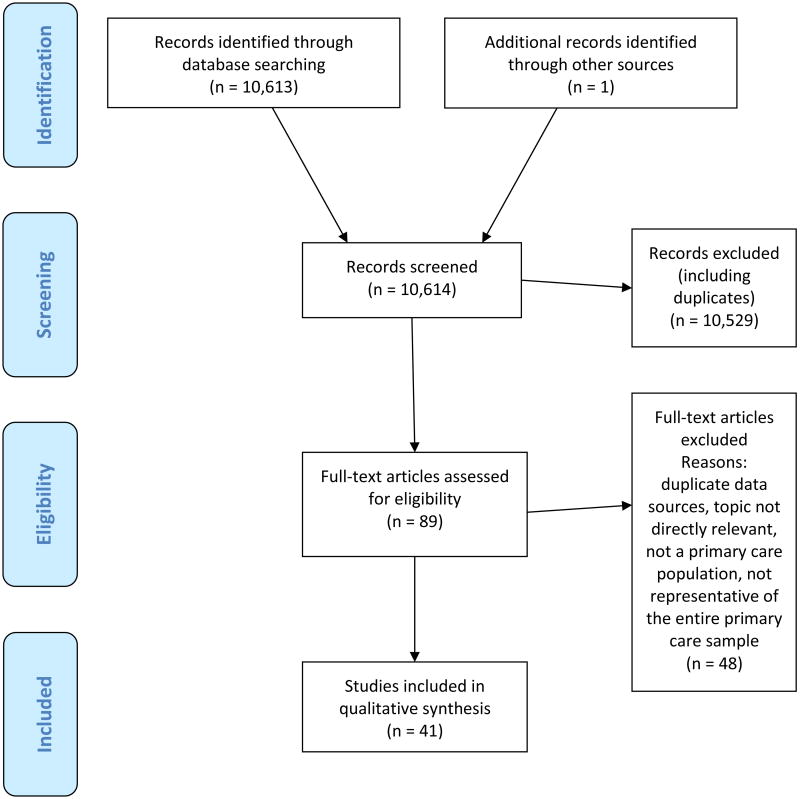
Results: Of 10,614 titles screened, 41 studies were eligible for inclusion. The included studies assessed PTSD in a total of 7,256,826 primary care patients. The median point prevalence of PTSD across studies was 12.5%. The median point prevalence in the civilian population was 11.1%; in the special-risk population, 12.5%; and in veterans, 24.5%. The point prevalence of diagnostic interview-ascertained PTSD ranged from 2% to 32.5%, and the point prevalence of questionnaire-based substantial PTSD symptoms ranged from 2.9% to 39.1%. Lifetime prevalence of diagnostic interview-ascertained PTSD ranged from 14.5% to 48.8%. The prevalence of PTSD in administrative data-based studies ranged from 3.5% to 29.2%.
Conclusions: PTSD is common in primary care settings. Additional research on effective and generalizable interventions for PTSD in primary care is needed.
Conflict of interest statement
Figures
References
-
- Herman J. Trauma and Recovery: The aftermath of violence--from domestic abuse to political terror. 2nd. New York: Basic Books; 1997.
-
- Zatzick DF, Rivera FP, Nathens AB, Jurkovich GJ, Wang J, Fan MY, Russo J, Salkever DS, Mackenzie EJ. A nationwide US study of post-traumatic stress after hospitalization for physical injury. Psychol Med. 2007;37(10):1469–1480. - PubMed
-
- Diagnostic and Statistical Manual of Mental Disorders. Vol. 5. Arlington, VA: American Psychiatric Association; 2013.
-
- Kessler RC, Berglund P, Delmer O, Jin R, Merikangas KR, Walters EE. Lifetime prevalence and age-of-onset distributions of DSM-IV disorders in the National Comorbidity Survey Replication. Archives of General Psychiatry. 2005;62(6):593–602. - PubMed
Publication types
MeSH terms
Grants and funding
LinkOut - more resources
Full Text Sources
Other Literature Sources
Medical