


The effects of social contact on cocaine intake in female rats
- PMID: 28558271
- PMCID: PMC5534368
- DOI: 10.1016/j.drugalcdep.2017.03.027
The effects of social contact on cocaine intake in female rats
Abstract
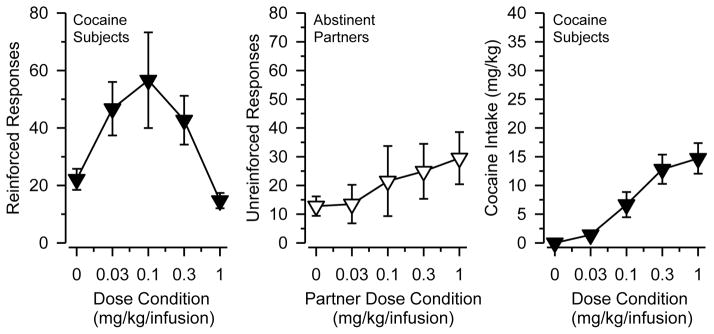
Background: Studies conducted in male rats report that social contact can either facilitate or inhibit drug intake depending on the behavior of social partners. The purpose of the present study was to: (1) examine the effects of social contact on cocaine intake in female rats, (2) examine the behavioral mechanisms by which social contact influences cocaine intake, and (3) examine whether the estrous cycle moderates the effects of social contact on cocaine intake.
Methods: Female rats were assigned to either isolated or pair-housed conditions in which a social partner either had access to cocaine (cocaine partner) or did not have access to cocaine (abstinent partner). Pair-housed rats were tested in custom-built operant conditioning chambers that allowed both rats to be tested simultaneously in the same chamber.
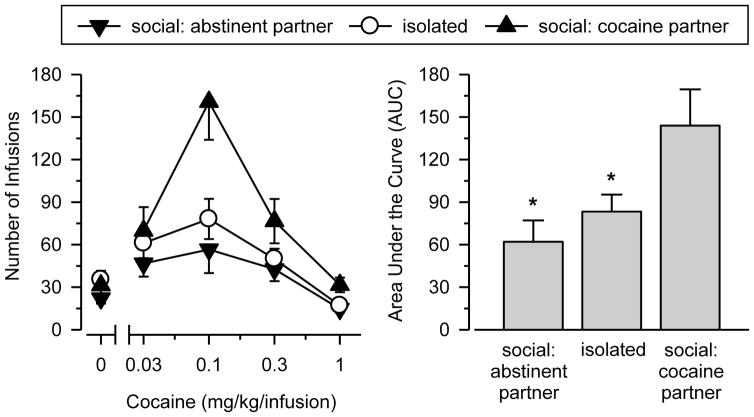
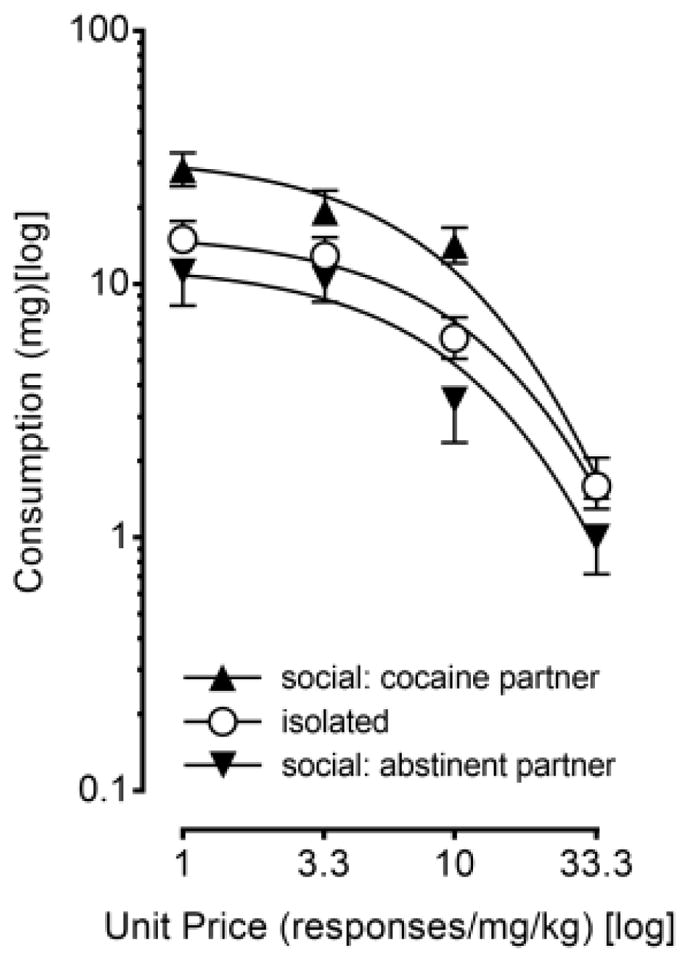
Results: Rats housed with a cocaine partner self-administered more cocaine than isolated rats and rats housed with an abstinent partner. A behavioral economic analysis indicated that these differences were driven by a greater intensity of cocaine demand (i.e., greater intake at lower unit prices) in rats housed with a cocaine partner. Multivariate modeling revealed that the estrous cycle did not moderate the effects of social contact on cocaine intake.
Conclusions: These findings indicate that: (1) social contact influences cocaine self-administration in females in a manner similar to that reported in males, (2) these effects are due to differences in the effects of social contact on the intensity of cocaine demand, and (3) these effects are consistent across all phases of the estrous cycle.
Keywords: Behavioral economics; Demand curve; Estrous; Social environment; Social learning; Substance use.
Copyright © 2017. Published by Elsevier B.V.
Conflict of interest statement
No conflict declared.
Figures
References
-
- Anker JJ, Carroll ME. Females are more vulnerable to drug abuse than males: Evidence from preclinical studies and the role of ovarian hormones. In: Neill JC, Kulkarni J, editors. Biological Basis of Sex Differences in Psychopharmacology. Springer Berlin Heidelberg; New York: 2010. pp. 73–96. - PubMed
-
- Bahr SJ, Hoffmann JP, Yang X. Parental and peer influences on the risk of adolescent drug use. J Prim Prev. 2005;26:529–551. - PubMed
-
- Bahr SJ, Maughan SL, Marcos AC, Li B. Family, religion, and the risk of adolescent drug use. J Marriage Fam. 1998;60:979–992.
MeSH terms
Substances
Grants and funding
LinkOut - more resources
Full Text Sources
Other Literature Sources
