


Genome-wide association study of salt tolerance at the seed germination stage in rice
- PMID: 28558653
- PMCID: PMC5450148
- DOI: 10.1186/s12870-017-1044-0
Genome-wide association study of salt tolerance at the seed germination stage in rice
Abstract
Background: Improving the salt tolerance of direct-seeding rice at the seed germination stage is a major breeding goal in many Asian rice-growing countries, where seedlings must often establish in soils with a high salt content. Thus, it is important to understand the genetic mechanisms of salt tolerance in rice and to screen for germplasm with salt tolerance at the seed germination stage. Here, we investigated seven seed germination-related traits under control and salt-stress conditions and conducted a genome-wide association study based on the re-sequencing of 478 diverse rice accessions.
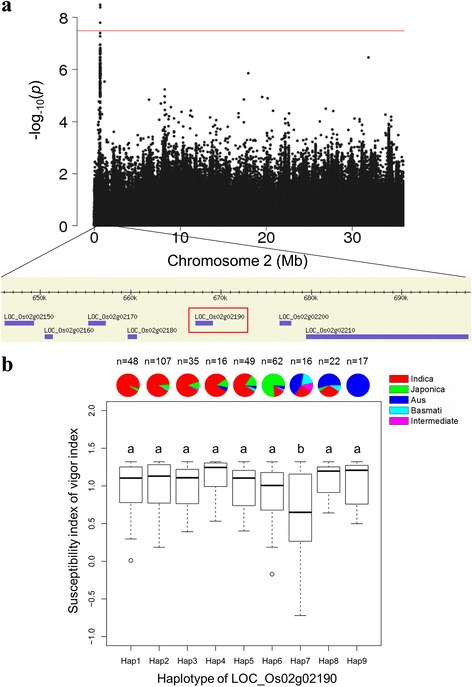
Results: The analysis used a mixed linear model and was based on 6,361,920 single nucleotide polymorphisms in 478 rice accessions grouped into whole, indica, and non-indica panels. Eleven loci containing 22 significant salt tolerance-associated single nucleotide polymorphisms were identified based on the stress-susceptibility indices (SSIs) of vigor index (VI) and mean germination time (MGT). From the SSI of VI, six major loci were identified, explaining 20.2% of the phenotypic variation. From the SSI of MGT, five major loci were detected, explaining 26.4% of the phenotypic variation. Of these, seven loci on chromosomes 1, 5, 6, 11, and 12 were close to six previously identified quantitative gene loci/genes related to tolerance to salinity or other abiotic stresses. The strongest association region for the SSI of MGT was identified in a ~ 13.3 kb interval (15450039-15,463,330) on chromosome 1, near salt-tolerance quantitative trait loci controlling the Na+: K+ ratio, total Na+ uptake, and total K+ concentration. The strongest association region for the SSI of VI was detected in a ~ 164.2 kb interval (526662-690,854) on chromosome 2 harboring two nitrate transporter family genes (OsNRT2.1 and OsNRT2.2), which affect gene expression under salt stress. The haplotype analysis indicated that OsNRT2.2 was associated with subpopulation differentiation and its minor/rare tolerant haplotype was detected.
Conclusions: These results provide valuable information for salt tolerance-related gene cloning and for understanding the genetic mechanisms of salt tolerance at the seed germination stage. This information will be useful to improve the salt tolerance of direct-seeding rice varieties by genomic selection or marker-assisted selection.
Keywords: Genome-wide association study; Germination; Rice; Salt tolerance.
Figures
References
-
- Farooq M, Siddique KHM, Rehman H, Aziz T, Lee D-J, Wahid A. Rice direct seeding: experiences, challenges and opportunities. Soil Tillage Res. 2011;111(2):87–98. doi: 10.1016/j.still.2010.10.008. - DOI
-
- Zeng L, Shannon MC, Lesch SM. Timing of salinity stress affects rice growth and yield components. Agric Water Manag. 2001;48(3):191–206. doi: 10.1016/S0378-3774(00)00146-3. - DOI
-
- Johnson DW, Smith SE, Dobrenz AK. Genetic and phenotypic relationships in response to NaCl at different developmental stages in alfalfa. Theor Appl Genet. 1992;83(6–7):833–838. - PubMed
-
- Hu S, Tao H, Qian Q, Guo L. Genetics and molecular breeding for salt-tolerance in Rice. Rice Genomics Genet. 2012;3(7):39–49.
MeSH terms
LinkOut - more resources
Full Text Sources
Other Literature Sources
