. 2017 May 30;17(1):90.
doi: 10.1186/s12870-017-1038-y.

Global identification, structural analysis and expression characterization of bHLH transcription factors in wheat

Affiliations

Global identification, structural analysis and expression characterization of bHLH transcription factors in wheat

Xiao-Jiang Guo et al. BMC Plant Biol. .

Abstract

Background: Basic helix-loop-helix (bHLH) transcription factors (TFs), which are widely distributed in eukaryotic organisms, play crucial roles in plant development. However, no comprehensive analysis of the bHLH family in wheat (Triticum aestivum L.) has been undertaken previously.

Results: In this study, 225 bHLH TFs predicted from wheat using genomic and RNA sequencing data were subjected to identification, classification, phylogenetic reconstruction, conserved motif characterization, chromosomal distribution determination and expression pattern analysis. One basic region, two helix regions and one loop region were found to be conserved in wheat bHLH TFs. The bHLH proteins could be separated into four categories based on sequences in their basic regions. Neighbor-joining-based phylogenetic analysis of conserved bHLH domains from wheat, Arabidopsis and rice identified 26 subfamilies of bHLH TFs, of which 23 were found in wheat. A total of 82 wheat bHLH genes had orthologs in Arabidopsis (27 TFs), rice (28 TFs) and both of them (27 TFs). Seven tissue-specific bHLH TF clusters were identified according to their expression patterns in endosperm, aleurone, seedlings, heading-stage spikes, flag leaves, shoots and roots. Expression levels of six endosperm-specifically expressed TFs measured by qPCR and RNA-seq showed a good correlation.

Conclusion: The 225 bHLH transcription factors identified from wheat could be classed into 23 subfamilies, and those members from the same subfamily with similar sequence motifs generally have similar expression patterns.

Keywords: Expression pattern; RNA-Seq; Transcription factor; Wheat; bHLH.


Figures
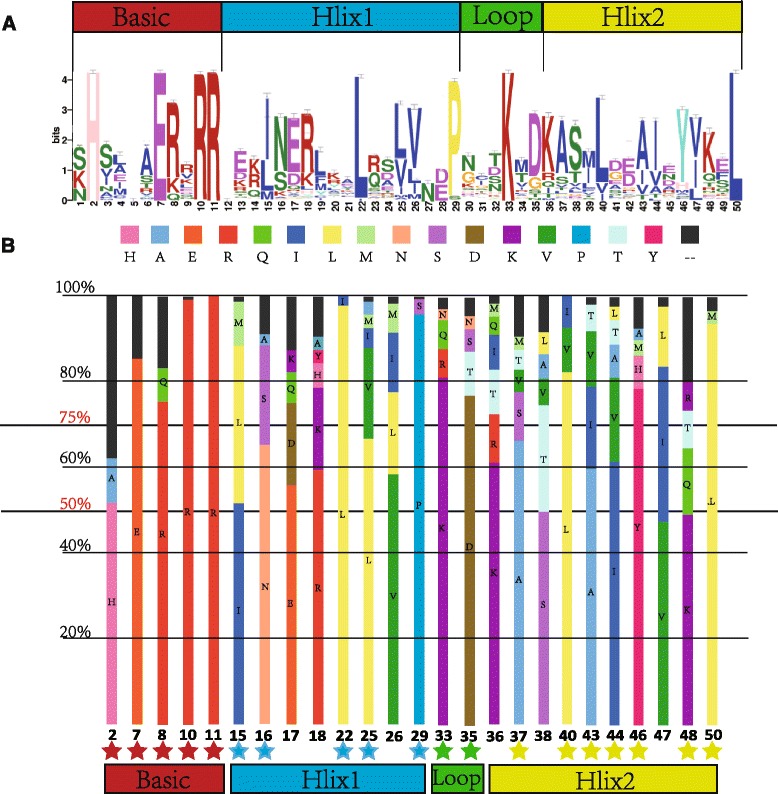
Fig. 1
Fig. 1
Characterization and distribution of bHLH domains. a Sequence logo of the bHLH domain generated in MEME. Amino acids important for dimerization of the helix-loop-helix domain are indicated by stars. b Distribution of amino acids in the bHLH consensus motif of wheat bHLH transcription factors. The numbers at the bottom are positions of the residues in the alignment
Fig. 2
Fig. 2
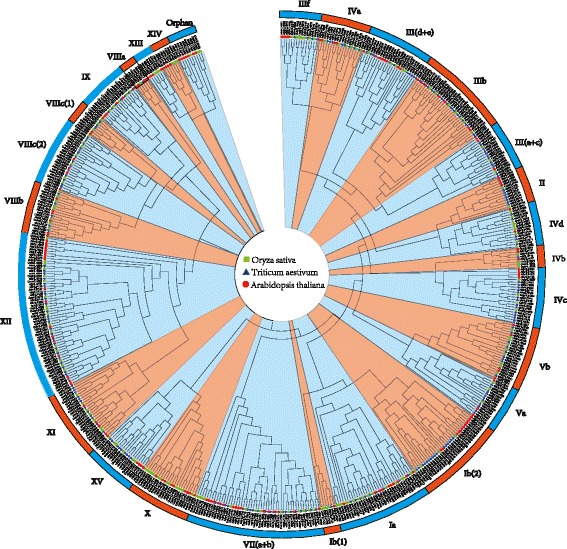
Phylogenetic tree of bHLH transcription factor domains in wheat, Arabidopsis and rice. The phylogenetic tree was constructed by the neighbor-joining method using ClustalX2 and MEGA6 software. Bootstrapping with 1000 replicates was used to assess the statistical reliability of nodes in the tree
Fig. 3
Fig. 3
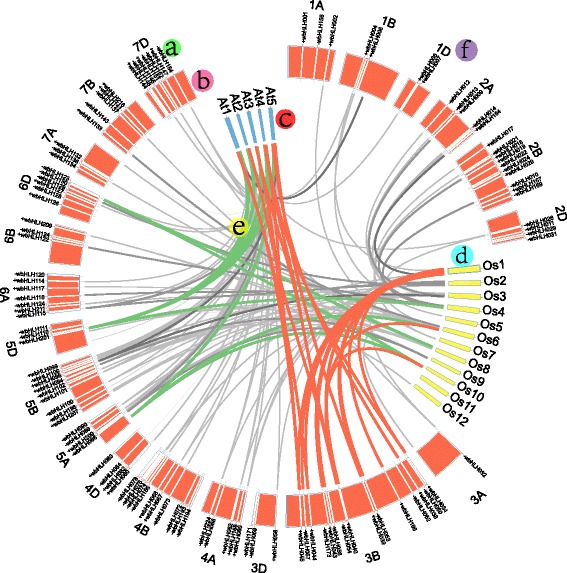
Chromosomal distribution and syntenic relationships of the bHLH transcription factor family. bHLH gene locations, chromosomes and chromosome complements are indicated by lowercase letters (a, b and f), respectively. The chromosomes of Arabidopsis and rice are indicated by lowercase letters (c and d), respectively. Wheat bHLH transcription factor genes in synteny with regions in Arabidopsis and rice are indicated by lowercase letter (e)
Fig. 4
Fig. 4
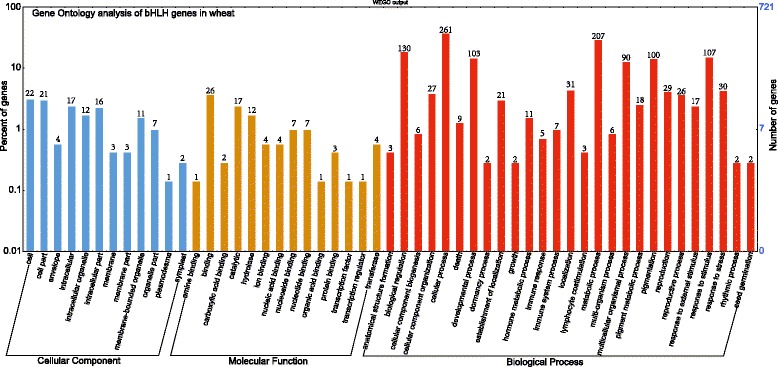
Gene ontology analysis of bHLH genes. The results are classified into three main categories: cellular component, molecular function and biological process. The y-axis indicates the percentage of genes in a given category, while numbers above bars represent the number of genes in that category
Fig. 5
Fig. 5
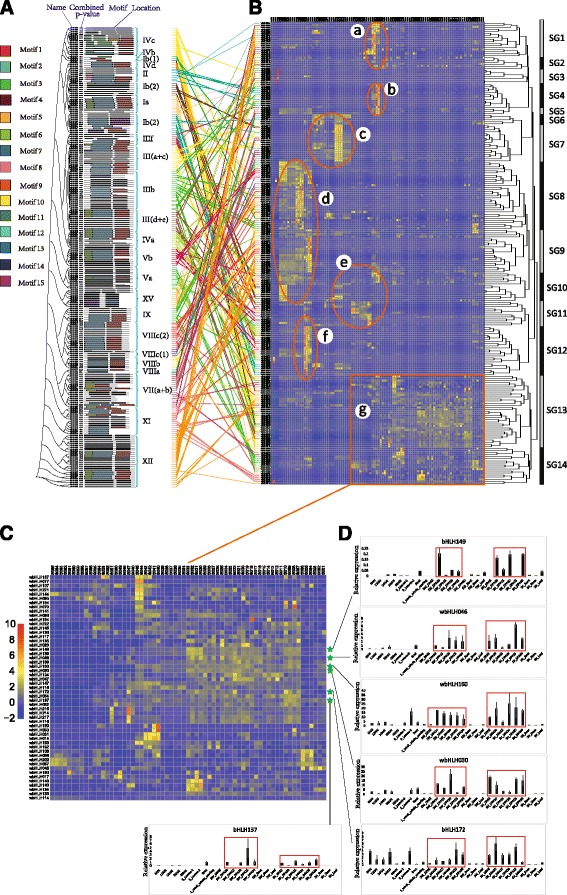
Heat map of expression levels of wheat bHLH transcription factor family genes at different growth periods in different tissues and organs. The lines link gene structures and expression levels. Each subfamily is represented by a different color. a Grouping of 225 bHLH genes into 24 subfamilies according to gene structure. b Clustering of bHLH gene expression patterns into 14 subgroups (SGs). Seven blocks (ag) correspond to higher expression levels. c Enlarged map section showing details of bHLH gene expression of block g as an example. d These expression profile data were obtained using qPCR. The ‘scale’ function in R was used to normalize relative expression values. The heat map was generated using the Pheatmap package of R. FPKM values were normalized using the ‘scale’ function in R

References

    1. Riechmann JL, Heard J, Martin G, Reuber L, Jiang C, Keddie J, et al. Arabidopsis transcription factors: genome-wide comparative analysis among eukaryotes. Science. 2000;290(5499):2105–2110. doi: 10.1126/science.290.5499.2105. - DOI - PubMed
    1. Amoutzias GD, Veron AS, Weiner J, Robinson-Rechavi M, Bornberg-Bauer E, Oliver SG, et al. One billion years of bZIP transcription factor evolution: conservation and change in dimerization and DNA-binding site specificity. Mol Biol Evol. 2007;24(3):827–835. doi: 10.1093/molbev/msl211. - DOI - PubMed
    1. Ledent V, Vervoort M. The basic helix-loop-helix protein family: comparative genomics and phylogenetic analysis. Genome Res. 2001;11(5):754–770. doi: 10.1101/gr.177001. - DOI - PMC - PubMed
    1. Atchley WR, Terhalle W, Dress A. Positional dependence cliques and predictive motifs in the bHLH protein domain. J Mol Evol. 1999;48(5):501–516. doi: 10.1007/PL00006494. - DOI - PubMed
    1. Jones S. An overview of the basic helix-loop-helix proteins. Genome Biol. 2004;5(6):226. doi: 10.1186/gb-2004-5-6-226. - DOI - PMC - PubMed

Publication types

MeSH terms

Substances

LinkOut - more resources