. 2017 May 30;16(1):95.
doi: 10.1186/s12934-017-0711-z.

Production, characterization, and antifungal activity of a biosurfactant produced by Rhodotorula babjevae YS3

Affiliations

Production, characterization, and antifungal activity of a biosurfactant produced by Rhodotorula babjevae YS3

Suparna Sen et al. Microb Cell Fact. .

Abstract

Background: Sophorolipids are one of the most promising glycolipid biosurfactants and have been successfully employed in bioremediation and various other industrial sectors. They have also been described to exhibit antimicrobial activity against different bacterial species. Nevertheless, previous literature pertaining to the antifungal activity of sophorolipids are limited indicating the need for further research to explore novel strains with wide antimicrobial activity. A novel yeast strain, Rhodotorula babjevae YS3, was recently isolated from an agricultural field in Assam, Northeast India. This study was primarily emphasized at the characterization and subsequent evaluation of antifungal activity of the sophorolipid biosurfactant produced by R. babjevae YS3.

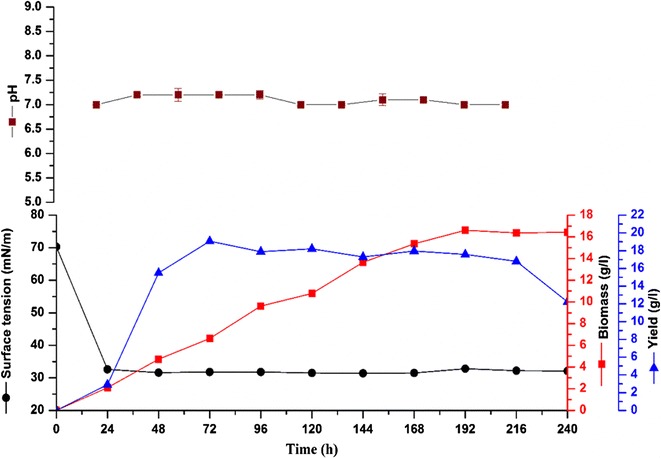
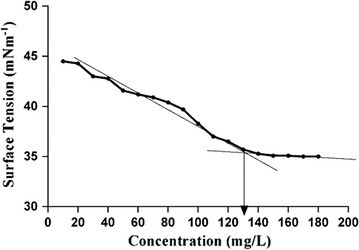
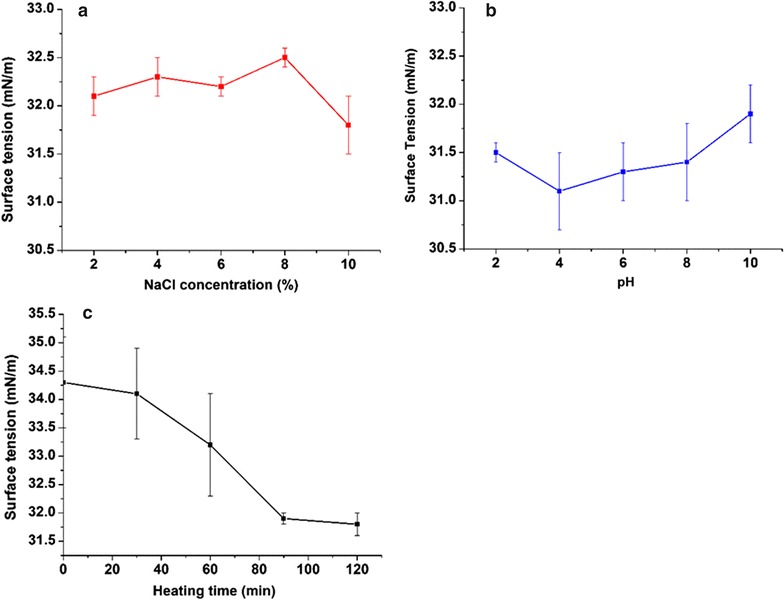
Results: The growth kinetics and biosurfactant production by R. babjevae YS3 was evaluated by cultivation in Bushnell-Haas medium containing glucose (10% w/v) as the sole carbon source. A reduction in the surface tension of the culture medium from 70 to 32.6 mN/m was observed after 24 h. The yield of crude biosurfactant was recorded to be 19.0 g/l which might further increase after optimization of the growth parameters. The biosurfactant was characterized to be a heterogeneous sophorolipid (SL) with both lactonic and acidic forms after TLC, FTIR and LC-MS analyses. The SL exhibited excellent oil spreading and emulsifying activity against crude oil at 38.46 mm2 and 100% respectively. The CMC was observed to be 130 mg/l. The stability of the SL was evaluated over a wide range of pH (2-10), salinity (2-10% NaCl) and temperature (at 120 °C for time intervals of 30 up to 120 min). The SL was found to retain surface-active properties under the extreme conditions. Additionally, the SL exhibited promising antifungal activity against a considerably broad group of pathogenic fungi viz. Colletotrichum gloeosporioides, Fusarium verticilliodes, Fusarium oxysporum f. sp. pisi, Corynespora cassiicola, and Trichophyton rubrum.

Conclusions: The study reports, for the first time, the biosurfactant producing ability of R. babjevae, a relatively lesser studied yeast. The persistent surface active properties of the sophorolipid in extreme conditions advocates its applicability in diverse environmental and industrial sectors. Further, antifungal activities against plant and human pathogens opens up possibilities for development of efficient and eco-friendly antifungal agents with agricultural and biomedical applications.

Keywords: Antifungal activity; Biosurfactant; LC–MS; Rhodotorula babjevae; Sophorolipid.


Figures
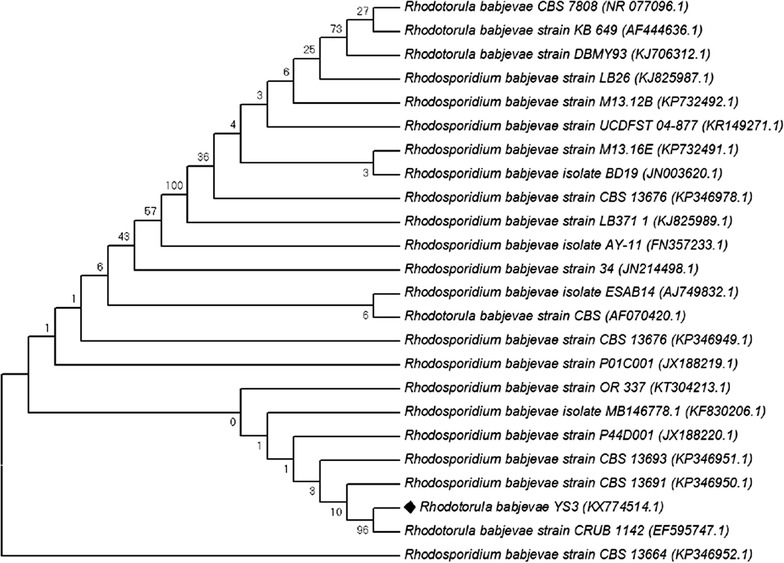
Fig. 1
Fig. 1
Phylogenetic tree of Rhodotorula babjevae YS3 and its related sequences retrieved from NCBI database
Fig. 2
Fig. 2
Growth kinetics, pH, surface tension, and biosurfactant yield of Rhodotorula babjevae YS3 grown at 19 °C, 200 rpm, 5% inoculum (v/v), 10% glucose (w/v) plotted as a function of time. Error bars illustrate standard error of mean (SEM), calculated from two independent experiments in triplicates
Fig. 3
Fig. 3
CMC and minimum surface tension of the biosurfactant produced by Rhodotorula babjevae YS3. Arrow depicts the CMC value
Fig. 4
Fig. 4
Effect of NaCl concentration (%) (a), pH (b), and heating time (min) (c) at 120 °C on ST of the culture supernatants of Rhodotorula babjevae YS3 grown at 19 °C, 200 rpm, 5% inoculum (v/v), 10% glucose (w/v). Error bars illustrate standard error of mean (SEM), calculated from two independent experiments in triplicates
Fig. 5
Fig. 5
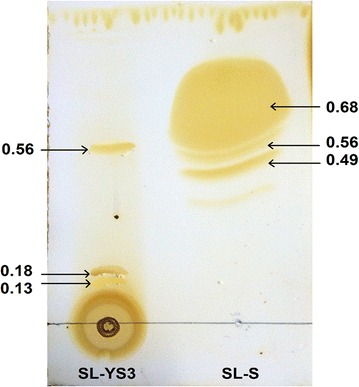
TLC chromatogram showing the separation of components of sophorolipid biosurfactant produced by Rhodotorula babjevae YS3 (SL-YS3) in comparison to the sophorolipid standard, 1,4′′-sophorolactone 6′,6′′-diacetate (SL-S)
Fig. 6
Fig. 6
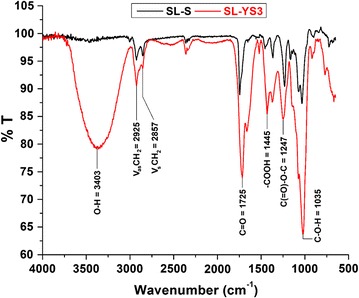
FTIR spectra of the biosurfactant produced by Rhodotorula babjevae YS3 (SL-YS3) and sophorolipid standard, 1,4′′-sophorolactone 6′,6′′-diacetate (SL-S)
Fig. 7
Fig. 7
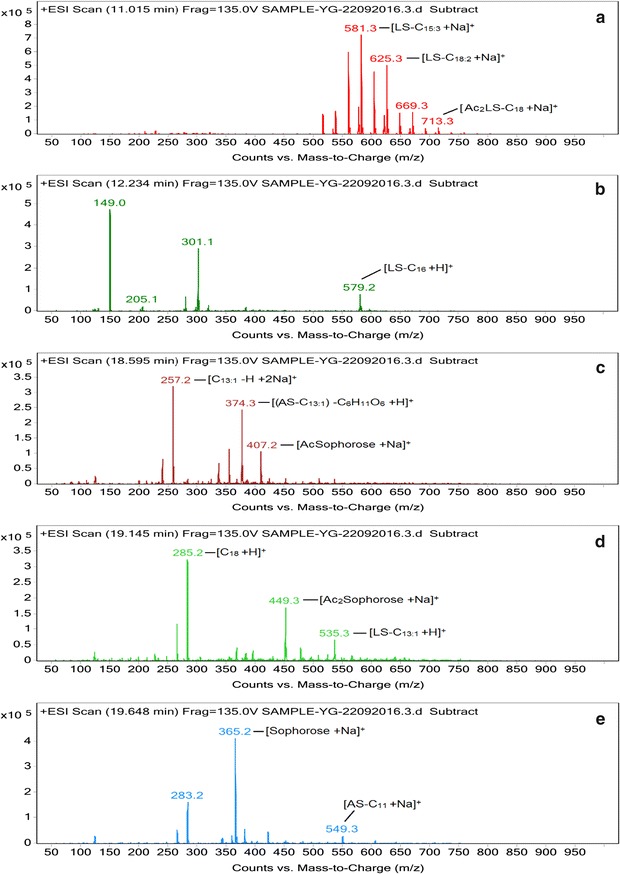
Characterization of the biosurfactant (YG) produced by Rhodotorula babjevae YS3 with glucose as the sole carbon source using LC–MS in positive electrospray ionization mode (+ESI). a MS showing the sodiated adducts of lactonic sophorolipids (LS) with pentadecatrienoic (C15:3) and octadecadienoic (C18:2) lipid side chains at m/z values 581 and 625 respectively, while the adduct ion at m/z 713 represents di-acetylated lactonic sophorolipid (Ac2LS) with octadecanoic (C18) lipid chain. b The ion at m/z 579 corresponds to lactonic sophorolipid with hexadecanoic lipid chain (LS-C16). c Disodiated adduct ion of the fragmented tridecenoic fatty acid side chain was observed at m/z 257, the protonated ion at m/z 374 represents the acidic sophorolipid with tridecenoic acidic chain (AS-C13:1) after loss of the terminal hexose (C6H11O6) from the sophorose disaccharide, sodiated adduct of fragmented mono-acetylated disaccharide moiety (AcSophorose) was observed at m/z 407. d The protonated ions at m/z 285 and 535 represent fragmented octadecanoic fatty acid side chain and lactonic sophorolipid with tridecenoic lipid chain (LS-C13:1) respectively; the sodiated adduct of fragmented di-acetylated sophorose moiety (Ac2Sophorose) was observed at m/z 449. e The sodiated adducts of the fragmented sophorose moiety and the acidic sophorolipid with undecanoic acidic side chain (AS-C11) were observed at m/z 365 and 549 respectively
Fig. 8
Fig. 8
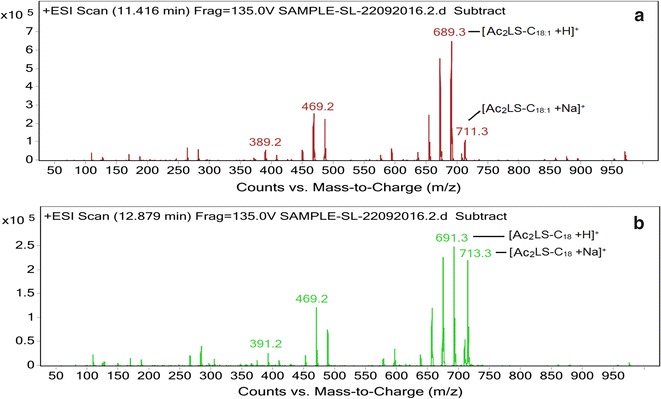
LC–MS spectra of the standard sophorolactone (SL), 1,4′′-sophorolactone 6′,6′′-diacetate in positive electrospray ionization mode (+ESI). a MS showing the protonated ion and sodiated adducts of di-acetylated lactonic sophorolipids (Ac2LS) with octadecenoic (C18:1) lipid side chains at m/z values 689 and 711 respectively. b The peaks at m/z 691 and 713 represent protonated ion and sodiated adduct of Ac2LS with octadecanoic (C18) lipid chain
Fig. 9
Fig. 9
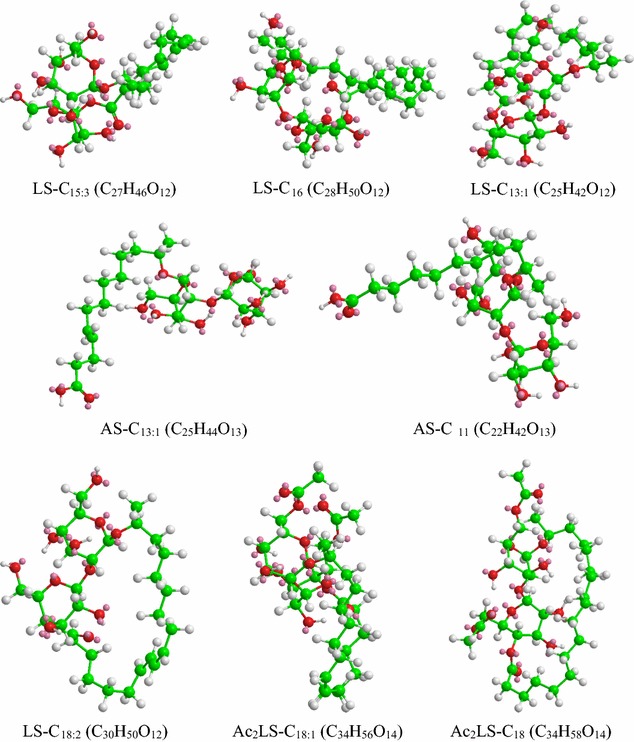
The least energy structures of the sophorolipid (SL) homologues detected during LC–MS analyses of the SL produced by Rhodotorula babjevae YS3 and SL standard, 1,4′′-sophorolactone 6′,6′′-diacetate. Structures were drawn in ChemDraw Ultra 12.0 (LS lactonic SL, AS acidic SL, Ac acetyl group)

References

    1. Banat IM, Franzetti A, Gandolfi I, Bestetti G, Martinotti MG, Fracchia L, Smyth TJ, Marchant R. Microbial biosurfactants production, applications and future potential. Appl Microbiol Biotechnol. 2010;87:427–444. doi: 10.1007/s00253-010-2589-0. - DOI - PubMed
    1. Rahman PK, Gakpe E. Production, characterisation and applications of biosurfactants-Review. Biotechnology. 2008;7:360–370. doi: 10.3923/biotech.2008.360.370. - DOI
    1. Desai JD, Banat IM. Microbial production of surfactants and their commercial potential. Microbiol Mol Biol Rev. 1997;61:47–64. - PMC - PubMed
    1. Cameotra SS, Makkar RS. Recent applications of biosurfactants as biological and immunological molecules. Curr Opin Microbiol. 2004;7:262–266. doi: 10.1016/j.mib.2004.04.006. - DOI - PubMed
    1. Borah SN, Goswami D, Lahkar J, Sarma HK, Khan MR, Deka S. Rhamnolipid produced by Pseudomonas aeruginosa SS14 causes complete suppression of wilt by Fusarium oxysporum f. sp. pisi in Pisum sativum. Biocontrol. 2015;60:375–385. doi: 10.1007/s10526-014-9645-0. - DOI

LinkOut - more resources