


Enhancing global vaccine pharmacovigilance: Proof-of-concept study on aseptic meningitis and immune thrombocytopenic purpura following measles-mumps containing vaccination
- PMID: 28558983
- PMCID: PMC5656178
- DOI: 10.1016/j.vaccine.2017.05.012
Enhancing global vaccine pharmacovigilance: Proof-of-concept study on aseptic meningitis and immune thrombocytopenic purpura following measles-mumps containing vaccination
Abstract
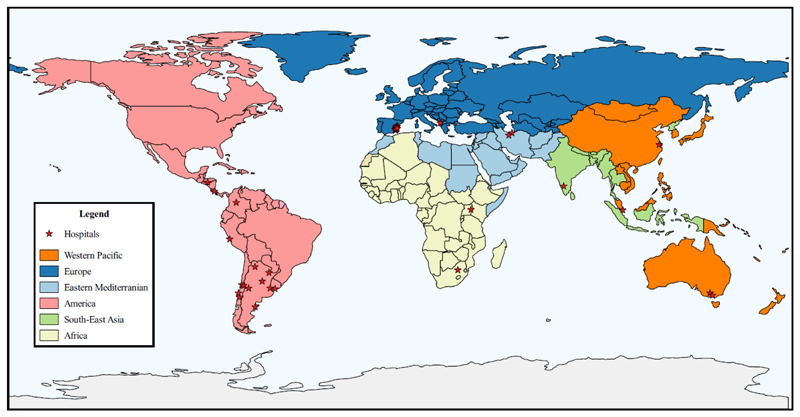
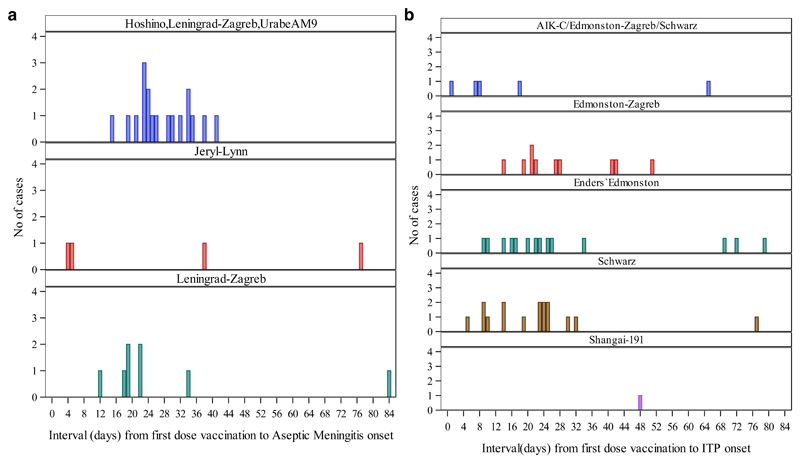
New vaccines designed to prevent diseases endemic in low and middle-income countries (LMICs) are now being introduced without prior record of utilization in countries with robust pharmacovigilance systems. To address this deficit, our objective was to demonstrate feasibility of an international hospital-based network for the assessment of potential epidemiological associations between serious and rare adverse events and vaccines in any setting. This was done through a proof-of-concept evaluation of the risk of immune thrombocytopenic purpura (ITP) and aseptic meningitis (AM) following administration of the first dose of measles-mumps-containing vaccines using the self-controlled risk interval method in the primary analysis. The World Health Organization (WHO) selected 26 sentinel sites (49 hospitals) distributed in 16 countries of the six WHO regions. Incidence rate ratios (IRR) of 5.0 (95% CI: 2.5-9.7) for ITP following first dose of measles-containing vaccinations, and of 10.9 (95% CI: 4.2-27.8) for AM following mumps-containing vaccinations were found. The strain-specific analyses showed significantly elevated ITP risk for measles vaccines containing Schwarz (IRR: 20.7; 95% CI: 2.7-157.6), Edmonston-Zagreb (IRR: 11.1; 95% CI: 1.4-90.3), and Enders'Edmonston (IRR: 8.5; 95% CI: 1.9-38.1) strains. A significantly elevated AM risk for vaccines containing the Leningrad-Zagreb mumps strain (IRR: 10.8; 95% CI: 1.3-87.4) was also found. This proof-of-concept study has shown, for the first time, that an international hospital-based network for the investigation of rare vaccine adverse events, using common standardized procedures and with high participation of LMICs, is feasible, can produce reliable results, and has the potential to characterize differences in risk between vaccine strains. The completion of this network by adding large reference hospitals, particularly from tropical countries, and the systematic WHO-led implementation of this approach, should permit the rapid post-marketing evaluation of safety signals for serious and rare adverse events for new and existing vaccines in all settings, including LMICs.
Keywords: Adverse events following immunization (AEFI); Global Vaccine Safety Initiative (GVSI); Post-marketing surveillance; Vaccine safety.
Copyright © 2017 World Health Organization. Published by Elsevier Ltd.. All rights reserved.
Conflict of interest statement
DW has received honoraria from GlaxoSmithKline Biologicals (GSK) for consultancies on malaria vaccine safety studies and implementation unrelated to the content of this manuscript. SB is a consultant for GSK. MS is heading a research group that conducts PASS studies for pharmaceutical companies including GSK.
All other authors confirm that there are no known conflicts of interest associated with this publication.
Figures
Comment in
-
Hospital-based collaboration for epidemiological investigation of vaccine safety: A potential solution for low and middle-income countries?Vaccine. 2018 Jan 8;36(3):345-346. doi: 10.1016/j.vaccine.2017.10.003. Epub 2017 Oct 21. Vaccine. 2018. PMID: 29033065 Free PMC article. No abstract available.
References
-
- Gavi. The Vaccine Alliance 2017. [cited 2017 February 27]; Available from: http://www.gavi.org.
-
- Izurieta HS, Zuber P, Bonhoeffer J, Chen RT, Sankohg O, Laserson KF, et al. Roadmap for the international collaborative epidemiologic monitoring of safety and effectiveness of new high priority vaccines. Vaccine. 2013;31(35):3623–7. - PubMed
-
- World Health Organization. [cited 2016 February, 7];Global vaccine safety blueprint. The landscape analysis. WHO/IVB/12.04: Quality, Safety, and Standards unit of the Department of Immunizations, Vaccines and Biologicals. 2012 Available from: http://apps.who.int/iris/bitstream/10665/70854/1/WHO_IVB_12.04_eng.pdf.
-
- Amarasinghe A, Black S, Bonhoeffer J, Carvalho SM, Dodoo A, Eskola J, et al. Effective vaccine safety systems in all countries: a challenge for more equitable access to immunization. Vaccine. 2013;31(Suppl 2):B108–14. - PubMed
-
- World Health Organization. [cited 2016 February 7];Global vaccine safety blueprint. WHO/IVB/12.07: Quality, Safety, and Standards unit of the Department of Immunization, Vaccines and Biologicals. 2012 Available from: http://extranet.who.int/iris/restricted/bitstream/10665/70919/1/WHO_IVB_....
Publication types
MeSH terms
Substances
Grants and funding
LinkOut - more resources
Full Text Sources
Other Literature Sources
Medical
