


Improving accuracy of RNA-based diagnosis and prognosis of oral cancer by using noninvasive methods
- PMID: 28559022
- PMCID: PMC5497764
- DOI: 10.1016/j.oraloncology.2017.04.001
Improving accuracy of RNA-based diagnosis and prognosis of oral cancer by using noninvasive methods
Abstract
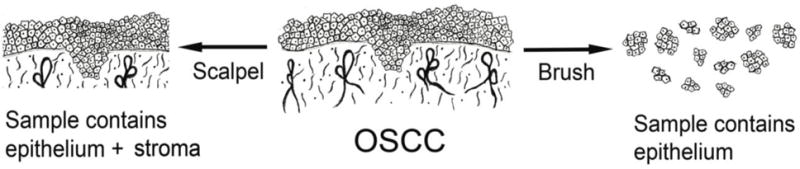
RNA-based diagnosis and prognosis of squamous cell carcinoma has been slow to come to the clinic. Improvements in RNA measurement, statistical evaluation, and sample preservation, along with increased sample numbers, have not made these methods reproducible enough to be used clinically. We propose that, in the case of squamous cell carcinoma of the oral cavity, a chief source of variability is sample dissection, which leads to variable amounts of stroma mixed in with tumor epithelium. This heterogeneity of the samples, which requires great care to avoid, makes it difficult to see changes in RNA levels specific to tumor cells. An evaluation of the data suggests that, paradoxically, brush biopsy samples of oral lesions may provide a more reproducible method than surgical acquisition of samples for miRNA measurement. The evidence also indicates that body fluid samples can show similar changes in miRNAs with oral squamous cell carcinoma (OSCC) as those seen in tumor brush biopsy samples - suggesting much of the miRNA in these samples is coming from the same source: tumor epithelium. We conclude that brush biopsy or body fluid samples may be superior to surgical samples in allowing miRNA-based diagnosis and prognosis of OSCC in that they feature a rapid method to obtain homogeneous tumor cells and/or RNA.
Keywords: Body fluid; Brush biopsy; Cancer detection; Head and neck cancer; Prognosis; RNA; Saliva; Tumor markers; miRNA.
Copyright © 2017 Elsevier Ltd. All rights reserved.
Conflict of interest statement
Conflict of Interest
None of the authors have a financial conflict of interest to report. Though we note some of the work cited in this review article, which was done by G. Adami, was funded by a subaward to the University of Illinois at Chicago from a National Science Foundation STTR grant awarded to Arphion Ltd for 2014.
Figures
References
-
- Choi P, Chen C. Genetic expression profiles and biologic pathway alterations in head and neck squamous cell carcinoma. Cancer. 2005;104:1113–28. - PubMed
-
- Lee JJ, Hung HC, Cheng SJ, Chiang CP, Liu BY, Yu CH, et al. Factors associated with underdiagnosis from incisional biopsy of oral leukoplakic lesions. Oral Surg Oral Med Oral Pathol Oral Radiol Endod. 2007;104:217–25. - PubMed
-
- Mendez E, Cheng C, Farwell DG, Ricks S, Agoff SN, Futran ND, et al. Transcriptional expression profiles of oral squamous cell carcinomas. Cancer. 2002;95:1482–94. - PubMed
Publication types
MeSH terms
Substances
Grants and funding
LinkOut - more resources
Full Text Sources
Other Literature Sources
Medical
