


Historical climate controls soil respiration responses to current soil moisture
- PMID: 28559315
- PMCID: PMC5474806
- DOI: 10.1073/pnas.1620811114
Historical climate controls soil respiration responses to current soil moisture
Abstract
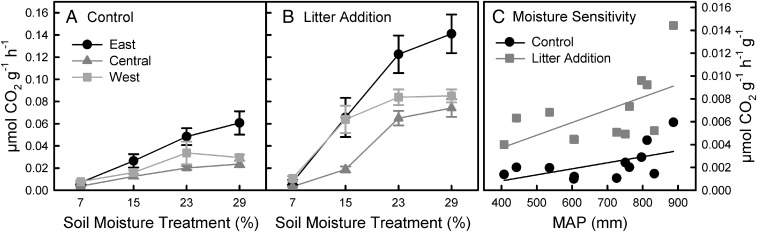
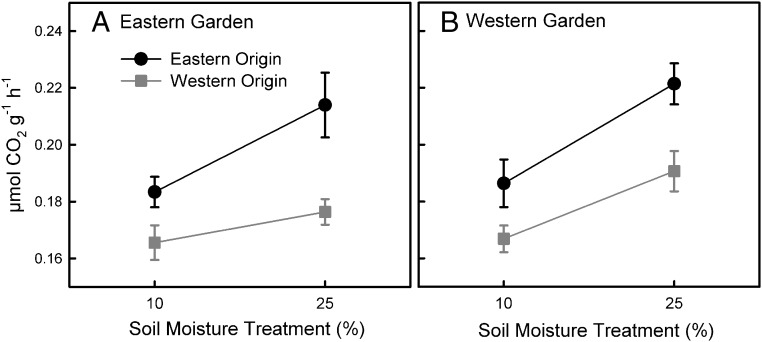
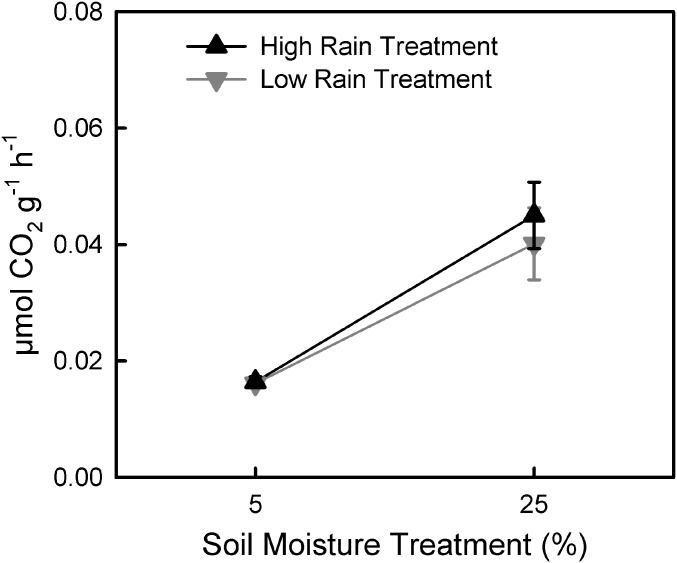
Ecosystem carbon losses from soil microbial respiration are a key component of global carbon cycling, resulting in the transfer of 40-70 Pg carbon from soil to the atmosphere each year. Because these microbial processes can feed back to climate change, understanding respiration responses to environmental factors is necessary for improved projections. We focus on respiration responses to soil moisture, which remain unresolved in ecosystem models. A common assumption of large-scale models is that soil microorganisms respond to moisture in the same way, regardless of location or climate. Here, we show that soil respiration is constrained by historical climate. We find that historical rainfall controls both the moisture dependence and sensitivity of respiration. Moisture sensitivity, defined as the slope of respiration vs. moisture, increased fourfold across a 480-mm rainfall gradient, resulting in twofold greater carbon loss on average in historically wetter soils compared with historically drier soils. The respiration-moisture relationship was resistant to environmental change in field common gardens and field rainfall manipulations, supporting a persistent effect of historical climate on microbial respiration. Based on these results, predicting future carbon cycling with climate change will require an understanding of the spatial variation and temporal lags in microbial responses created by historical rainfall.
Keywords: climate change; legacies; microbial; precipitation.
Conflict of interest statement
The authors declare no conflict of interest.
Figures
References
-
- Hawkes CV, Keitt TH. Resilience vs. historical contingency in microbial responses to environmental change. Ecol Lett. 2015;18:612–625. - PubMed
-
- Wieder WR, Bonan GB, Allison SD. Global soil carbon projections are improved by modelling microbial processes. Nat Clim Chang. 2013;3:909–912.
-
- Karhu K, et al. Temperature sensitivity of soil respiration rates enhanced by microbial community response. Nature. 2014;513:81–84. - PubMed
-
- Manzoni S, Taylor P, Richter A, Porporato A, Ågren GI. Environmental and stoichiometric controls on microbial carbon-use efficiency in soils. New Phytol. 2012;196:79–91. - PubMed
-
- Henry HAL. Soil extracellular enzyme dynamics in a changing climate. Soil Biol Biochem. 2012;47:53–59.
Publication types
MeSH terms
Substances
LinkOut - more resources
Full Text Sources
Other Literature Sources
Medical
