


Prevalence, Correlates, and Prognosis of Healthy Vascular Aging in a Western Community-Dwelling Cohort: The Framingham Heart Study
- PMID: 28559398
- PMCID: PMC5509504
- DOI: 10.1161/HYPERTENSIONAHA.117.09026
Prevalence, Correlates, and Prognosis of Healthy Vascular Aging in a Western Community-Dwelling Cohort: The Framingham Heart Study
Abstract
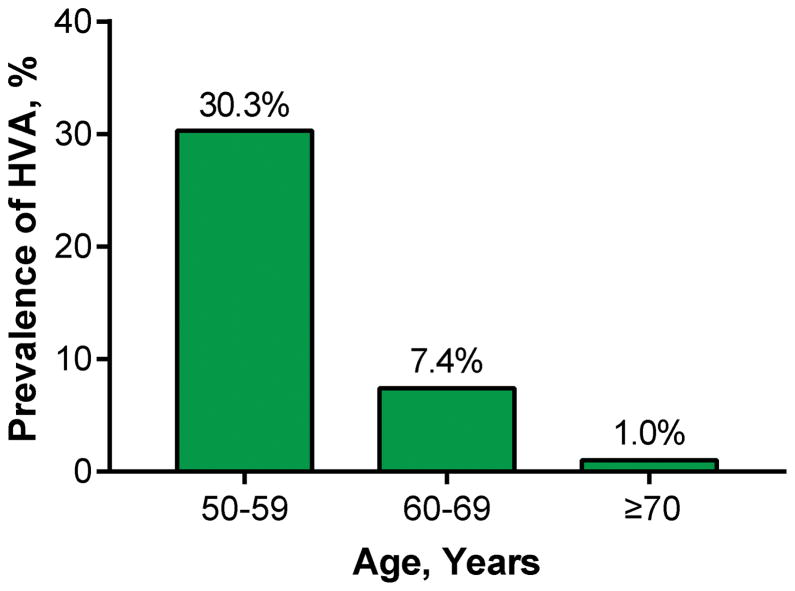
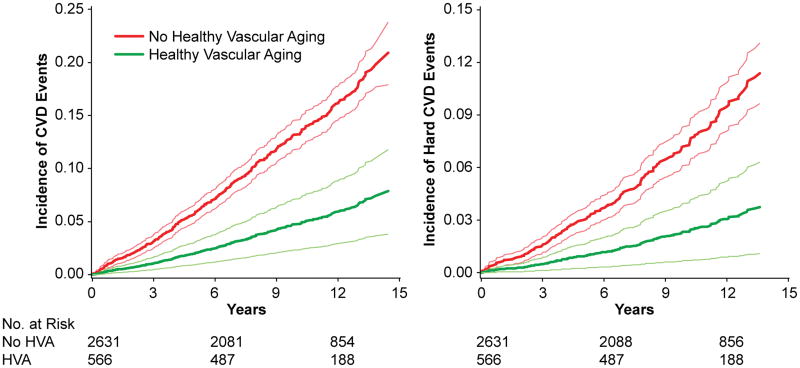
Hypertension and increased vascular stiffness are viewed as inevitable parts of aging. To elucidate whether the age-related decrease in vascular function is avoidable, we assessed the prevalence, correlates, and prognosis of healthy vascular aging (HVA) in 3196 Framingham Study participants aged ≥50 years. We defined HVA as absence of hypertension and pulse wave velocity <7.6 m/s (mean+2 SD of a reference sample aged <30 years). Overall, 566 (17.7%) individuals had HVA, with prevalence decreasing from 30.3% in people aged 50 to 59 to 1% in those aged ≥70 years. In regression models adjusted for physical activity, caloric intake, and traditional cardiovascular disease (CVD) risk factors, we observed that lower age, female sex, lower body mass index, use of lipid-lowering drugs, and absence of diabetes mellitus were cross-sectionally associated with HVA (P<0.001 for all). A unit increase in a cardiovascular health score (Life's Simple 7) was associated with 1.55-fold (95% confidence interval, 1.38-1.74) age- and sex-adjusted odds of HVA. During a follow-up of 9.6 years, 391 CVD events occurred. In Cox regression models adjusted for traditional CVD risk factors, including blood pressure, HVA was associated with a hazard ratio of 0.45 (95% confidence interval, 0.26-0.77) for CVD relative to absence of HVA. Although HVA is achievable in individuals acculturated to a Western lifestyle, maintaining normal vascular function beyond 70 years of age is challenging. Although our data are observational, our findings support prevention strategies targeting modifiable factors and behaviors and obesity, in particular, to prevent or delay vascular aging and the associated risk of CVD.
Keywords: aging; blood pressure; epidemiology; hypertension; vascular stiffness.
© 2017 American Heart Association, Inc.
Figures
Comment in
-
Healthy Vascular Aging.Hypertension. 2017 Aug;70(2):229-231. doi: 10.1161/HYPERTENSIONAHA.117.09122. Epub 2017 May 30. Hypertension. 2017. PMID: 28559393 No abstract available.
References
-
- SHEP Cooperative Research Group. Prevention of stroke by antihypertensive drug treatment in older persons with isolated systolic hypertension. Final results of the Systolic Hypertension in the Elderly Program (SHEP) JAMA. 1991;265:3255–3264. - PubMed
-
- Staessen JA, Fagard R, Thijs L, et al. Randomised double-blind comparison of placebo and active treatment for older patients with isolated systolic hypertension. The Systolic Hypertension in Europe (Syst-Eur) Trial Investigators. Lancet. 1997;350:757–764. - PubMed
-
- Beckett NS, Peters R, Fletcher AE, et al. Treatment of hypertension in patients 80 years of age or older. N Engl J Med. 2008;358:1887–1898. - PubMed
-
- Vasan RS, Beiser A, Seshadri S, Larson MG, Kannel WB, D’Agostino RB, Levy D. Residual lifetime risk for developing hypertension in middle-aged women and men: The Framingham Heart Study. JAMA. 2002;287:1003–1010. - PubMed
-
- Oliver WJ, Cohen EL, Neel JV. Blood pressure, sodium intake, and sodium related hormones in the Yanomamo Indians, a “no-salt” culture. Circulation. 1975;52:146–151. - PubMed
Publication types
MeSH terms
Substances
Grants and funding
LinkOut - more resources
Full Text Sources
Other Literature Sources
Medical
