. 2017 May 30;8(3):e00526-17.
doi: 10.1128/mBio.00526-17.

Finding the Needle in the Haystack-the Use of Microfluidic Droplet Technology to Identify Vitamin-Secreting Lactic Acid Bacteria

Affiliations

Finding the Needle in the Haystack-the Use of Microfluidic Droplet Technology to Identify Vitamin-Secreting Lactic Acid Bacteria

Jun Chen et al. mBio. .

Abstract

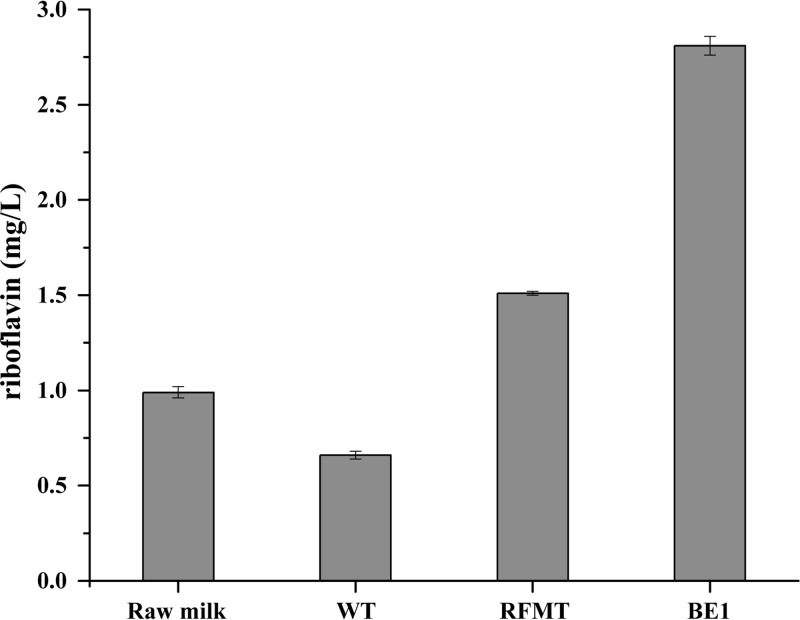
Efficient screening technologies aim to reduce both the time and the cost required for identifying rare mutants possessing a phenotype of interest in a mutagenized population. In this study, we combined a mild mutagenesis strategy with high-throughput screening based on microfluidic droplet technology to identify Lactococcus lactis variants secreting vitamin B2 (riboflavin). Initially, we used a roseoflavin-resistant mutant of L. lactis strain MG1363, JC017, which secreted low levels of riboflavin. By using fluorescence-activated droplet sorting, several mutants that secreted riboflavin more efficiently than JC017 were readily isolated from the mutagenesis library. The screening was highly efficient, and candidates with as few as 1.6 mutations per million base pairs (Mbp) were isolated. The genetic characterization revealed that riboflavin production was triggered by mutations inhibiting purine biosynthesis, which is surprising since the purine nucleotide GTP is a riboflavin precursor. Purine starvation in the mutants induced overexpression of the riboflavin biosynthesis cluster ribABGH When the purine starvation was relieved by purine supplementation in the growth medium, the outcome was an immediate downregulation of the riboflavin biosynthesis cluster and a reduction in riboflavin production. Finally, by applying the new isolates in milk fermentation, the riboflavin content of milk (0.99 mg/liter) was improved to 2.81 mg/liter, compared with 0.66 mg/liter and 1.51 mg/liter by using the wild-type strain and the original roseoflavin-resistant mutant JC017, respectively. The results obtained demonstrate how powerful classical mutagenesis can be when combined with droplet-based microfluidic screening technology for obtaining microorganisms with useful attributes.IMPORTANCE The food industry prefers to use classical approaches, e.g., random mutagenesis followed by screening, to improve microorganisms used in food production, as the use of recombinant DNA technologies is still not widely accepted. Although modern automated screening platforms are widely accessible, screening remains as a bottleneck in strain development, especially when a mild mutagenesis approach is applied to reduce the chance of accumulating unintended mutations, which may cause unwanted phenotypic changes. Here, we incorporate a droplet-based high-throughput screening method into the strain development process and readily capture L. lactis variants with more efficient vitamin secretion from low-error-rate mutagenesis libraries. This study shows that useful mutants showing strong phenotypes but without extensive mutations can be identified with efficient screening technologies. It is therefore possible to avoid accumulating detrimental mutations while enriching beneficial ones through iterative mutagenesis screening. Due to the low mutation rates, the genetic determinants are also readily identified.

Keywords: classical mutagenesis; droplet microfluidics; high-throughput screening; lactic acid bacteria; vitamin B2.


Figures

FIG 1
FIG 1
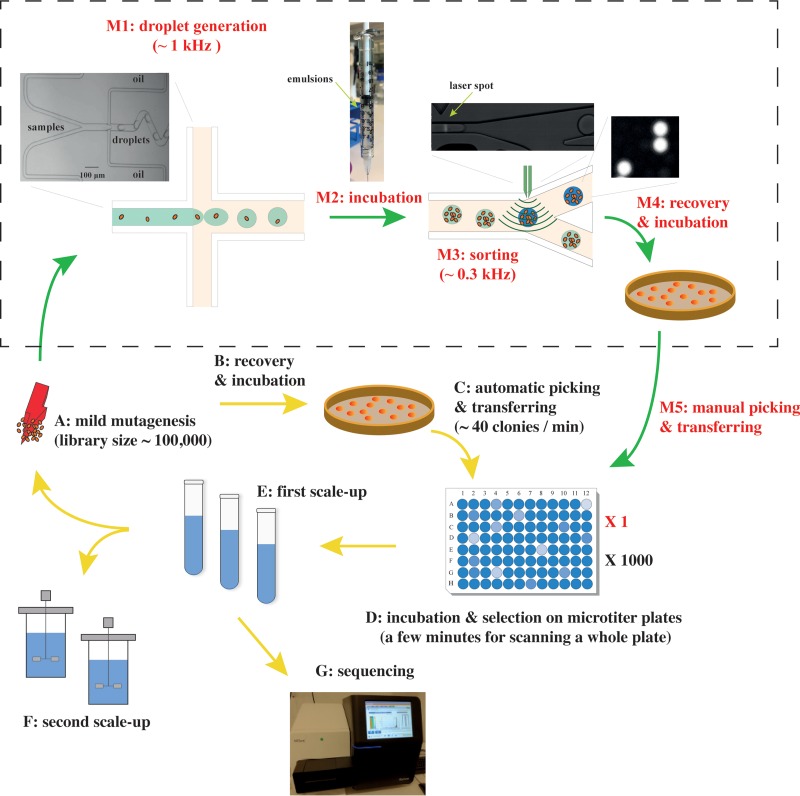
Incorporation of the droplet-based microfluidic screening toolbox into the classical strain development process based on random mutagenesis and microplate screening. Steps A to G represent the classical protocol, and the microfluidic toolbox (M1 to M5) is inserted between steps A and D. (A) Mutagenesis is induced by physical and chemical mutagens, such as UV and EMS. Mutation frequency is controlled by either the dosage used or the reaction time. (B) Prior to being selected by robots, well-separated colonies should have formed on agar plates. (C) Assuming that the automatic selection and transfer rate is 40 clones/minute (5), the process is completed in approximately 40 h for a library containing 100,000 clones. (D) One thousand 96-well microplates are required in the protocol that does not use the microfluidic toolbox. (M1 and M3) notably, if a Poisson distribution λ of 0.5 (60% empty droplets) is applied, the true rates for the generation and sorting of cell-loaded droplets are 60% lower. (M2) The conditions for incubation are the same as in steps B and M4. In this study, a 24-h incubation at 30°C is typically required for L. lactis. (M4) Cells in droplets are released by the addition of PFOH (1H,1H,2H,2H-perfluorooctan-1-ol). (M5) Due to the efficient enrichment (2,000-fold) using microfluidic screening, fewer than 90 clones are selected for the secondary screening in 96-well microplates.
FIG 2
FIG 2
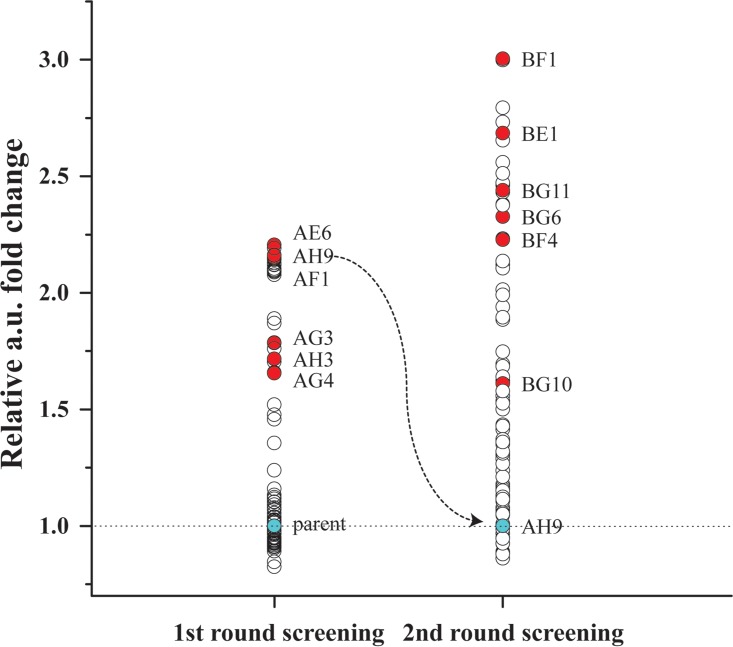
Secondary screening of riboflavin overproducers. Secondary screening of riboflavin production by the captured library was performed in 96-well plates using fluorometric assays. The parent strain JC017 and the mutant strain AH9 (blue-filled circles) were selected as the basal strains for the two rounds of mutagenesis and microfluidic screening. The relative titers of riboflavin are depicted in arbitrary units (a.u.). A few representative strains (red-filled circles) were selected for further characterization in test tubes, and their true riboflavin titers were determined using HPLC analysis (see Fig. S2 in the supplemental material).
FIG 3
FIG 3
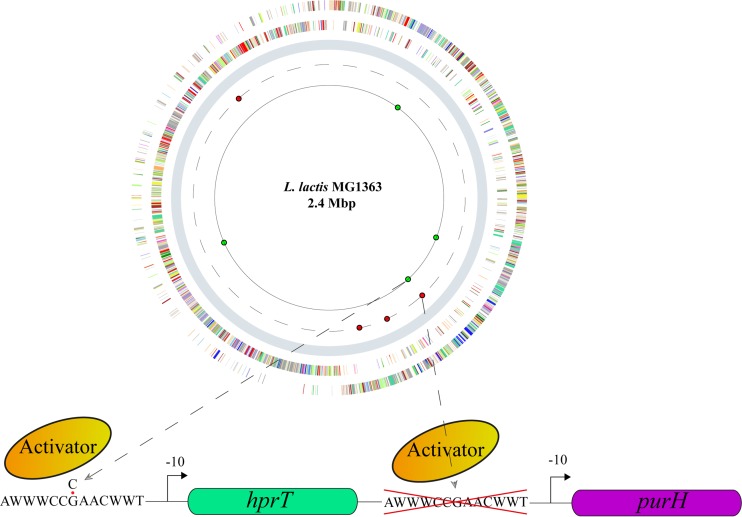
Distribution of variations in the mutants. The dashed and lined circles represent the chromosomes of the mutants AH9 and BE1, respectively. The locations of the mutations identified in AH9 are labeled with red-filled circles. The additional mutations identified in BE1 compared to AH9 are labeled with green-filled circles. A detailed list of mutations is presented in Table S1 in the supplemental material. The purH gene is transcribed either from its own promoter or through an operon with hprT.
FIG 4
FIG 4
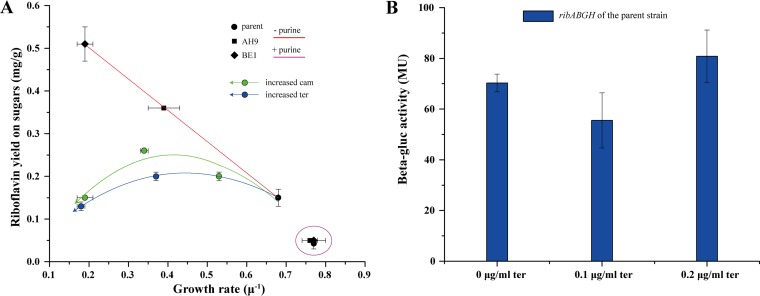
Effects of purine metabolism and growth rate on riboflavin production. (A) Effects of purine metabolism and growth rate on riboflavin yield. Ter, tetracycline; Cam, chloramphenicol. (B) Effect of inhibiting anabolism on the expression of the riboflavin synthesis cluster in the parent strain JC017. The data are the average results and standard deviations from two independent experiments. Error bars show standard deviations.
FIG 5
FIG 5
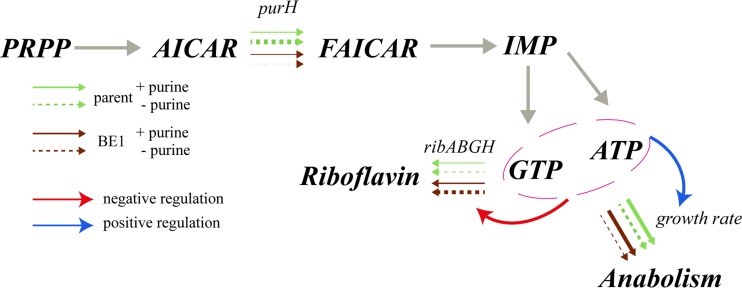
Pleiotropic effects of the purH-related mutations on riboflavin synthesis and anabolism. The line widths of the arrows (green and brown) represent the relative expression levels of purH and ribABGH. Differences in anabolism are indicated by the relative growth rates. The data presented for purH were summed from the results for purH and the hprT-purH fusion. Detailed expression data are presented in Fig. S3 in the supplemental material. + purine, 200 mg/liter guanosine was added; PRPP, phosphoribosyl pyrophosphate; AICAR, 5-aminoimidazole-4-carboxamide ribonucleotide; FAICAR, 5-formamidoimidazole-4-carboxamide ribotide.
FIG 6
FIG 6
Riboflavin content of milk after fermentation by different strains. WT, L. lactis MG1363; RFMT, the parent strain JC017 derived from MG1363 by roseoflavin selection. The data are the averages and standard deviations from three biologically independent replications. Error bars show standard deviations.

References

    1. Stephanopoulos G, Aristidou AA, Nielsen J. 1998. Metabolic engineering: principles and methodologies. Academic Press, New York, NY.
    1. Derkx PMF, Janzen T, Sørensen KI, Christensen JE, Stuer-Lauridsen B, Johansen E. 2014. The art of strain improvement of industrial lactic acid bacteria without the use of recombinant DNA technology. Microb Cell Fact 13(Suppl 1):S5. doi: 10.1186/1475-2859-13-S1-S5. - DOI - PMC - PubMed
    1. Bates H, Randall SK, Rayssiguier C, Bridges BA, Goodman MF, Radman M. 1989. Spontaneous and UV-induced mutations in Escherichia coli K-12 strains with altered or absent DNA polymerase I. J Bacteriol 171:2480–2484. doi: 10.1128/jb.171.5.2480-2484.1989. - DOI - PMC - PubMed
    1. Dove A. 2003. Screening for content—the evolution of high throughput. Nat Biotechnol 21:859–864. doi: 10.1038/nbt0803-859. - DOI - PubMed
    1. Johansen E, Øregaard G, Sørensen KI, Derkx PMF. 2015. Modern approaches for isolation, selection, and improvement of bacterial strains for fermentation applications, p 227–248. In Holzapfel W (ed), Advances in fermented foods and beverages: improving quality, technologies and health benefits. A volume in Woodhead Publishing Series in Food Science, Technology and Nutrition. Woodhead Publishing, Cambridge, United Kingdom. doi: 10.1016/B978-1-78242-015-6.00010-4. - DOI

LinkOut - more resources