. 2017 May 24:5:e3300.
doi: 10.7717/peerj.3300. eCollection 2017.

Eumelanin and pheomelanin are predominant pigments in bumblebee (Apidae: Bombus) pubescence

Affiliations

Eumelanin and pheomelanin are predominant pigments in bumblebee (Apidae: Bombus) pubescence

Carlo Polidori et al. PeerJ. .

Abstract

Background: Bumblebees (Hymenoptera: Apidae: Bombus) are well known for their important inter- and intra-specific variation in hair (or pubescence) color patterns, but the chemical nature of the pigments associated with these patterns is not fully understood. For example, though melanization is believed to provide darker colors, it still unknown which types of melanin are responsible for each color, and no conclusive data are available for the lighter colors, including white.

Methods: By using dispersive Raman spectroscopy analysis on 12 species/subspecies of bumblebees from seven subgenera, we tested the hypothesis that eumelanin and pheomelanin, the two main melanin types occurring in animals, are largely responsible for bumblebee pubescence coloration.

Results: Eumelanin and pheomelanin occur in bumblebee pubescence. Black pigmentation is due to prevalent eumelanin, with visible signals of additional pheomelanin, while the yellow, orange, red and brown hairs clearly include pheomelanin. On the other hand, white hairs reward very weak Raman signals, suggesting that they are depigmented. Additional non-melanic pigments in yellow hair cannot be excluded but need other techniques to be detected. Raman spectra were more similar across similarly colored hairs, with no apparent effect of phylogeny and both melanin types appeared to be already used at the beginning of bumblebee radiation.

Discussion: We suggest that the two main melanin forms, at variable amounts and/or vibrational states, are sufficient in giving almost the whole color range of bumblebee pubescence, allowing these insects to use a single precursor instead of synthesizing a variety of chemically different pigments. This would agree with commonly seen color interchanges between body segments across Bombus species.

Keywords: Bombus; Depigmentation; Eumelanin; Hymenoptera; Phenotype; Pheomelanin; Pigmentation; Pubescence; Raman spectroscopy.


Conflict of interest statement

The authors declare that they have no competing interests.

Figures
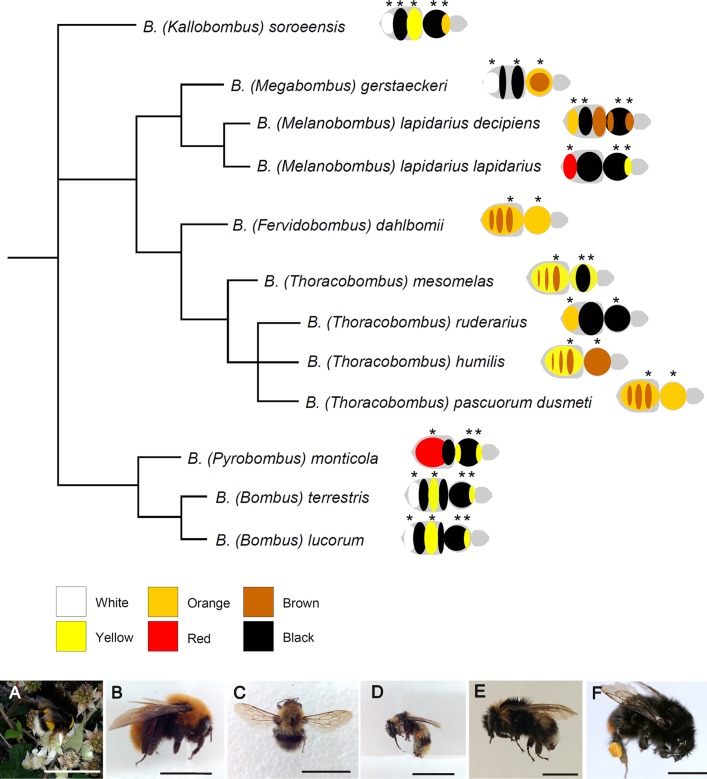
Figure 1
Figure 1. Phylogenetic relationships among the studied species of Bombus, hand-drawn starting from the results published in Cameron, Hines & Williams, 2007.
Close to each species/subspecies one finds the simplified color pattern of the pubescence, as observed in the studied individuals; the analyzed areas are indicated by asterisks. The range of colors and corresponding nomenclature is shown below the tree. Representative pictures of some of the studied species/subspecies are at the bottom of the figure: (A) Bombus terrestris; (B) Bombus dahlbomii; (C) Bombus gerstaerckeri; (D) Bombus lapidarius decipiens; (E) Bombus soroeensis; (F) Bombus lapidarius lapidarius (bar = 1 cm).
Figure 2
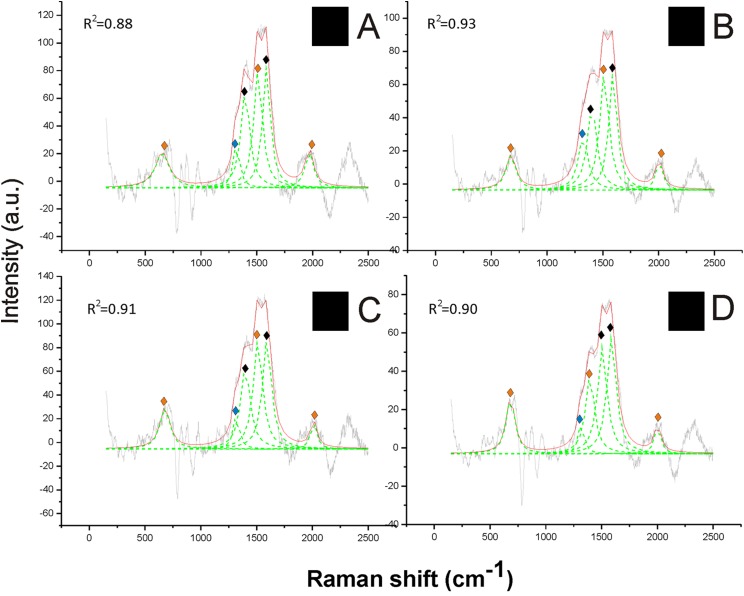
Figure 2. Examples of Raman spectra of black hair in Bombus and peak identification after having applied the reference deconvolution method.
The gray line represents the Raman spectrum, the dashed green lines represent the single deconvoluted curves, which highlight the different peaks contributing to the spectrum, and the red line represents the sum of the deconvoluted curves (i.e., the adjustment to the spectrum, whose goodness of fit expressed as R2 value). ♦ Signature peaks for eumelanin, formula image signature peaks for pheomelanin, formula image signature peaks for chitin. (A) Thorax of Bombus lucorum; (B) thorax of Bombus monticola; (C) abdomen of Bombus soroeensis; (D) thorax of Bombus terrestris.
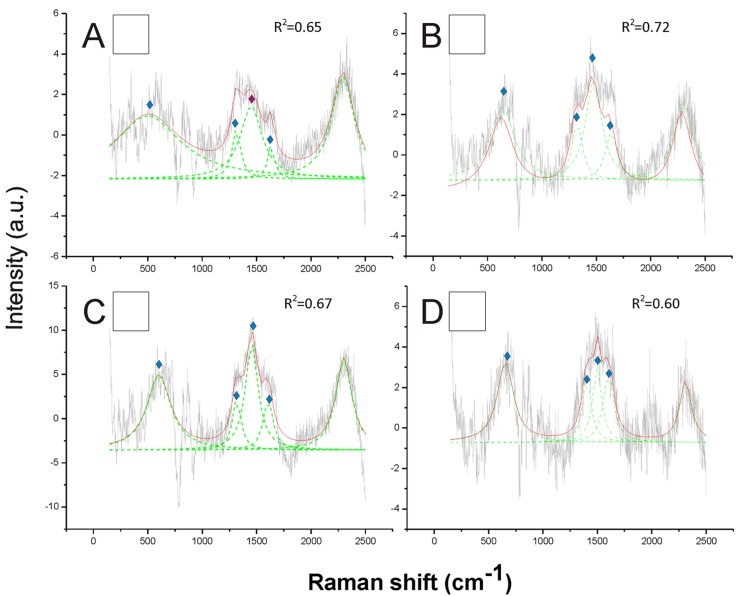
Figure 3
Figure 3. Examples of Raman spectra of white hair, and of hairless thorax ventral side cuticle, in Bombus, and peak identification after having applied the reference deconvolution method.
The gray line represents the Raman spectrum, the dashed green lines represent the single deconvoluted curves, which highlight the different peaks contributing to the spectrum, and the red line represents the sum of the deconvoluted curves (i.e., the adjustment to the spectrum, whose goodness of fit expressed as R2 value). formula image Signature peaks for chitin, formula image signature peaks for N-acetyl-d-glucosamine. (A) abdomen of Bombus lucorum; (B) abdomen of Bombus terrestris; (C) abdomen of Bombus soroeensis; (D) abdomen of Bombus gerstaeckeri. Note that no melanin peaks and overall very low intensity signal were detected in white hair.
Figure 4
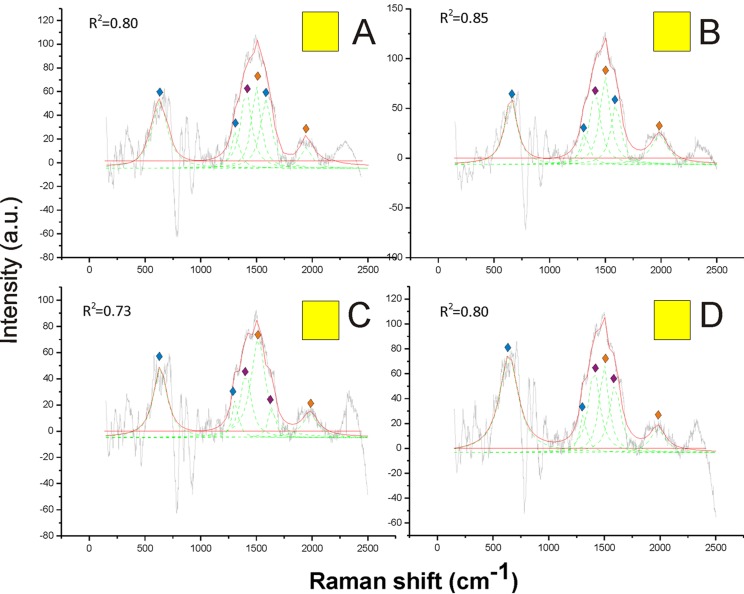
Figure 4. Examples of Raman spectra of yellow hair in Bombus, and peak identification after having applied the reference deconvolution method.
The gray line represents the Raman spectrum, the dashed green lines represent the single deconvoluted curves, which highlight the different peaks contributing to the spectrum, and the red line represents the sum of the deconvoluted curves (i.e., the adjustment to the spectrum, whose goodness of fit expressed as R2 value). formula image Signature peaks for pheomelanin, formula image signature peaks for chitin, formula image signature peaks for N-acetyl-d-glucosamine. (A) Abdomen of Bombus soroeensis; (B) abdomen of Bombus terrestris; (C) thorax of Bombus lucorum; (D) thorax of Bombus monticola.
Figure 5
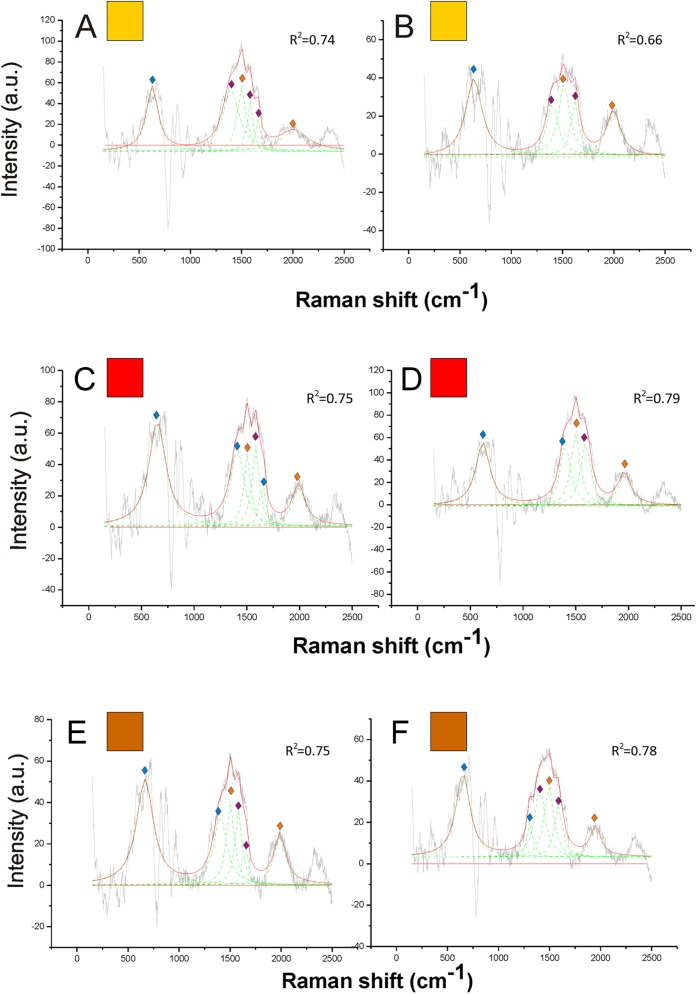
Figure 5. Examples of Raman spectra of orange, red and brown hair in Bombus, and peak identification after having applied the reference deconvolution method.
The gray line represents the Raman spectrum, the dashed green lines represent the single deconvoluted curves, which highlight the different peaks contributing to the spectrum, and the red line represents the sum of the deconvoluted curves (i.e., the adjustment to the spectrum, whose goodness of fit expressed as R2 value). formula image Signature peaks for pheomelanin, formula image signature peaks for chitin, formula image signature peaks for N-acetyl-d-glucosamine. (A) Orange hair on the abdomen of Bombus mesomelas; (B) orange hair on the thorax of Bombus dahlbomii; (C) red hair on the abdomen of Bombus lapidarius lapidarius; (D) red hair on the abdomen of Bombus monticola; (E) brown hair on the abdomen of Bombus pascuorum dusmeti; (F) brown hair on the thorax of Bombus humilis.
Figure 6
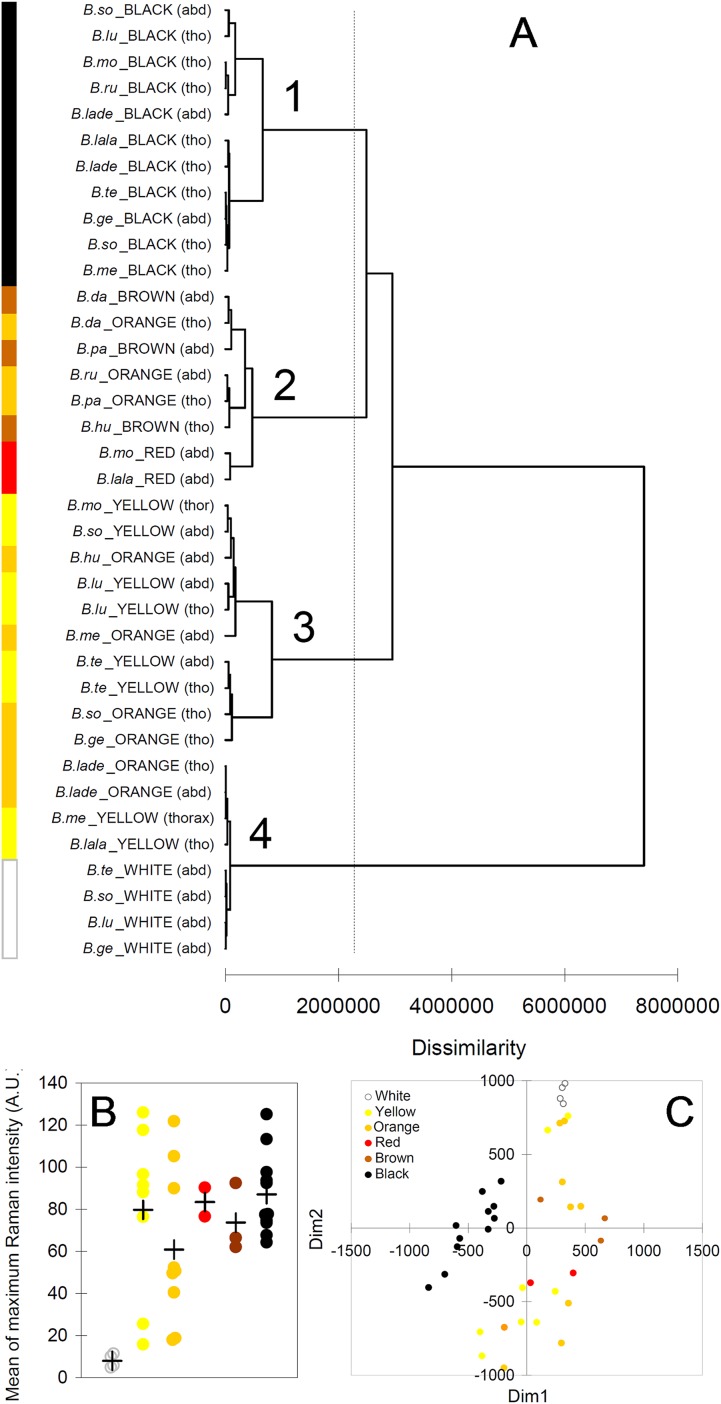
Figure 6. Results from multivariate analyses.
(A) Dendrogram obtained from the agglomerative hierarchical clustering (dashed vertical line represents the dissimilarity value which discriminates the major different clusters); (B) relationship between colors and maximum intensity signals in the Raman spectra (+ symbols identify mean values across species/color/body part); (C) multi-dimensional scaling plot, based on the mean values of each peak across individuals of each species/color/body part. Species abbreviations in (A): B.so, Bombus soroeensis; B.lu, Bombus lucorum; B.mo, Bombus monticola; B.ru, Bombus ruderarius; B.lade, Bombus lapidarius decipiens; B.lala, Bombus lapidarius lapidarius; B.te, Bombus terrestris; B.ge, Bombus gerstaerckeri; B.me, Bombus mesomelas; B.da, Bombus dahlbomii; B.pa, Bombus pascuorum dusmeti; B.hu, Bombus humilis.

References

    1. Babiy PP. Neues zum Hummelproblem. Zeitschrift für wissenschaftliche Zoologie, Liepzig. 1925;125:502–512.
    1. Bennett ATD, Thery M. Avian color vision and coloration: multidisciplinary evolutionary biology. American Naturalist. 2007;169(1):S1–S6. doi: 10.1086/510163. - DOI
    1. Borg I, Groenen PJF. Modern Multidimensional Scaling: Theory and Applications. Second Edition. New York: Springer; 2005.
    1. Brenner M, Hearing VJ. The protective role of melanin against UV damage in human skin. Photochemistry and Photobiology. 2008;84(3):539–549. doi: 10.1111/j.1751-1097.2007.00226.x. - DOI - PMC - PubMed
    1. Cameron SA, Hines HM, Williams PH. A comprehensive phylogeny of the bumble bees (Bombus) Biological Journal of the Linnean Society. 2007;91(1):161–188. doi: 10.1111/j.1095-8312.2007.00784.x. - DOI