Cyclical nursing patterns in wild orangutans
- PMID: 28560319
- PMCID: PMC5435413
- DOI: 10.1126/sciadv.1601517
Cyclical nursing patterns in wild orangutans
Abstract
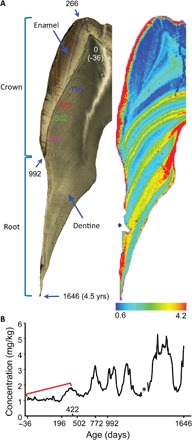
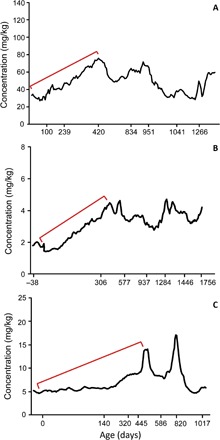
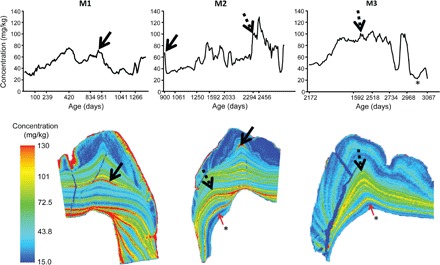
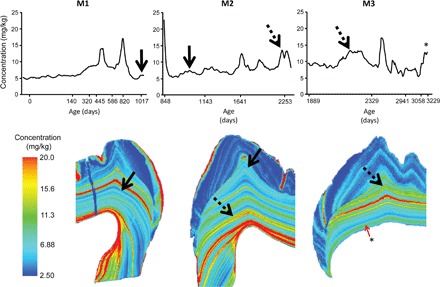
Nursing behavior is notoriously difficult to study in arboreal primates, particularly when offspring suckle inconspicuously in nests. Orangutans have the most prolonged nursing period of any mammal, with the cessation of suckling (weaning) estimated to occur at 6 to 8 years of age in the wild. Milk consumption is hypothesized to be relatively constant over this period, but direct evidence is limited. We previously demonstrated that trace element analysis of bioavailable elements from milk, such as barium, provides accurate estimates of early-life diet transitions and developmental stress when coupled with growth lines in the teeth of humans and nonhuman primates. We provide the first detailed nursing histories of wild, unprovisioned orangutans (Pongo abelii and Pongo pygmaeus) using chemical and histological analyses. Laser ablation inductively coupled plasma mass spectrometry was used to determine barium distributions across the teeth of four wild-shot individuals aged from postnatal biological rhythms. Barium levels rose during the first year of life in all individuals and began to decline shortly after, consistent with behavioral observations of intensive nursing followed by solid food supplementation. Subsequent barium levels show large sustained fluctuations on an approximately annual basis. These patterns appear to be due to cycles of varying milk consumption, continuing until death in an 8.8-year-old Sumatran individual. A female Bornean orangutan ceased suckling at 8.1 years of age. These individuals exceed the maximum weaning age reported for any nonhuman primate. Orangutan nursing may reflect cycles of infant demand that relate to fluctuating resource availability.
Keywords: Seasonality; barium; life history; non-human primates; nursing; orangutan; weaning.
Figures
References
-
- Lee P. C., Majluf P., Gordon I. J., Growth, weaning and maternal investment from a comparative perspective. J. Zool. 225, 99–114 (1991).
-
- Pontzer H., Brown M. H., Raichlen D. A., Dunsworth H., Hare B., Walker K., Luke A., Dugas L. R., Durazo-Arvizu R., Schoeller D., Plange-Rhule J., Bovet P., Forrester T. E., Lambert E. V., Thompson M. E., Shumaker R. W., Ross S. R., Metabolic acceleration and the evolution of human brain size and life history. Nature 533, 390–392 (2016). - PMC - PubMed
-
- Wich S. A., Utami-Atmoko S. S., Setia T. M., Rijksen H. D., Schürmann C., van Hooff J. A. R. A. M., van Schaik C. P., Life history of wild Sumatran orangutans (Pongo abelii). J. Hum. Evol. 47, 385–398 (2004). - PubMed
-
- C. D. Knott, M. E. Thompson, S. A. Wich, in Orangutans: Geographic Variation in Behavioral Ecology and Conservation, S. A. Wich, S. S. Utami Atmoko, T. M. Setia, C. P. van Schaik, Eds. (Oxford Univ. Press, 2009), pp. 171–188.
MeSH terms
Substances
Grants and funding
LinkOut - more resources
Full Text Sources
Other Literature Sources