The timetable of evolution
- PMID: 28560344
- PMCID: PMC5435417
- DOI: 10.1126/sciadv.1603076
The timetable of evolution
Abstract
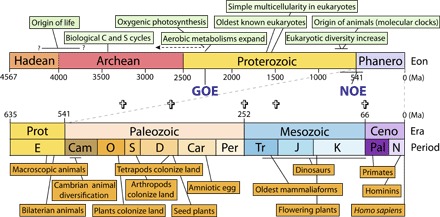
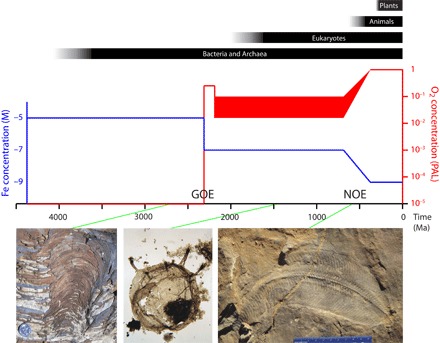
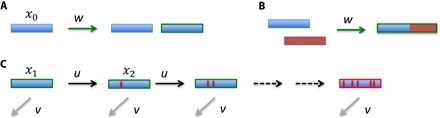
The integration of fossils, phylogeny, and geochronology has resulted in an increasingly well-resolved timetable of evolution. Life appears to have taken root before the earliest known minimally metamorphosed sedimentary rocks were deposited, but for a billion years or more, evolution played out beneath an essentially anoxic atmosphere. Oxygen concentrations in the atmosphere and surface oceans first rose in the Great Oxygenation Event (GOE) 2.4 billion years ago, and a second increase beginning in the later Neoproterozoic Era [Neoproterozoic Oxygenation Event (NOE)] established the redox profile of modern oceans. The GOE facilitated the emergence of eukaryotes, whereas the NOE is associated with large and complex multicellular organisms. Thus, the GOE and NOE are fundamental pacemakers for evolution. On the time scale of Earth's entire 4 billion-year history, the evolutionary dynamics of the planet's biosphere appears to be fast, and the pace of evolution is largely determined by physical changes of the planet. However, in Phanerozoic ecosystems, interactions between new functions enabled by the accumulation of characters in a complex regulatory environment and changing biological components of effective environments appear to have an important influence on the timing of evolutionary innovations. On the much shorter time scale of transient environmental perturbations, such as those associated with mass extinctions, rates of genetic accommodation may have been limiting for life.
Keywords: Earth history; evolution; evolutionary theory; geochronology.
Figures
References
-
- M. J. S. Rudwick, Earth’s Deep History; How It Was Discovered and Why It Matters (University of Chicago Press, 2014).
-
- Wyse Jackson P. N., John Joly (1857-1933) and his determinations of the age of the Earth. Geol. Soc. Lond. Spec. Publ. 190, 107–119 (2002).
-
- Davis D. W., Williams I. S., Krogh T. E., Historical development of zircon geochronology. Rev. Mineral. Geochem. 53, 145–181 (2013).
-
- Barghoorn E. S., Tyler S. A., Microorganisms from the Gunflint Chert. Science 147, 563–575 (1965). - PubMed
-
- Allsopp H. L., Roberts H. R., Schreiner G. D. L., Hunter D. R., Rb-Sr age measurements on various Swaziland granites. J. Geophys. Res. 67, 5307–5313 (1962).
Publication types
MeSH terms
LinkOut - more resources
Full Text Sources
Other Literature Sources