Increasing the revenue from lignocellulosic biomass: Maximizing feedstock utilization
- PMID: 28560350
- PMCID: PMC5438221
- DOI: 10.1126/sciadv.1603301
Increasing the revenue from lignocellulosic biomass: Maximizing feedstock utilization
Abstract
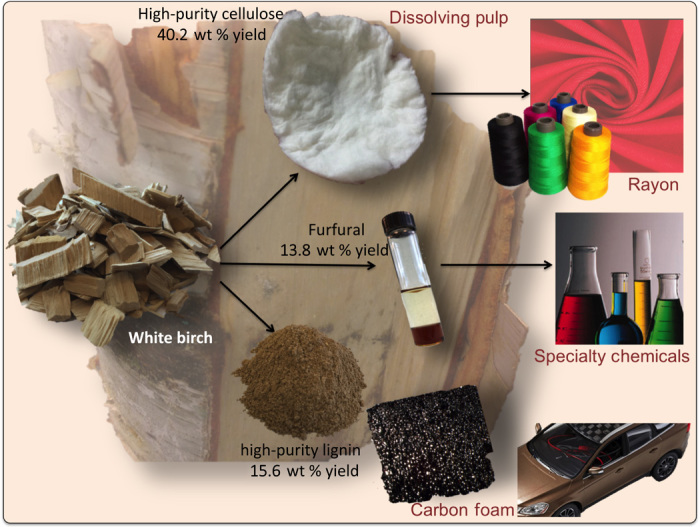
The production of renewable chemicals and biofuels must be cost- and performance- competitive with petroleum-derived equivalents to be widely accepted by markets and society. We propose a biomass conversion strategy that maximizes the conversion of lignocellulosic biomass (up to 80% of the biomass to useful products) into high-value products that can be commercialized, providing the opportunity for successful translation to an economically viable commercial process. Our fractionation method preserves the value of all three primary components: (i) cellulose, which is converted into dissolving pulp for fibers and chemicals production; (ii) hemicellulose, which is converted into furfural (a building block chemical); and (iii) lignin, which is converted into carbon products (carbon foam, fibers, or battery anodes), together producing revenues of more than $500 per dry metric ton of biomass. Once de-risked, our technology can be extended to produce other renewable chemicals and biofuels.
Keywords: biomass; cellulose; dissolving pulp; furfural; hemi-cellulose; lignin; viscose.
Figures
References
-
- Alonso D. M., Bond J. Q., Dumesic J. A., Catalytic conversion of biomass to biofuels. Green Chem. 12, 1493–1513 (2010).
-
- Ragauskas A. J., Williams C. K., Davison B. H., Britovsek G., Cairney J., Eckert C. A., Frederick W. J. Jr, Hallett J. P., Leak D. J., Liotta C. L., Mielenz J. R., Murphy R., Templer R., Tschaplinski T., The path forward for biofuels and biomaterials. Science 311, 484–489 (2006). - PubMed
-
- Ibrahim A. A., Nada A. M. A., Hagemann U., El Seoud O. A., Preparation of dissolving pulp from sugar cane bagasse, and its acetylation under homogeneous solution condition. Holzforschung 50, 221–225 (1996).
-
- K. J. Zeitsch, The Chemistry and Technology of Furfural and its Many By-Products (Elsevier, 2000).
-
- García-Negrón V., Phillip N. D., Li J., Daniel C., Wood D., Keffer D. J., Rios O., Harper D. P., Processing-structure-property relationships for lignin-based carbonaceous materials used in energy storage applications. Energy Technol. 10.1002/ente.201600646 (2017).
LinkOut - more resources
Full Text Sources
Other Literature Sources
Molecular Biology Databases