


Design of a TW-SLIM Module for Dual Polarity Confinement, Transport, and Reactions
- PMID: 28560562
- PMCID: PMC5551421
- DOI: 10.1007/s13361-017-1680-5
Design of a TW-SLIM Module for Dual Polarity Confinement, Transport, and Reactions
Abstract
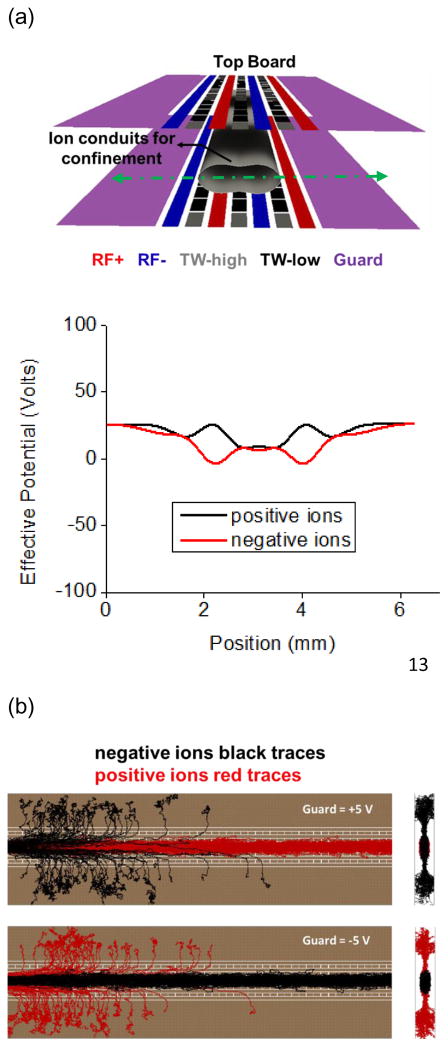
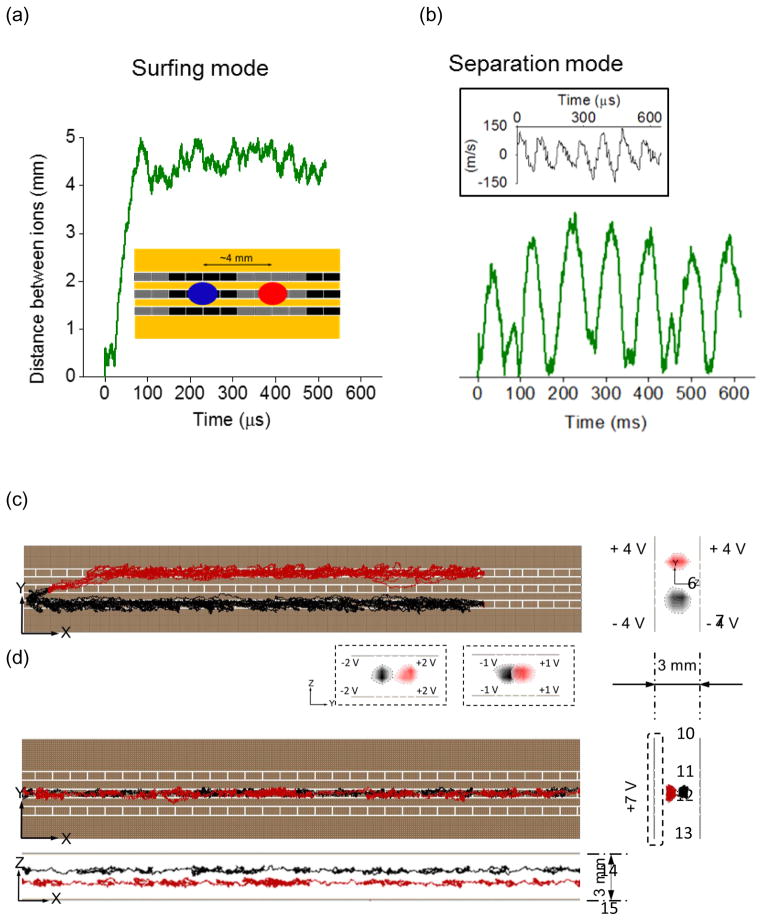
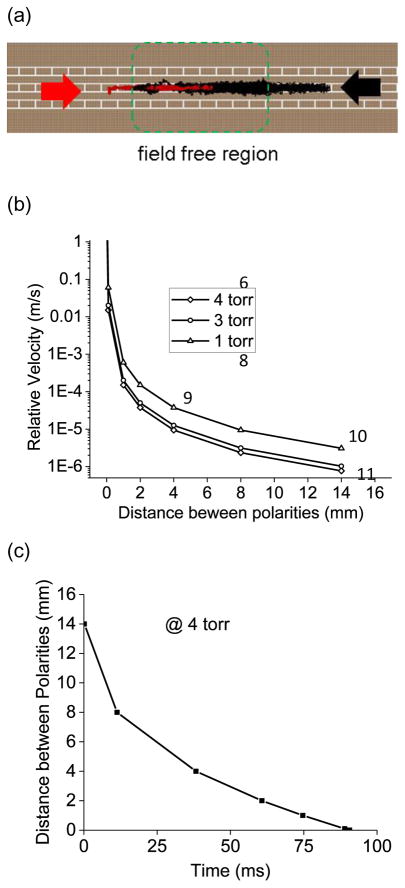
Here we describe instrumental approaches for performing dual polarity ion confinement, transport, ion mobility separations, and reactions in structures for lossless ion manipulations (SLIM). Previous means of ion confinement in SLIM, based upon rf-generated pseudopotentials and DC fields for lateral confinement, cannot trap ions of opposite polarity simultaneously. Here we explore alternative approaches to provide simultaneous lateral confinement of both ion polarities. Traveling wave ion mobility (IM) separations experienced in such SLIM cause ions of both polarities to migrate in the same directions and exhibit similar separations. The ion motion (and relative motion of the two polarities) under both surfing and IM separation conditions are discussed. In surfing conditions the two polarities are transported losslessly and non-reactively in their respective potential minima (higher absolute voltage regions confine negative polarities, and lower absolute potential regions are populated by positive polarities). In separation mode, where ions roll over an overtaking traveling wave, the two polarities can interact during the rollovers. Strategies to minimize overlap of the two ion populations to prevent reactive losses during separations are presented. A theoretical treatment of the time scales over which two populations (injected into a DC field-free region of the dual polarity SLIM device) interact is considered, and SLIM designs for allowing ion/ion interactions and other manipulations with dual polarities at 4 Torr are presented. Graphical Abstract ᅟ.
Keywords: Dual polarity; Ion mobility; Ion/ion reaction; SLIM; Traveling wave.
Figures


References
-
- Thomson JJ. Longmans, Green and Co; London: 1913.
-
- Osburn S, Ryzhov V. Ion–Molecule Reactions: Analytical and Structural Tool. Analytical Chemistry. 2013;85:769–778. - PubMed
-
- Gronert S, Li KH, Horiuchi M. Manipulating the fragmentation patterns of phosphopeptides via gas-phase boron derivatization: Determining phosphorylation sites in peptides with multiple serines. J Am Soc Mass Spectrom. 2005;16:1905–1914. - PubMed
-
- Gao H, Petzold CJ, Leavell MD, Leary JA. Investigation of ion/molecule reactions as a quantification method for phosphorylated positional isomers: An FT-ICR approach. J Am Soc Mass Spectrom. 2003;14:916–924. - PubMed
Grants and funding
LinkOut - more resources
Full Text Sources
Other Literature Sources
Research Materials
