


Long-term quality of life after definitive treatment for prostate cancer: patient-reported outcomes in the second posttreatment decade
- PMID: 28560840
- PMCID: PMC5504320
- DOI: 10.1002/cam4.1103
Long-term quality of life after definitive treatment for prostate cancer: patient-reported outcomes in the second posttreatment decade
Abstract
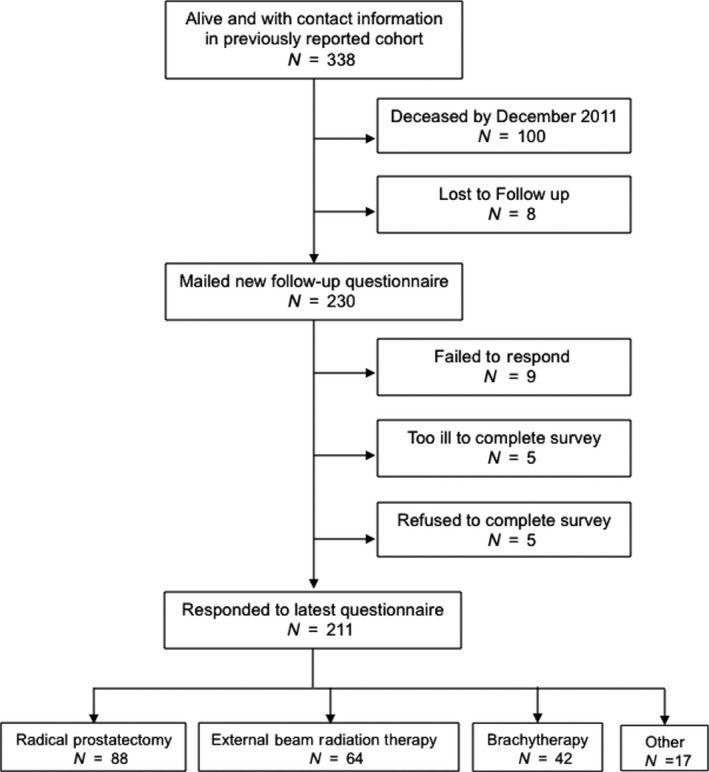
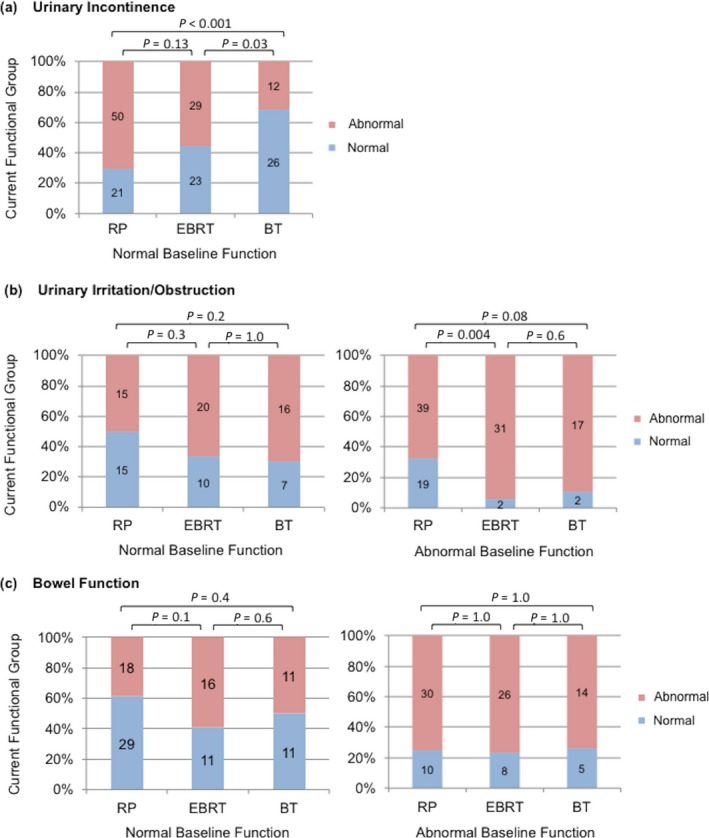
Definitive treatment for prostate cancer includes radical prostatectomy (RP), external beam radiation therapy (EBRT), and brachytherapy (BT). The different side effect profiles of these options are crucial factors for patients and clinicians when deciding between treatments. This study reports long-term health-related quality of life (HRQOL) for patients in their second decade after treatment for prostate cancer. We used a validated survey to assess urinary, bowel, and sexual function and HRQOL in a prospective cohort of patients diagnosed with localized prostate cancer 14-18 years previously. We report and compare the outcomes of patients who were initially treated with RP, EBRT, or BT. Of 230 eligible patients, the response rate was 92% (n = 211) and median follow-up was 14.6 years. Compared to baseline, RP patients had significantly worse urinary incontinence and sexual function, EBRT patients had worse scores in all domains, and BT patients had worse urinary incontinence, urinary irritation/obstruction, and sexual function. When comparing treatment groups, RP patients underwent larger declines in urinary continence than did BT patients, and EBRT and BT patients experienced larger changes in urinary irritation/obstruction. Baseline functional status was significantly associated with long-term function for urinary obstruction and bowel function domains. This is one of the few prospective reports on quality of life for prostate cancer patients beyond 10 years, and adds information about the late consequences of treatment choices. These data may help patients make informed decisions regarding treatment choice based on symptoms they may experience in the decades ahead.
Keywords: Long-term quality of life; Patient-reported outcomes; prostate cancer; treatment choice; treatment-related dysfunction.
© 2017 The Authors. Cancer Medicine published by John Wiley & Sons Ltd.
Figures
References
-
- Aizer, A. A. , Yu J. B., Colberg J. W., McKeon A. M., Decker R. H., and Peschel R. E.. 2009. Radical prostatectomy vs. intensity‐modulated radiation therapy in the management of localized prostate adenocarcinoma. Radiother. Oncol. 93:185–191. - PubMed
-
- Vassil, A. D. , Murphy E. S., Reddy C. A., Angermeier K. W., Altman A., Ulchaker J., et al. 2010. Five year biochemical recurrence free survival for intermediate risk prostate cancer after radical prostatectomy, external beam radiotherapy or permanent seed implantation. Urology 76:1251–1257. - PubMed
-
- Freedland, S. J. 2011. Screening, risk assessment, and the approach to therapy in patients with prostate cancer. Cancer 117:1123–1135. - PubMed
-
- Stattin, P. , Holmberg E., Johansson J. E., Holmberg L., Adolfsson J., Jonas Hugosson, on behalf of the National Prostate Cancer Register (NPCR) of Sweden. 2010. Outcomes in localized prostate cancer: National Prostate Cancer Register of Sweden follow‐up study. J. Natl Cancer Inst. 102:950–958. - PMC - PubMed
-
- Chen, R. C. , Clark J. A., and Talcott J. A.. 2009. Individualizing quality‐of‐life outcomes reporting: how localized prostate cancer treatments affect patients with different levels of baseline urinary, bowel, and sexual function. J. Clin. Oncol. 27:3916–3922. - PubMed
MeSH terms
LinkOut - more resources
Full Text Sources
Other Literature Sources
Medical
