. 2017 Jun;48(3):166-184.
doi: 10.1055/s-0037-1601449. Epub 2017 Apr 10.

Genetic, Phenotypic, and Interferon Biomarker Status in ADAR1-Related Neurological Disease

Affiliations

Genetic, Phenotypic, and Interferon Biomarker Status in ADAR1-Related Neurological Disease

Gillian I Rice et al. Neuropediatrics. 2017 Jun.

Abstract

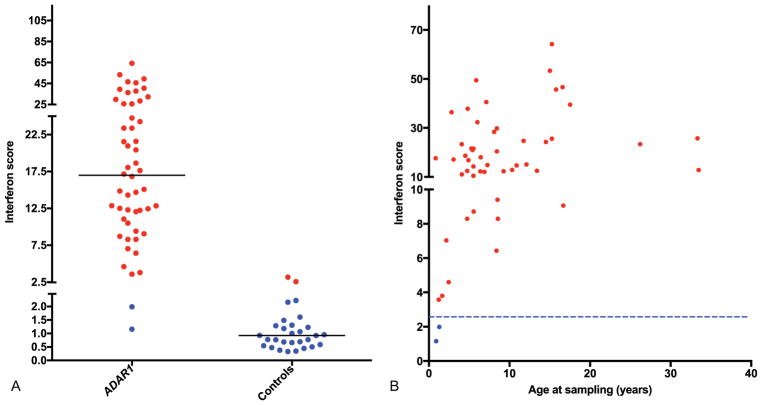
We investigated the genetic, phenotypic, and interferon status of 46 patients from 37 families with neurological disease due to mutations in ADAR1. The clinicoradiological phenotype encompassed a spectrum of Aicardi-Goutières syndrome, isolated bilateral striatal necrosis, spastic paraparesis with normal neuroimaging, a progressive spastic dystonic motor disorder, and adult-onset psychological difficulties with intracranial calcification. Homozygous missense mutations were recorded in five families. We observed a p.Pro193Ala variant in the heterozygous state in 22 of 23 families with compound heterozygous mutations. We also ascertained 11 cases from nine families with a p.Gly1007Arg dominant-negative mutation, which occurred de novo in four patients, and was inherited in three families in association with marked phenotypic variability. In 50 of 52 samples from 34 patients, we identified a marked upregulation of type I interferon-stimulated gene transcripts in peripheral blood, with a median interferon score of 16.99 (interquartile range [IQR]: 10.64-25.71) compared with controls (median: 0.93, IQR: 0.57-1.30). Thus, mutations in ADAR1 are associated with a variety of clinically distinct neurological phenotypes presenting from early infancy to adulthood, inherited either as an autosomal recessive or dominant trait. Testing for an interferon signature in blood represents a useful biomarker in this context.


Conflict of interest statement

Authors' Contributions: J.H.L. and Y.J.C. collated and reviewed all clinical and radiological data. G.I.R. performed quantitative PCR analysis, with assistance from N.K., M.B., T.A.B., A.C.E.B., M.L.C., A.M.C., C.C., R.C.D., F.R.D., N.D., B. De A., V. De G., C.G.E.L. De G., I.D., C De L., A.E., M.C.F., P.F., A.F., E.F., M.P.G., N.R.G., M.H., M.A.K., N.L., J.-P.S.-M.L., M.A.L., S.S.M., R.M., L.M.-S., G.M., M.M., V.N., S.O., J.D.O.-E., B.P.-D., F.P., K.M.R., M.R., F.R., P.R.-P., A.R., T.I.S., M.B.T., A.T., F.U., N.U., A.V., and A.W. provided clinical samples and critically reviewed clinical and immunological patient data. Y.J.C. conceived the study and wrote the initial draft with the assistance of G.I.R. All authors critically reviewed the article and agreed to its publication. Financial Disclosure None of the authors have any financial disclosure to report.

Figures

Fig. 1
Fig. 1
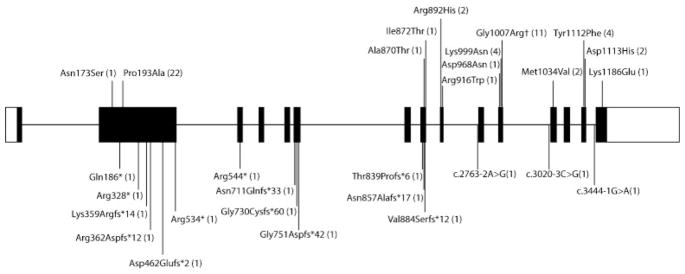
Schematic of ADAR1 gene showing mutations (according to protein nomenclature) ascertained in the present study. Missense and nonsense mutations are annotated above and below, respectively. Numbers in brackets indicate the number of families in which each mutation was observed. Indicates mutation acting as a dominant negative.
Fig. 2
Fig. 2
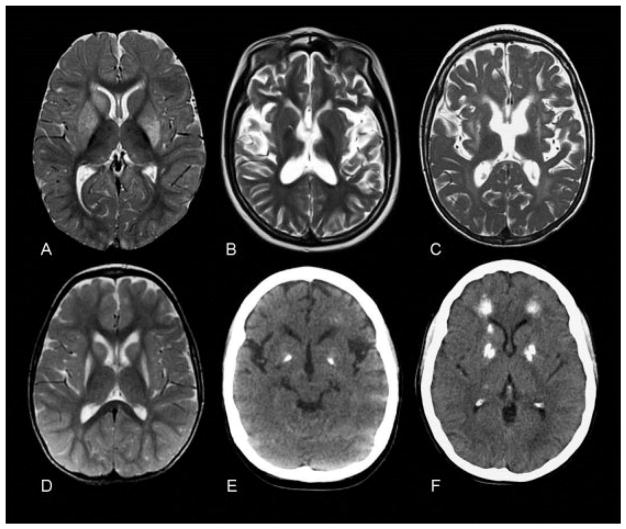
Characteristic neuroradiological features of ADAR1-related disease. Images (A) and (D) are axial T2 images of AGS251, presenting at 9 months of age with bilateral striatal necrosis following varicella zoster infection, showing characteristic high signal and swelling of head of caudate and putamen (A). (D) Follow-up at 35 months shows persisting signal change and shrinkage of caudate and putamen. Images (B) and (E) are from AGS150, a 10-year-old child presenting with an Aicardi–Goutières syndrome phenotype. (B) T2 axial MR shows cerebral atrophy with mildly increased signal in white matter. (E) CT shows dense bilateral globus pallidus calcification. Image (C) is of a patient presenting with an Aicardi–Goutières syndrome phenotype (AGS810_P1). (C) T2 axial MR at 5 years shows marked cerebral atrophy, white matter high signal, and signal change and shrinkage of the putamen. (F) CT scan of his mother (AGS810_P2) aged 34 years shows dense calcification of globus pallidus, head of caudate, and deep frontal white matter. Her MR (not shown) was normal. CT, computed tomography; MR, magnetic resonance.
Fig. 3
Fig. 3
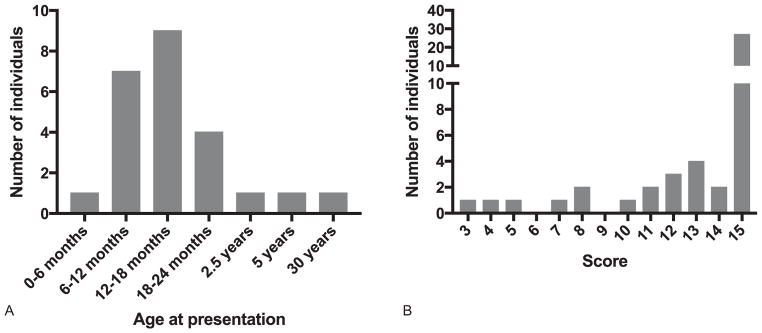
Age at presentation and associated disability. (A) Age at presentation in patients developing disease after a period of clearly normal development. (B) Assessment of gross motor function, manual ability, and communication status in living patients with mutations in ADAR1 over 1 year of age.
Fig. 4
Fig. 4
Interferon score data in ADAR1-mutated patients and controls. Summary of interferon score data (A) in ADAR1-mutated patients and controls and (B) in ADAR1-mutated patients by age. Circles indicate results above +2 SD of the mean of 29 controls (= 2.466, considered “positive”). Solid horizontal lines indicate median value of ADAR1-mutated and control groups. Dotted line indicates positive/negative boundary (2.466) of interferon score.

References

    1. Liddicoat BJ, Chalk AM, Walkley CR. ADAR1, inosine and the immune sensing system: distinguishing self from non-self. Wiley Interdiscip Rev RNA. 2016;7(2):157–172. - PubMed
    1. Hartner JC, Walkley CR, Lu J, Orkin SH. ADAR1 is essential for the maintenance of hematopoiesis and suppression of interferon signaling. Nat Immunol. 2009;10(1):109–115. - PMC - PubMed
    1. Liddicoat BJ, Piskol R, Chalk AM, et al. RNA editing by ADAR1 prevents MDA5 sensing of endogenous dsRNA as nonself. Science. 2015;349(6252):1115–1120. - PMC - PubMed
    1. Pestal K, Funk CC, Snyder JM, Price ND, Treuting PM, Stetson DB. Isoforms of RNA-editing enzyme ADAR1 independently control nucleic acid sensor MDA5-driven autoimmunity and multi-organ development. Immunity. 2015;43(5):933–944. - PMC - PubMed
    1. Rice GI, Kasher PR, Forte GM, et al. Mutations in ADAR1 cause Aicardi-Goutières syndrome associated with a type I interferon signature. Nat Genet. 2012;44(11):1243–1248. - PMC - PubMed

MeSH terms

Supplementary concepts