


Evaluation of Low-Cost Mitigation Measures Implemented to Improve Air Quality in Nursery and Primary Schools
- PMID: 28561795
- PMCID: PMC5486271
- DOI: 10.3390/ijerph14060585
Evaluation of Low-Cost Mitigation Measures Implemented to Improve Air Quality in Nursery and Primary Schools
Abstract
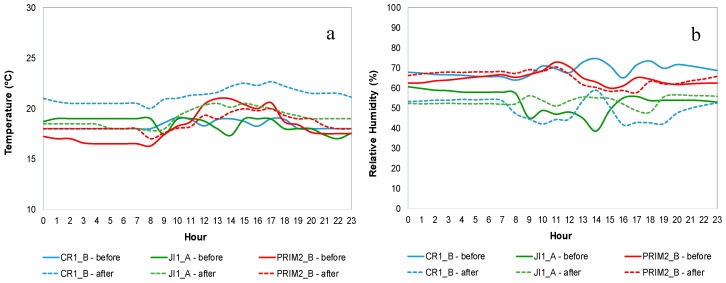
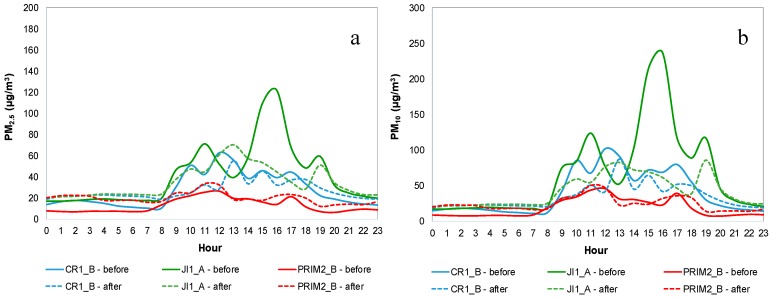
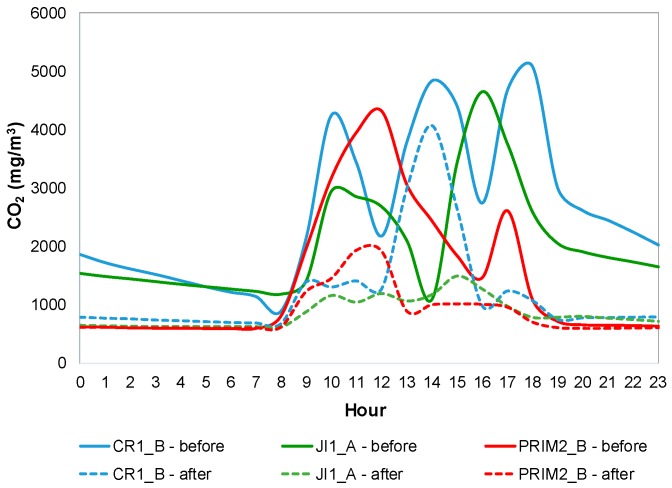
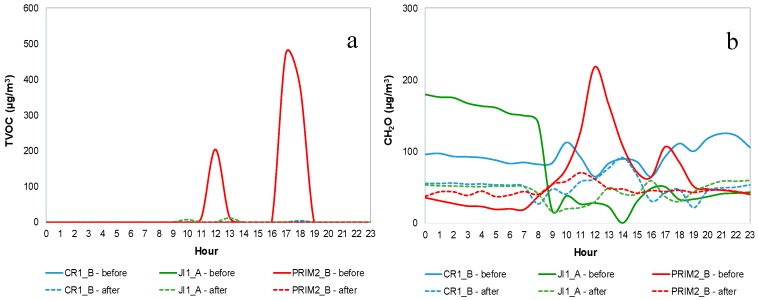
Indoor air pollution mitigation measures are highly important due to the associated health impacts, especially on children, a risk group that spends significant time indoors. Thus, the main goal of the work here reported was the evaluation of mitigation measures implemented in nursery and primary schools to improve air quality. Continuous measurements of CO₂, CO, NO₂, O₃, CH₂O, total volatile organic compounds (VOC), PM₁, PM2.5, PM10, Total Suspended Particles (TSP) and radon, as well as temperature and relative humidity were performed in two campaigns, before and after the implementation of low-cost mitigation measures. Evaluation of those mitigation measures was performed through the comparison of the concentrations measured in both campaigns. Exceedances to the values set by the national legislation and World Health Organization (WHO) were found for PM2.5, PM10, CO₂ and CH₂O during both indoor air quality campaigns. Temperature and relative humidity values were also above the ranges recommended by American Society of Heating, Refrigerating, and Air-Conditioning Engineers (ASHRAE). In general, pollutant concentrations measured after the implementation of low-cost mitigation measures were significantly lower, mainly for CO₂. However, mitigation measures were not always sufficient to decrease the pollutants' concentrations till values considered safe to protect human health.
Keywords: indoor air; mitigation measures evaluation; nursery schools; primary school.
Conflict of interest statement
The authors declare no conflict of interest.
Figures
References
-
- Almeida S.M., Canha N., Silva A., do Carmo Freitas M., Pegas P., Alves C., Evtyugina M., Pio C.A. Children exposure to atmospheric particles in indoor of Lisbon primary schools. Atmos. Environ. 2011;45:7594–7599. doi: 10.1016/j.atmosenv.2010.11.052. - DOI
-
- De Gennaro G., Dambruoso P.R., Loiotile A.D., Di Gilio A., Giungato P., Tutino M., Marzocca A., Mazzone A., Palmisani J., Porcelli F. Indoor air quality in schools. Environ. Chem. Lett. 2014;12:467–482. doi: 10.1007/s10311-014-0470-6. - DOI
-
- USEPA . United States Environmental Protection Agency; 2017. [(accessed on 17 January 2017)]. Creating Healthy Indoor Air Quality in Schools: Adopting IAQ Best Practices. Available online: https://www.epa.gov/iaq-schools/
-
- Chatzidiakou L., Mumovic D., Summerfield A.J. What do we know about indoor air quality in school classrooms? A critical review of the literature. Intell. Build. Int. 2012;4:228–259. doi: 10.1080/17508975.2012.725530. - DOI
MeSH terms
Substances
LinkOut - more resources
Full Text Sources
Other Literature Sources
Medical
Miscellaneous
