


Social Information Is Integrated into Value and Confidence Judgments According to Its Reliability
- PMID: 28566360
- PMCID: PMC5481942
- DOI: 10.1523/JNEUROSCI.3880-16.2017
Social Information Is Integrated into Value and Confidence Judgments According to Its Reliability
Abstract
How much we like something, whether it be a bottle of wine or a new film, is affected by the opinions of others. However, the social information that we receive can be contradictory and vary in its reliability. Here, we tested whether the brain incorporates these statistics when judging value and confidence. Participants provided value judgments about consumer goods in the presence of online reviews. We found that participants updated their initial value and confidence judgments in a Bayesian fashion, taking into account both the uncertainty of their initial beliefs and the reliability of the social information. Activity in dorsomedial prefrontal cortex tracked the degree of belief update. Analogous to how lower-level perceptual information is integrated, we found that the human brain integrates social information according to its reliability when judging value and confidence.SIGNIFICANCE STATEMENT The field of perceptual decision making has shown that the sensory system integrates different sources of information according to their respective reliability, as predicted by a Bayesian inference scheme. In this work, we hypothesized that a similar coding scheme is implemented by the human brain to process social signals and guide complex, value-based decisions. We provide experimental evidence that the human prefrontal cortex's activity is consistent with a Bayesian computation that integrates social information that differs in reliability and that this integration affects the neural representation of value and confidence.
Keywords: Bayesian; confidence; integration; social; value; vmPFC.
Copyright © 2017 De Martino et al.
Figures
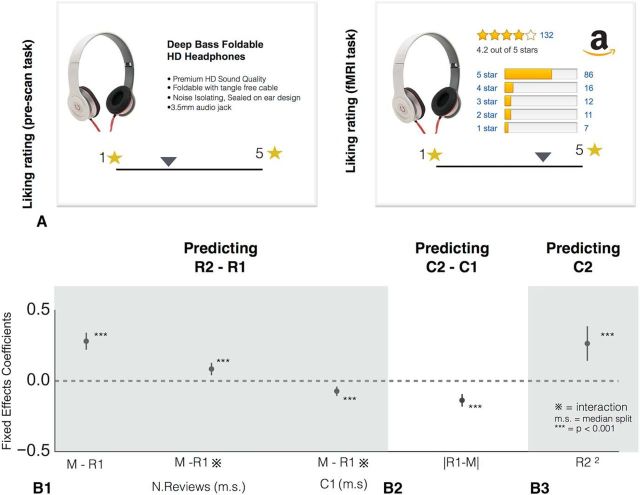
 N), interaction between the initial deviation from the group and first confidence rating (M − R1
C1), absolute difference in a participant's initial product rating and the group consensus (|R1 − M|), quadratic function of product rating (R22). Error bars indicate 95% CI. ***p < 0.001. m.s., Median split.
N), interaction between the initial deviation from the group and first confidence rating (M − R1
C1), absolute difference in a participant's initial product rating and the group consensus (|R1 − M|), quadratic function of product rating (R22). Error bars indicate 95% CI. ***p < 0.001. m.s., Median split.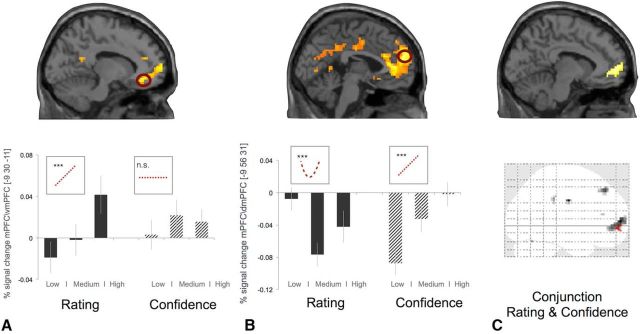
References
-
- Bates D, Mächler M, Bolker B, Walker S (2014) Fitting linear mixed-effects models using lme4. arXiv preprint arXiv:1406.5823.
Publication types
MeSH terms
Grants and funding
LinkOut - more resources
Full Text Sources
Other Literature Sources
