Toward elimination of mother-to-child transmission of HIV in South Africa: how best to monitor early infant infections within the Prevention of Mother-to-Child Transmission Program
- PMID: 28567281
- PMCID: PMC5441442
- DOI: 10.7189/jogh.07.010701
Toward elimination of mother-to-child transmission of HIV in South Africa: how best to monitor early infant infections within the Prevention of Mother-to-Child Transmission Program
Abstract
Background: South Africa has utilized three independent data sources to measure the impact of its program for the prevention of mother-to-child transmission (PMTCT) of HIV. These include the South African National Health Laboratory Service (NHLS), the District Health Information System (DHIS), and South African PMTCT Evaluation (SAPMTCTE) surveys. We compare the results of each, outlining advantages and limitations, and make recommendations for monitoring transmission rates as South Africa works toward achieving elimination of mother-to-child transmission (eMTCT).
Methods: HIV polymerase chain reaction (PCR) test data, collected between 1 January 2010 to 31 December 2014, from the NHLS, DHIS and SAPMTCTE surveys were used to compare early mother-to-child transmission (MTCT) rates in South Africa. Data from the NHLS and DHIS were also used to compare early infant diagnosis (EID) coverage.
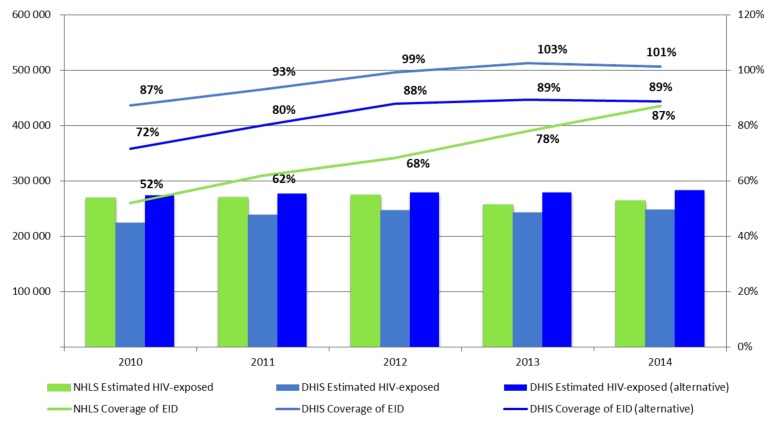
Results: The age-adjusted NHLS early MTCT rates of 4.1% in 2010, 2.6% in 2011 and 2.3% in 2012 consistently fall within the 95% confidence interval as measured by three SAPMTCTE surveys in corresponding time periods. Although DHIS data over-estimated MTCT rates in 2010, the MTCT rate declines thereafter to converge with age-adjusted NHLS MTCT rates by 2012. National EID coverage from NHLS data increases from around 52% in 2010 to 87% in 2014. DHIS data over-estimates EID coverage, but this can be corrected by employing an alternative estimate of the HIV-exposed infant population.
Conclusion: NHLS and DHIS, two routine data sources, provide very similar early MTCT rate estimates that fall within the SAPMTCTE survey confidence intervals for 2012. This analysis validates the usefulness of routine data sources to track eMTCT in South Africa.
Conflict of interest statement
Competing interests: The authors completed the Unified Competing Interest form at www.icmje.org/coi_disclosure.pdf (available upon request from the corresponding author), and declare no conflict of interest.
Figures
References
-
- Shisana O, Rehle T, Simbayi LC, Zuma K, Jooste S, Zungu N, et al. South African National HIV Prevalence, Incidence and Behaviour Survey, 2012. Cape Town: Human Sciences Research Council; 2014. Available: http://www.hsrc.ac.za/uploads/pageContent/4565/SABSSM%20IV%20LEO%20final.... Accessed: 15 February 2016. - PubMed
-
- National Department of Health. The 2013 National Antenatal Sentinel HIV Prevalence Survey South Africa. Pretoria: National Department of Health; 2015. Available: http://www.health.gov.za/index.php/2014-03-17-09-09-8/reports/category/1.... Accessed: 15 February 2016.
-
- World Health Organization. Global Guidance on Criteria and Processes for Validation: Elimination of Mother-to-Child Transmission (EMTCT) of HIV and syphilis; 2014. Available: http://apps.who.int/iris/bitstream/10665/112858/1/9789241505888_eng.pdf?.... Accessed: 21 February 2016.
-
- National Department of Health. National Consolidated Guidelines for the Prevention of Mother-to-Child Transmission of HIV (PMTCT) and the Management of HIV in Children, Adolescents and Adults. Pretoria: National Department of Health; 2015. Available: http://www.sahivsoc.org/upload/documents/ART%20Guidelines%2015052015.pdf. Accessed: 21 February 2016.
Publication types
MeSH terms
LinkOut - more resources
Full Text Sources
Other Literature Sources
Medical