. 2017 May 31;19(1):115.
doi: 10.1186/s13075-017-1324-y.

The prevalence of ACPA is lower in rheumatoid arthritis patients with an older age of onset but the composition of the ACPA response appears identical

Affiliations

The prevalence of ACPA is lower in rheumatoid arthritis patients with an older age of onset but the composition of the ACPA response appears identical

Debbie M Boeters et al. Arthritis Res Ther. .

Abstract

Background: Rheumatoid arthritis (RA) consists of two syndromes, one autoantibody-positive and one autoantibody-negative. Existing data on the relation between age of onset and prevalence of autoantibodies were conflicting. Therefore this multicohort study assessed the age of onset in relation to the presence of autoantibodies. The association with characteristics of the anti-citrullinated protein antibodies (ACPA) response was also explored.

Methods: The 1987 criteria-positive RA patients included in the Leiden EAC, BARFOT, ESPOIR, Umeå and Lund cohorts (n = 3321) were studied at presentation for age of onset and the presence of ACPA, rheumatoid factor (RF) and anti-carbamylated protein (anti-CarP) antibodies. Logistic regression analyses were performed; effect sizes were summarized in inverse-weighted meta-analyses. Within ACPA-positive RA, ACPA level was studied in all cohorts; ACPA isotypes, ACPA fine specificity and ACPA avidity index and clinical characteristics were studied in the Leiden EAC.

Results: From the age of 50 onward, the proportion of ACPA-negative RA patients increased with age in the five cohorts. Similar observations were made for RF and anti-CarP. The composition of the ACPA response did not change with increasing age of onset with respect to titer, isotype distribution, fine specificity and avidity index. With increasing age of onset, RA patients smoked less often, had higher acute phase reactants and more often had a sub(acute) symptom onset.

Conclusions: Data of five cohorts revealed that with older age of onset ACPA-negative RA is more frequent than ACPA-positive RA, while characteristics of ACPA-positive RA as judged by the composition of the ACPA response appeared not age dependent. Further biologic studies are needed to characterize the pathogenesis of ACPA-negative polyarthritis at older age and to promote personalized treatment decisions in ACPA-negative patients in daily practice.

Keywords: ACPA characteristics; Age; Autoantibodies; Rheumatoid arthritis.


Figures

Fig. 1
Fig. 1
Proportion of ACPA-negative RA patients at different ages of RA onset. Proportion of ACPA-negative and ACPA-positive RA patients within the different age groups at RA onset in the five different cohorts. Number of patients in each age group: Leiden EAC: <25, n = 48; 25–29, n = 23; 30–34, n = 49; 35–39, n = 65; 40–44, n = 86; 45–49, n = 121; 50–54, n = 125; 55–59, n = 144; 60–64, n = 153; 65–69, n = 122; 70–74, n = 131; 75–79, n = 92; ≥80, n = 49; BARFOT: <25, n = 16; 25–29, n = 25; 30–34, n = 42; 35–39, n = 40; 40–44, n = 45; 45–49, n = 66; 50–54, n = 92; 55–59, n = 90; 60–64, n = 75; 65–69, n = 92; 70–74, n = 82; 75–79, n = 66; ≥80, n = 29; ESPOIR: <25, n = 30; 25–29, n = 24; 30–34, n = 45; 35–39, n = 52; 40–44, n = 65; 45–49, n = 78; 50–54, n = 107; 55–59, n = 109; 60–64, n = 73; ≥65, n = 49; Umeå: <25, n = 20; 25–29, n = 13; 30–34, n = 22; 35–39, n = 28; 40–44, n = 28; 45–49, n = 43; 50–54, n = 62; 55–59, n = 60; 60–64, n = 72; 65–69, n = 48; 70–74, n = 32; ≥75, n = 31; Lund: <25, n = 2; 25–29, n = 6; 30–34, n = 2; 35–39, n = 13; 40–44, n = 15; 45–49, n = 30; 50–54, n = 21; 55–59, n = 25; 60–64, n = 11; ≥65, n = 17. ACPA anti-citrullinated protein antibodies
Fig. 2
Fig. 2
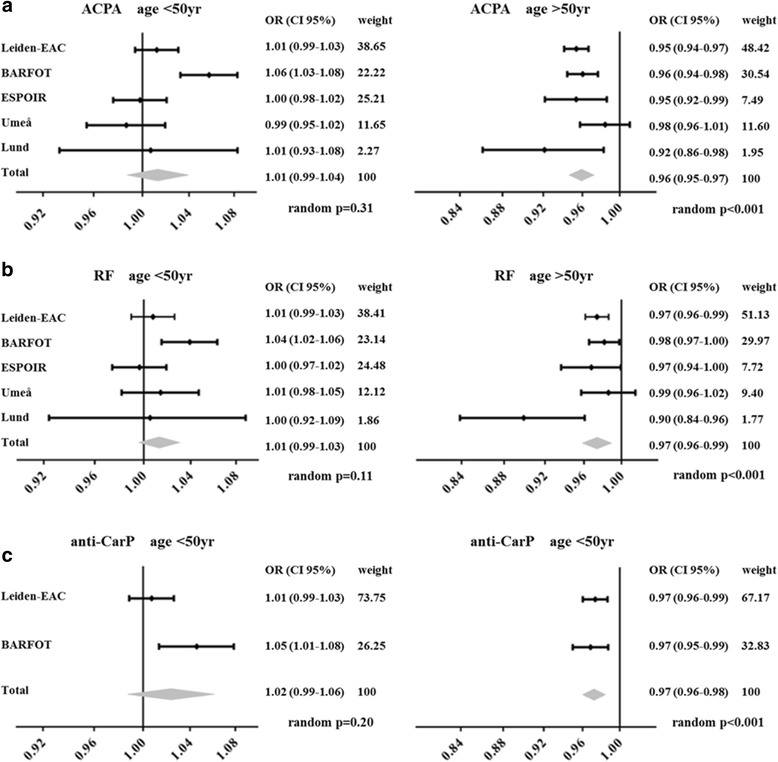
Meta-analysis on the association between age of onset (<50 and >50 years) and the presence of ACPA, RF and anti-CarP. Association between ACPA (a), RF (b) and anti-CarP (c) with age of onset in the different cohorts. The meta-analysis summarizes the effect of age of onset in the different cohorts and is based on a random effect model, combining ORs from separate logistic regression analyses of the different cohorts with age and gender as independent variables and ACPA, RF or anti-CarP as outcome. Separate meta-analyses were performed for the association between autoantibodies and age <50 years and >50 years. OR of 0.96 indicates that for a 1-year increase in age, the odds of being ACPA-positive decrease 4%; this is 18% per 5-year increase in age of RA onset (0.965). ACPA anti-citrullinated protein antibodies, anti-CarP anti-carbamylated protein antibodies, OR odds ratio, RF rheumatoid factor
Fig. 3
Fig. 3
Risk of ACPA-positivity and ACPA-negativity in RA patients compared with individuals from the Dutch source population, presented for different age categories. For example, in the age group 18–29 the risk of being ACPA-positive was 87 times higher for RA patients than for individuals from the general Dutch population, and the risk of being ACPA-negative was 0.48 times higher (meaning 52% lower). The ratio for ACPA-negativity increased at older age. ACPA anti-citrullinated protein antibodies
Fig. 4
Fig. 4
ACPA level of ACPA-positive RA at different ages of RA onset; data from five cohorts. Association between age of onset and ACPA level within RA patients of the Leiden EAC (a), BARFOT (b), ESPOIR (c), Umeå (d) and Lund (e) cohorts. In Lund the upper detection limit of the anti-CCP2 test was 200 U/ml; there were 76 patients with anti-CCP2 level > 200 U/ml. Horizontal lines represent median values. Each dot represents one patient. ACPA anti-citrullinated protein antibodies
Fig. 5
Fig. 5
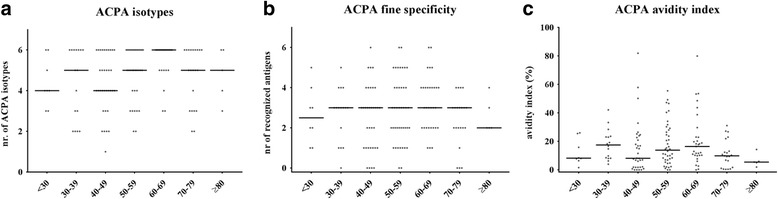
Isotypes, fine specificity and avidity index of ACPA-positive RA patients at different ages of onset; data from the Leiden EAC. Association between age of onset and ACPA isotypes (a), ACPA fine specificity (b) and ACPA avidity index (c) within RA patients of the Leiden EAC. Horizontal lines represent median values. Each dot represents one patient. ACPA anti-citrullinated protein antibodies

References

    1. Arnett FC, Edworthy SM, Bloch DA, Mcshane DJ, Fries JF, Cooper NS, et al. The american rheumatism association 1987 revised criteria for the classification of rheumatoid arthritis. Arthritis Rheum. 1988;31:315–24. doi: 10.1002/art.1780310302. - DOI - PubMed
    1. Padyukov L, Seielstad M, Ong RTH, Ding B, Rönnelid J, Seddighzadeh M, et al. A genome-wide association study suggests contrasting associations in ACPA-positive versus ACPA-negative rheumatoid arthritis. Ann Rheum Dis. 2011;70:259–65. doi: 10.1136/ard.2009.126821. - DOI - PMC - PubMed
    1. Karlson EW, Deane K. Environmental and gene-environment interactions and risk of rheumatoid arthritis. Rheum Dis Clin North Am. 2012;38:405–26. doi: 10.1016/j.rdc.2012.04.002. - DOI - PMC - PubMed
    1. van Schaardenburg D, Breedveld FC. Elderly-onset rheumatoid arthritis. Semin Arthritis Rheum. 1994;23:367–78. doi: 10.1016/0049-0172(94)90087-6. - DOI - PubMed
    1. Yazici Y, Paget SA. Elderly-onset rheumatoid arthritis. Rheum Dis Clin N Am. 2000;26:517–26. doi: 10.1016/S0889-857X(05)70154-X. - DOI - PubMed

Publication types

Substances