


Direct and simultaneous observation of ultrafast electron and hole dynamics in germanium
- PMID: 28569752
- PMCID: PMC5461502
- DOI: 10.1038/ncomms15734
Direct and simultaneous observation of ultrafast electron and hole dynamics in germanium
Abstract
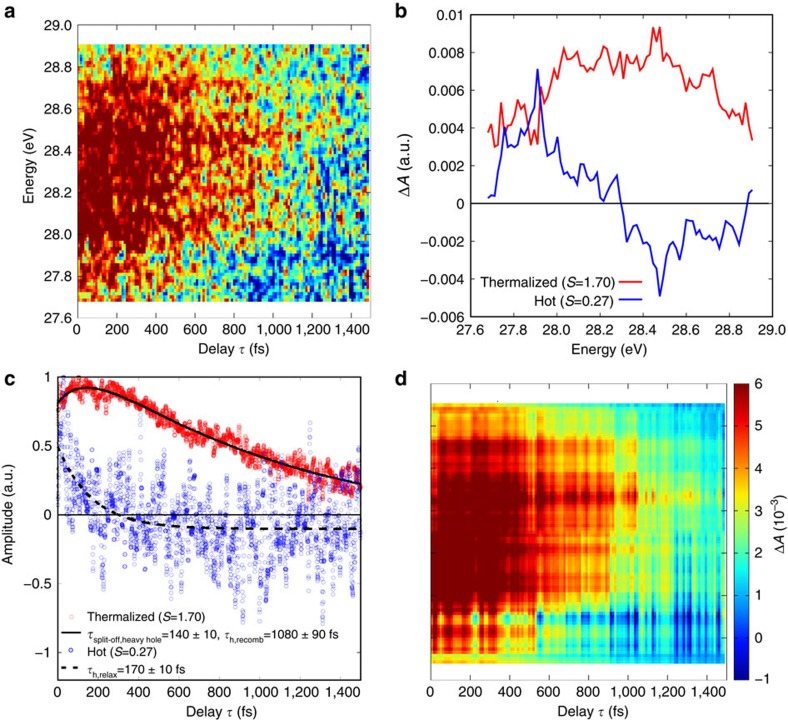
Understanding excited carrier dynamics in semiconductors is crucial for the development of photovoltaics and efficient photonic devices. However, overlapping spectral features in optical pump-probe spectroscopy often render assignments of separate electron and hole carrier dynamics ambiguous. Here, ultrafast electron and hole dynamics in germanium nanocrystalline thin films are directly and simultaneously observed by ultrafast transient absorption spectroscopy in the extreme ultraviolet at the germanium M4,5 edge. We decompose the spectra into contributions of electronic state blocking and photo-induced band shifts at a carrier density of 8 × 1020 cm-3. Separate electron and hole relaxation times are observed as a function of hot carrier energies. A first-order electron and hole decay of ∼1 ps suggests a Shockley-Read-Hall recombination mechanism. The simultaneous observation of electrons and holes with extreme ultraviolet transient absorption spectroscopy paves the way for investigating few- to sub-femtosecond dynamics of both holes and electrons in complex semiconductor materials and across junctions.
Conflict of interest statement
The authors declare no competing financial interests.
Figures


 (I=2 × 10¹¹ W cm−2) features positive and negative differential absorption in the VB and CB, respectively. Positive time delays correspond to the VIS-NIR pump pulse arriving before the XUV probe pulse. Comparison with a calculated density of states (DOS) allows assigning characteristic valleys of the band structure to the measured energy axis (cf. Fig. 1c). (b) The absolute values of the rises of the two main transient features around 28.3 eV (VB) and 29.9 eV (CB) are associated with electrons (blue open circles) and holes (red open squares), respectively, exhibiting a rise time limited by the duration of the VIS-NIR pulse. The measured band shift ΔEshift(τ) (black open diamonds) also follows the carrier excitation within the instrumental response time. The solid lines in b are moving averages to guide the eye. In (c) the differential absorption of the carrier dynamics directly after VB to CB excitation, that is, for positive time delays averaged over τ=8 to 12 fs (indicated by the black rectangle in a), is shown. The shaded error bar in (c) corresponds to the s.d. of individual data points within the averaging window. The dashed black line shows the differential absorption calculated from a TDDFT calculation assuming pulses with a peak intensity of 1011 W cm−2.

 , assuming a single exponential carrier decay with a time constant of 1.1 ps (red dotted line). In the inset the measured initial shifts (black squares) for different initial carrier densities is compared to an analytic calculation of the band shift. The calculated redshift of the CB (red dashed line, inset) due to bandgap renormalization (BGR) for different carrier densities is slightly larger than the measured band shifts. The vertical error bars in the inset correspond to the s.d. of the data points in the time delay segment. The horizontal error bars are derived by taking the uncertainties of the measured excitation fluence into account. See text for discussion.
References
-
- Soref R. Mid-infrared photonics in silicon and germanium. Nat. Photonics 4, 495–497 (2010).
-
- King R. R., Law D. C., Edmondson K. M., Fetzer C. M. & Kinsey H. 40% efficient metamorphic GaInP/GaInAs/Ge multijunction solar cells. Appl. Phys. Lett. 90, 183516 (2007).
-
- Grzybowski G. et al.. Direct versus indirect optical recombination in Ge films grown on Si substrates. Phys. Rev. B 84, 205307 (2011).
-
- Shah J. Ultrafast Spectroscopy of Semiconductors and Semiconductor Nanostructures 2nd edn Springer (1999).
-
- Rossi F. & Kuhn T. Theory of ultrafast phenomena in photoexcited semiconductors. Rev. Mod. Phys. 74, 895–950 (2002).
Publication types
LinkOut - more resources
Full Text Sources
Other Literature Sources
