. 2017 Jun 1:8:15757.
doi: 10.1038/ncomms15757.

Thermal annihilation of photo-induced radicals following dynamic nuclear polarization to produce transportable frozen hyperpolarized 13C-substrates

Affiliations

Thermal annihilation of photo-induced radicals following dynamic nuclear polarization to produce transportable frozen hyperpolarized 13C-substrates

Andrea Capozzi et al. Nat Commun. .

Abstract

Hyperpolarization via dynamic nuclear polarization (DNP) is pivotal for boosting magnetic resonance imaging (MRI) sensitivity and dissolution DNP can be used to perform in vivo real-time 13C MRI. The type of applications is however limited by the relatively fast decay time of the hyperpolarized spin state together with the constraint of having to polarize the 13C spins in a dedicated apparatus nearby but separated from the MRI magnet. We herein demonstrate that by polarizing 13C with photo-induced radicals, which can be subsequently annihilated using a thermalization process that maintains the sample temperature below its melting point, hyperpolarized 13C-substrates can be extracted from the DNP apparatus in the solid form, while maintaining the enhanced 13C polarization. The melting procedure necessary to transform the frozen solid into an injectable solution containing the hyperpolarized 13C-substrates can therefore be performed ex situ, up to several hours after extraction and storage of the polarized solid.


Conflict of interest statement

A. Comment is currently employed by General Electric Medical Systems, Inc. The remaining authors declare no competing financial interests.

Figures
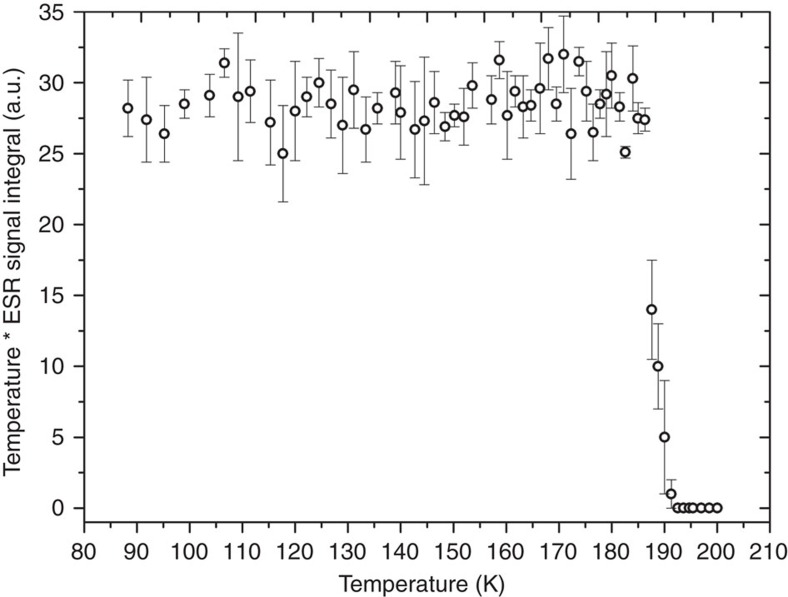
Figure 1
Figure 1. Annihilation temperature of photo-induced radicals.
ESR signal integral multiplied by temperature as a function of temperature. Each ESR measurement is the average of three single scans (the error bar represents the s.d.).
Figure 2
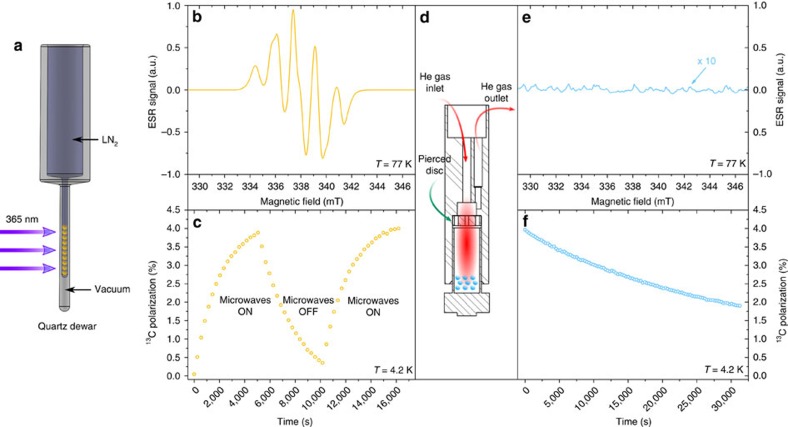
Figure 2. Rapid thermalization method.
(a) Sample preparation: frozen beads of [1-13C]PA:H2O 1:1 (v/v) placed in a quartz dewar filled with liquid nitrogen are irradiated with ultraviolet light (365 nm) for 1 h. The orange colour indicates the presence of radicals. (b) X-band ESR spectrum collected at 77 K in a single ultraviolet-irradiated frozen bead. (c) 13C polarization time evolution measured by 13C NMR at 7 T and 4.2 K in ten ultraviolet-irradiated frozen beads during an ON–OFF–ON microwave cycle. (d) Sketch of the bottom part of the thermalization insert sealed onto the sample cup. The compressed helium gas inlet (3 mm diameter) and outlet (2 mm diameter) are sketched along with the warm helium gas profile (red cloud) inside the sample cup together with the frozen beads (the cyan colour indicates that the ultraviolet-induced radicals have been annihilated). (e) X-band ESR spectrum measured at 77 K in all ten ultraviolet-irradiated beads recovered from the sample cup after thermalization and 13C NMR longitudinal relaxation measurement. (f) 13C NMR longitudinal relaxation measurement performed at 4.2 K and 7 T following thermalization.
Figure 3
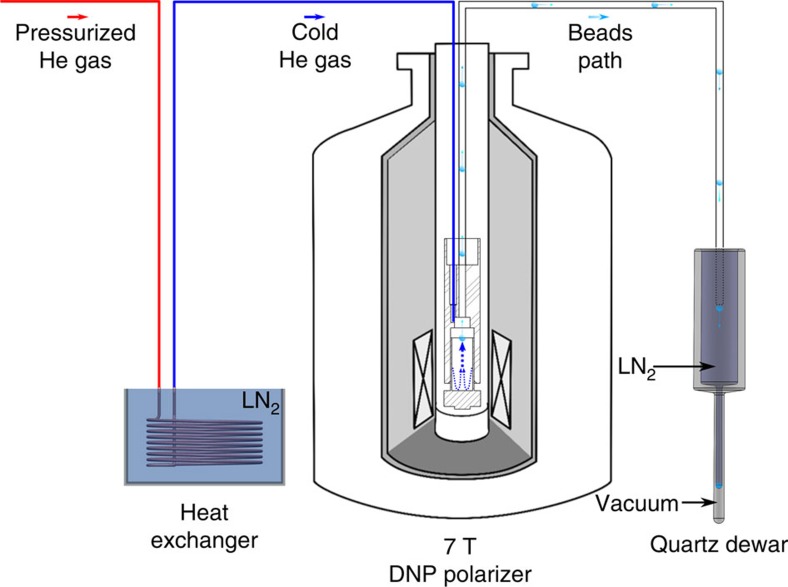
Figure 3. Solid sample extraction setup.
Setup used to extract the frozen beads from the DNP polarizer. The pressurized helium gas path is sketched from left to right: room-temperature helium gas (5 bar) is cooled through a heat exchanger (copper solenoid plunged in liquid nitrogen); the cold gas enters the extraction insert (only the bottom part is sketched inside the DNP polarizer) through the 2 mm diameter inlet and the frozen beads are pushed out of the sample cup through the 3 mm outlet; the extracted beads are recovered inside a quartz dewar filled with liquid nitrogen located next to the DNP polarizer.
Figure 4
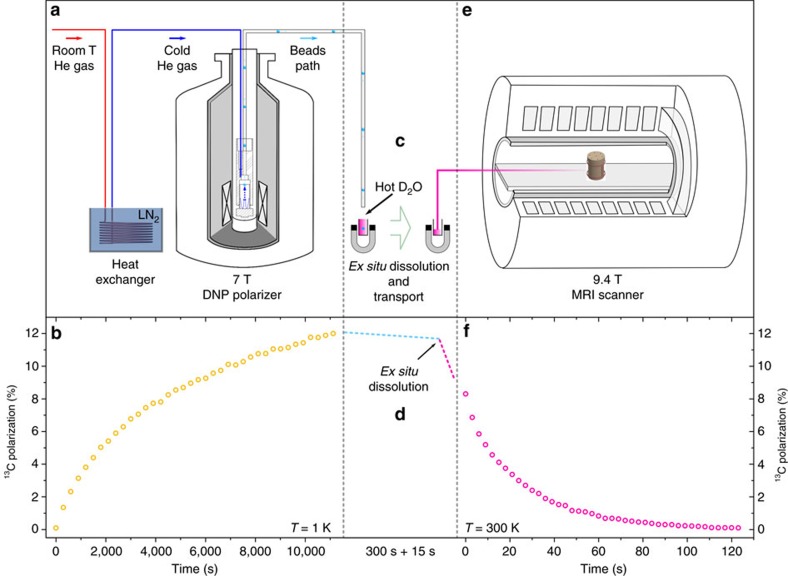
Figure 4. Ex situ dissolution.
(a) Solid sample extraction procedure as illustrated in Fig. 3. (b) 13C polarization time evolution measured by 13C NMR at 7 T and 1 K in 10 ultraviolet-irradiated frozen beads; once the 13C polarization had reached 12±0.5%, the ultraviolet-induced radicals were annihilated using the thermalization process described in the text (c). Schematic representation of the ex situ dissolution and transfer of the hyperpolarized [1-13C]PA aqueous solution from the side of the polarizer to the custom-designed injection pump placed inside the MRI scanner. (d) Estimated 13C polarization behavior during all intermediate operations: the cyan dotted line represents the decay of the 13C polarization at 7 T and 4.2 K during the 300 s required to cool down the extraction line; the fuchsia dotted line sketches the liquid-state 13C longitudinal relaxation after ex situ dissolution at 100 mT in hot D2O during the 15 s needed to transport the hyperpolarized solution in proximity of the 9.4 T MRI scanner. (e) Sketch of the injection pump equipped with a 13C Alderman–Grant NMR coil and placed at the isocentre of the 9.4 T MRI scanner. (f) Liquid-state 13C NMR longitudinal relaxation measurement performed at 9.4 T and room temperature inside the injection pump.

References

    1. Golman K., in't Zandt R. & Thaning M. Real-time metabolic imaging. Proc. Natl Acad. Sci. USA 103, 11270–11275 (2006). - PMC - PubMed
    1. Nelson S. J. et al.. Metabolic imaging of patients with prostate cancer using hyperpolarized [1-13C]pyruvate. Sci. Transl. Med. 5, 198ra108 (2013). - PMC - PubMed
    1. James M. L. & Gambhir S. S. A molecular imaging primer: modalities, imaging agents, and applications. Physiol. Rev. 92, 897–965 (2012). - PubMed
    1. Comment A. in New Applications of NMR in Drug Discovery and Development 252–272The Royal Society of Chemistry (2013).
    1. Nikolaou P., Goodson B. M. & Chekmenev E. Y. NMR hyperpolarization techniques for biomedicine. Chem. Eur. J. 21, 3156–3166 (2015). - PMC - PubMed

Publication types