


Evidence of selective reporting bias in hematology journals: A systematic review
- PMID: 28570573
- PMCID: PMC5453439
- DOI: 10.1371/journal.pone.0178379
Evidence of selective reporting bias in hematology journals: A systematic review
Abstract
Introduction: Selective reporting bias occurs when chance or selective outcome reporting rather than the intervention contributes to group differences. The prevailing concern about selective reporting bias is the possibility of results being modified towards specific conclusions. In this study, we evaluate randomized controlled trials (RCTs) published in hematology journals, a group in which selective outcome reporting has not yet been explored.
Methods: Our primary goal was to examine discrepancies between the reported primary and secondary outcomes in registered and published RCTs concerning hematological malignancies reported in hematology journals with a high impact factor. The secondary goals were to address whether outcome reporting discrepancies favored statistically significant outcomes, whether a pattern existed between the funding source and likelihood of outcome reporting bias, and whether temporal trends were present in outcome reporting bias. For trials with major outcome discrepancies, we contacted trialists to determine reasons for these discrepancies. Trials published between January 1, 2010 and December 31, 2015 in Blood; British Journal of Haematology; American Journal of Hematology; Leukemia; and Haematologica were included.
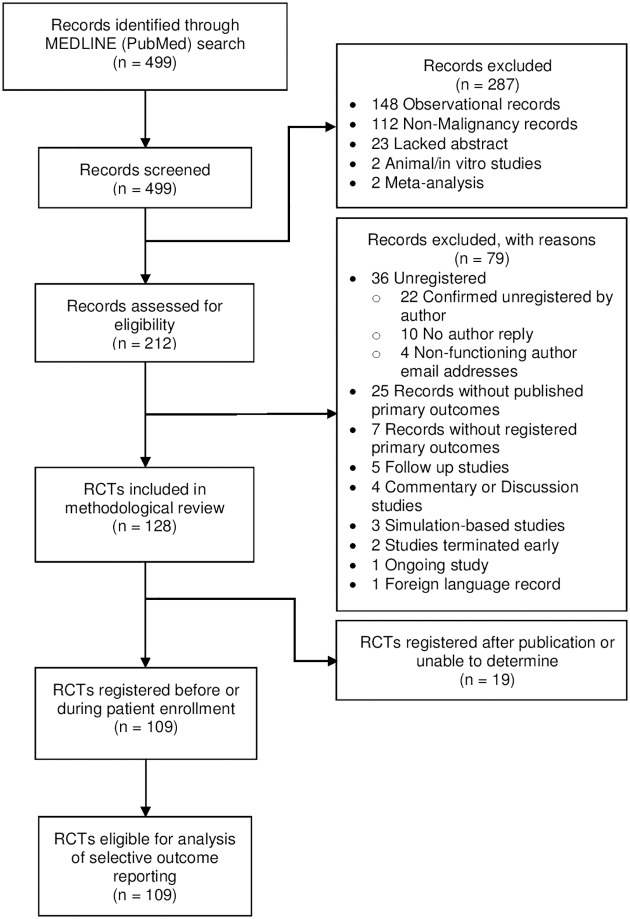
Results: Of 499 RCTs screened, 109 RCTs were included. Our analysis revealed 118 major discrepancies and 629 total discrepancies. Among the 118 discrepancies, 30 (25.4%) primary outcomes were demoted, 47 (39.8%) primary outcomes were omitted, and 30 (25.4%) primary outcomes were added. Three (2.5%) secondary outcomes were upgraded to a primary outcome. The timing of assessment for a primary outcome changed eight (6.8%) times. Thirty-one major discrepancies were published with a P-value and twenty-five (80.6%) favored statistical significance. A majority of authors whom we contacted cited a pre-planned subgroup analysis as a reason for outcome changes.
Conclusion: Our results suggest that outcome changes occur frequently in hematology trials. Because RCTs ultimately underpin clinical judgment and guide policy implementation, selective reporting could pose a threat to medical decision making.
Conflict of interest statement
Figures
References
Publication types
MeSH terms
LinkOut - more resources
Full Text Sources
Other Literature Sources
