. 2017 Sep 1;313(3):G180-G191.
doi: 10.1152/ajpgi.00036.2017. Epub 2017 Jun 1.

Ductular and proliferative response of esophageal submucosal glands in a porcine model of esophageal injury and repair

Affiliations

Ductular and proliferative response of esophageal submucosal glands in a porcine model of esophageal injury and repair

Leandi Krüger et al. Am J Physiol Gastrointest Liver Physiol. .

Abstract

Esophageal injury is a risk factor for diseases such as Barrett's esophagus (BE) and esophageal adenocarcinoma. To improve understanding of signaling pathways associated with both normal and abnormal repair, animal models are needed. Traditional rodent models of esophageal repair are limited by the absence of esophageal submucosal glands (ESMGs), which are present in the human esophagus. Previously, we identified acinar ductal metaplasia in human ESMGs in association with both esophageal injury and cancer. In addition, the SOX9 transcription factor has been associated with generation of columnar epithelium and the pathogenesis of BE and is present in ESMGs. To test our hypothesis that ESMGs activate after esophageal injury with an increase in proliferation, generation of a ductal phenotype, and expression of SOX9, we developed a porcine model of esophageal injury and repair using radiofrequency ablation (RFA). The porcine esophagus contains ESMGs, and RFA produces a consistent and reproducible mucosal injury in the esophagus. Here we present a temporal assessment of this model of esophageal repair. Porcine esophagus was evaluated at 0, 6, 18, 24, 48, and 72 h and 5 and 7 days following RFA and compared with control uninjured esophagus. Following RFA, ESMGs demonstrated an increase in ductal phenotype, echoing our prior studies in humans. Proliferation increased in both squamous epithelium and ESMGs postinjury with a prominent population of SOX9-positive cells in ESMGs postinjury. This model promises to be useful in future experiments evaluating mechanisms of esophageal repair.NEW & NOTEWORTHY A novel porcine model of injury and repair using radiofrequency ablation has been developed, allowing for reproducible injury to the esophagus to study repair in an animal model with esophageal submucosal glands, a key anatomical feature and missing in rodent models but possibly harboring progenitor cells. There is a strong translational component to this porcine model given the anatomical and physiological similarities between pigs and humans.

Keywords: esophageal submucosal gland; esophagus; injury; proliferation; repair.


Figures

Fig. 1.
Fig. 1.
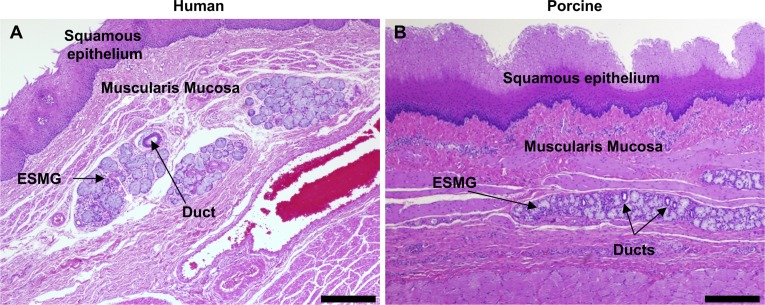
Comparison of esophageal microanatomy in human and porcine tissue. Human esophagus (A) and porcine esophagus (B). Esophageal submucosal glands (ESMGs) are similar in human and porcine esophagus and are located below stratified squamous epithelium and muscularis mucosa. Normal ESMGs contain mucin-producing acini and intercalated ducts. Scale bar = 200 µm.
Fig. 2.
Fig. 2.
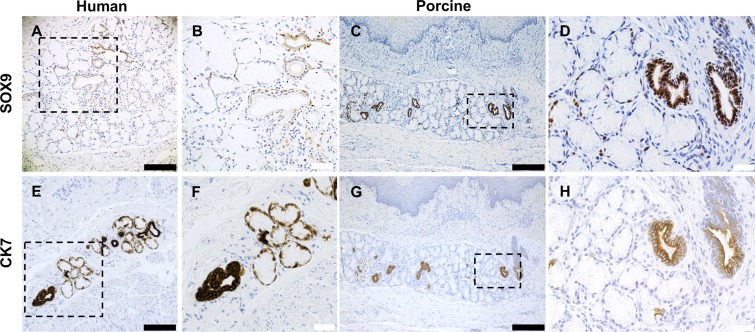
Comparison of antibody reactivity between human and porcine esophageal tissue. SOX9 and cytokeratin 7 (CK7) antibody staining was compared between human (A, B, E, and F) and pig esophagus (C, D, G, and H). A–D: SOX9 produced a strong nuclear pattern and was identified in ducts and rare cells in the ESMGs in both human and the uninjured pig. E–H: CK7 produced strong cytoplasmic staining in the ducts of both human and pig, with some peripheral staining in the acini in human (E and F); rare CK7 staining was noted in the acini of uninjured pig (G and H). Scale bar = 200 µm (black) and 40 µm (white).
Fig. 3.
Fig. 3.
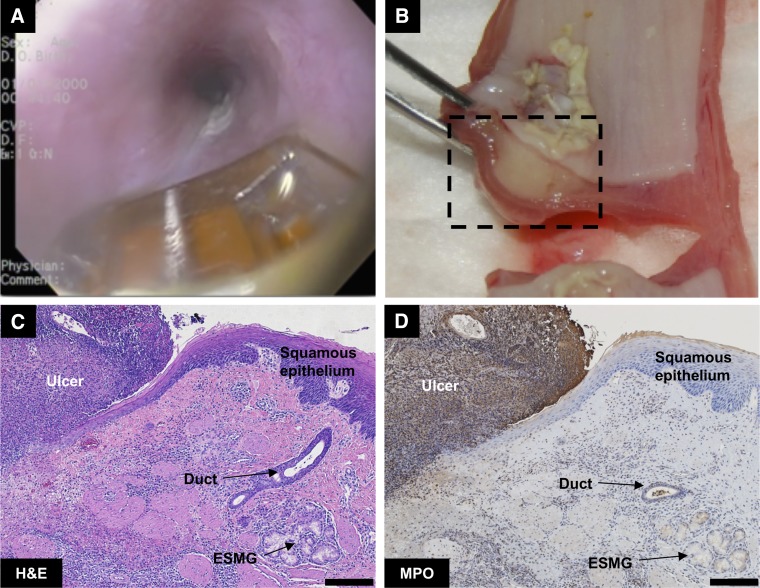
Assessment of radiofrequency ablation (RFA)-generated wound in porcine esophagus. A: endoscopic view of uninjured porcine esophagus with RFA probe. B: gross appearance in cross section of esophageal injury 48 h postablation with extensive ulceration and mild edema. C: hematoxylin and eosin (H&E) staining 48-h postablation, with a demarcation between ulcerated (left) and healthy tissue (right) where an ESMG and duct are present. D: myeloperoxidase (MPO) staining for neutrophils demonstrated evidence of ulceration on the top left of the image and a clear demarcation at the edge of the injured area. Scale bar = 200 µm.
Fig. 4.
Fig. 4.
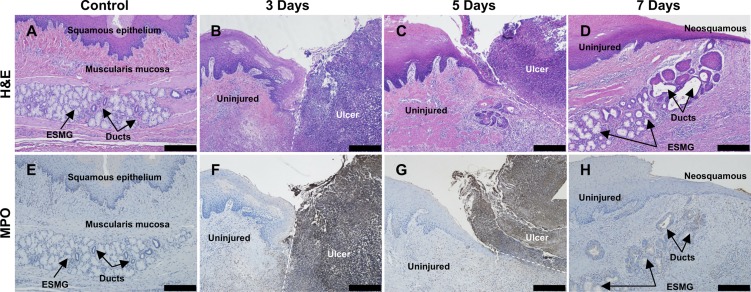
Areas of RFA injured esophageal tissue at 3, 5, and 7 days were compared with control using both H&E and MPO. A: control H&E with normal appearance of an ESMG with overlying squamous epithelium. B: at 3 days, a large ulcer was present (right) with clear demarcation between the uninjured tissue (left) and ablated, ulcerated tissue (right). C: at 5 days, a small area of neosquamous epithelium (left) appeared underneath ulcerated tissue (right) above an ESMG at the junction of injured and uninjured tissue. D: 7 days postablation, neosquamous epithelium appeared along with an ESMG with the ductular phenotype and areas of squamous islands near the neosquamous epithelium. E: uninjured control tissue did not demonstrate MPO-positive cells. F: 3 days after injury, dark MPO staining was present on the right in the ablated area, with little to no staining present in the uninjured tissue (left). G: at 5 days, MPO-stained tissue (right) separated from uninjured, repairing epithelium (left). H: neosquamous epithelium and associated ESMG with little to no positive MPO cells, indicating a reduction in inflammation and resolution of the ulcer. Scale bar = 200 µm.
Fig. 5.
Fig. 5.
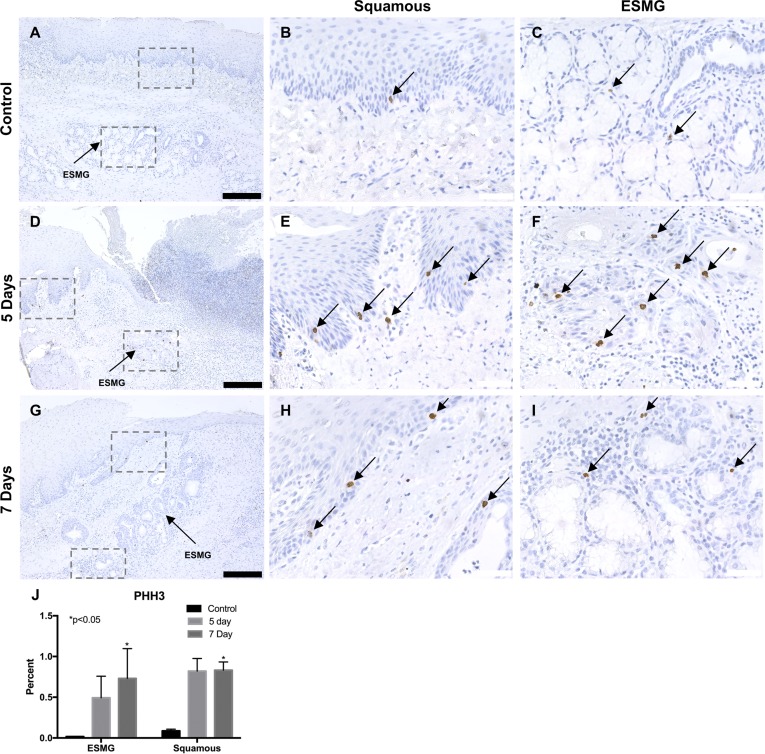
Phosphohistone H3 (PHH3), an M-phase marker for proliferation, was used to detect proliferating cells in the porcine esophagus. A–C: in uninjured esophagus, cells were rarely positive for PHH3 in the squamous epithelium (B) and ESMGs (C). D-F: 5 days postablation (n = 3), a marked increase of PHH3-positive cells was noted in both the squamous epithelium (E) and ESMGs (F). G–I: 7 days postablation (n = 6), PHH3-positive cells were present in the squamous epithelium (H) and ESMGs (I). J: after quantification, compared with uninjured control, PHH3 increased significantly in ESMGs 7 days postablation (*P < 0.05) and increased significantly in squamous epithelium 7 days postablation (P < 0.05). Scale bar = 200 µm (black) and 40 µm (white). Percentages reported as means ± SE.
Fig. 6.
Fig. 6.
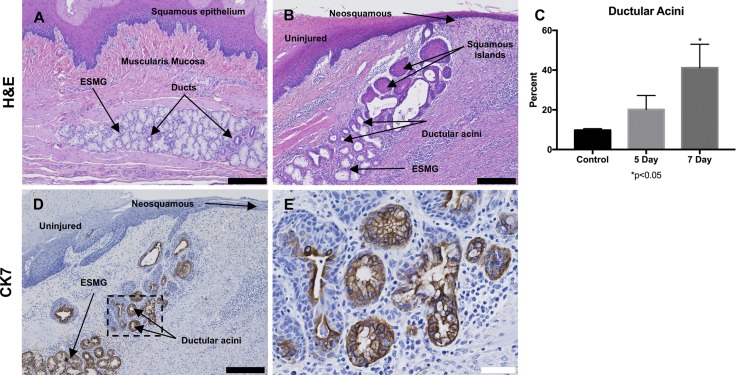
A ductular phenotype was present in injured porcine ESMGs. A: control ESMGs contained mucinous acini with a few small normal ducts to collect acinar secretions. B: 7 days postablation, the ESMGs exhibited an increased ductular phenotype rather than mucinous acini within the ESMGs, with additional squamous islands near the lumen. C: when acinar phenotype was counted (ductal vs. mucinous) and compared with uninjured control, 5 days postablation the ductular phenotype nearly doubled compared with control, and it quadrupled at 7 days to 41.16 ± 11.85% compared with control (*P < 0.05). D: CK7, a ductal marker, stained strongly positive in 7 days postablation ESMGs. E: CK7 in higher magnification image demonstrating acini with mixed phenotype, dilation of the acini, loss of mucin. Multiple layers are present in some ducts, particularly near the overlying repairing squamous epithelium. Scale bar = 200 µm (black) and 40 µm (white). Percentages reported as mean ± SE.
Fig. 7.
Fig. 7.
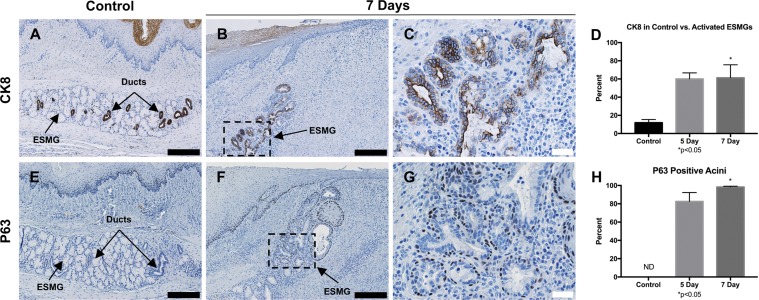
Epithelial markers P63 and CK8 in RFA-injured tissue. A: CK8 expression in control ESMGs had strong expression within the ducts. B and C: after injury, expression of CK8 was strongly present in the ductular acini with a notable expansion. D: in control tissue, 11.99 ± 3.39% of the control ESMGs consisted of CK8-positive ducts. Compared with uninjured controls, CK8 expression increased to 60.13% ± 6.54% in ESMGs 5 days postablation, and to 61.41 ± 14.23% (*P < 0.05) in ESMGs 7 days postablation. E: P63 expression was present on the basal cells in the ducts contained within ESMGs but not detected (ND) in the acini of the uninjured ESMGs. F and G: P63 expression remained active in the ducts associated with ESMGs postablation, and P63-positive cells were found in the acini of injured ESMGs. H: compared with uninjured controls, P63-positive cells were present in 82.64 ± 9.65% of acini in injured ESMGs 5 days postablation, and significantly increased to 98.33 ± 0.88% (P < 0.05) in injured ESMGs 7 days postablation. Scale bar = 200 µm (black) and 40 µm (white). Percentages reported as mean ± SE.
Fig. 8.
Fig. 8.
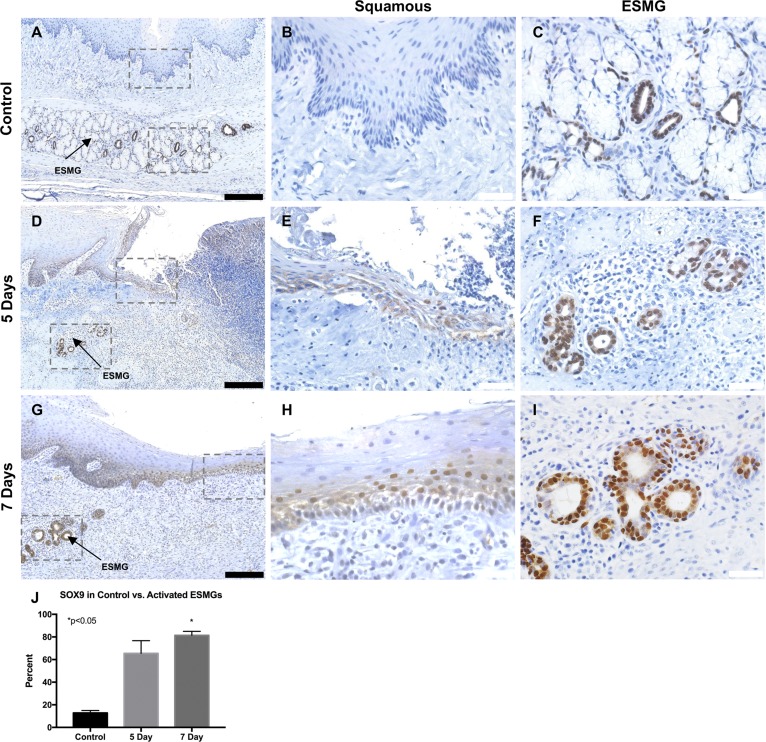
Location of SOX9 expression was assessed in RFA-injured tissue. A–C: In uninjured esophagus, SOX9 was rare in the squamous epithelium (B) but present in the ESMGs and associated ducts (C). D–F: 5 days postablation (n = 3), nuclear positive SOX9 increased in both the squamous epithelium (E) and ESMGs, particularly where the ductal phenotype was noted (F). G–I: 7 days postablation (n = 6), SOX9-positive cells increased in the squamous epithelium (H), and increased in the ESMGs, again where the ductal phenotype was noted (I). J: compared with uninjured controls, in the activated acinar ductal phenotype within ESMGs, SOX9 increased from 12.82 ± 2.11% to 65.42 ± 11.33% 5 days postablation. SOX9-positive ductal acini significantly (*P < 0.05) increased to 81.37 ± 3.62% in ESMGs 7 days postablation, compared with uninjured controls. Scale bar = 200 µm (black) and 40 µm (white). Percentages reported as mean ± SE.
Fig. 9.
Fig. 9.
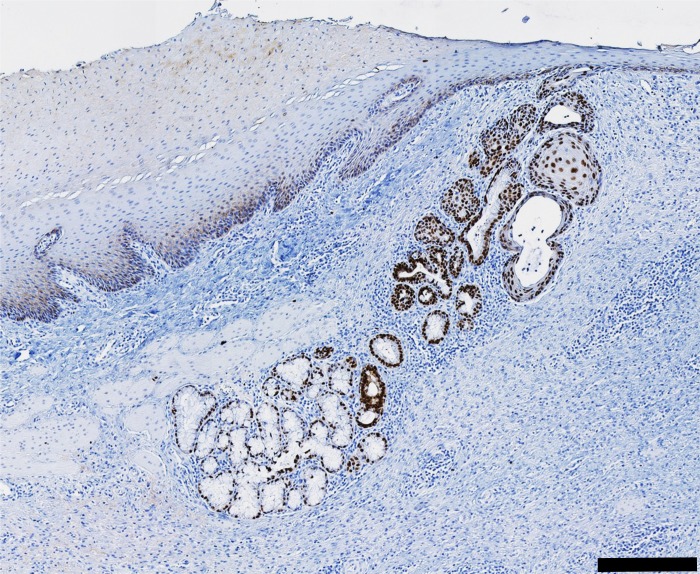
Continuity was observed from ductular ESMG connecting with neosquamous epithelium. Ductular acini were visible and positive for SOX9, 7 days postablation. The ductular acini appeared in continuity with repairing squamous epithelium and SOX9-positive cells were common. Scale bar = 200 µm.

References

    1. Akiyama J, Marcus SN, Triadafilopoulos G. Effective intra-esophageal acid control is associated with improved radiofrequency ablation outcomes in Barrett’s esophagus. Dig Dis Sci 57: 2625–2632, 2012. doi: 10.1007/s10620-012-2313-2. - DOI - PubMed
    1. Boult J, Roberts K, Brookes MJ, Hughes S, Bury JP, Cross SS, Anderson GJ, Spychal R, Iqbal T, Tselepis C. Overexpression of cellular iron import proteins is associated with malignant progression of esophageal adenocarcinoma. Clin Cancer Res 14: 379–387, 2008. doi: 10.1158/1078-0432.CCR-07-1054. - DOI - PubMed
    1. Chen NM, Singh G, Koenig A, Liou GY, Storz P, Zhang JS, Regul L, Nagarajan S, Kühnemuth B, Johnsen SA, Hebrok M, Siveke J, Billadeau DD, Ellenrieder V, Hessmann E. NFATc1 links EGFR signaling to induction of Sox9 transcription and acinar-ductal transdifferentiation in the pancreas. Gastroenterology 148: 1024–1034.e9, 2015. doi: 10.1053/j.gastro.2015.01.033. - DOI - PMC - PubMed
    1. Clemons NJ, Wang DH, Croagh D, Tikoo A, Fennell CM, Murone C, Scott AM, Watkins DN, Phillips WA. Sox9 drives columnar differentiation of esophageal squamous epithelium: a possible role in the pathogenesis of Barrett’s esophagus. Am J Physiol Gastrointest Liver Physiol 303: G1335–G1346, 2012. doi: 10.1152/ajpgi.00291.2012. - DOI - PubMed
    1. Coad RA, Woodman AC, Warner PJ, Barr H, Wright NA, Shepherd NA. On the histogenesis of Barrett’s oesophagus and its associated squamous islands: a three-dimensional study of their morphological relationship with native oesophageal gland ducts. J Pathol 206: 388–394, 2005. doi: 10.1002/path.1804. - DOI - PubMed

Substances

LinkOut - more resources