. 2017 Jun 1;7(1):2648.
doi: 10.1038/s41598-017-02805-x.

A nucleotide-controlled conformational switch modulates the activity of eukaryotic IMP dehydrogenases

Affiliations

A nucleotide-controlled conformational switch modulates the activity of eukaryotic IMP dehydrogenases

Rubén M Buey et al. Sci Rep. .

Abstract

Inosine-5'-monophosphate dehydrogenase (IMPDH) is an essential enzyme for nucleotide metabolism and cell proliferation. Despite IMPDH is the target of drugs with antiviral, immunosuppressive and antitumor activities, its physiological mechanisms of regulation remain largely unknown. Using the enzyme from the industrial fungus Ashbya gossypii, we demonstrate that the binding of adenine and guanine nucleotides to the canonical nucleotide binding sites of the regulatory Bateman domain induces different enzyme conformations with significantly distinct catalytic activities. Thereby, the comparison of their high-resolution structures defines the mechanistic and structural details of a nucleotide-controlled conformational switch that allosterically modulates the catalytic activity of eukaryotic IMPDHs. Remarkably, retinopathy-associated mutations lie within the mechanical hinges of the conformational change, highlighting its physiological relevance. Our results expand the mechanistic repertoire of Bateman domains and pave the road to new approaches targeting IMPDHs.


Conflict of interest statement

The authors declare that they have no competing interests.

Figures
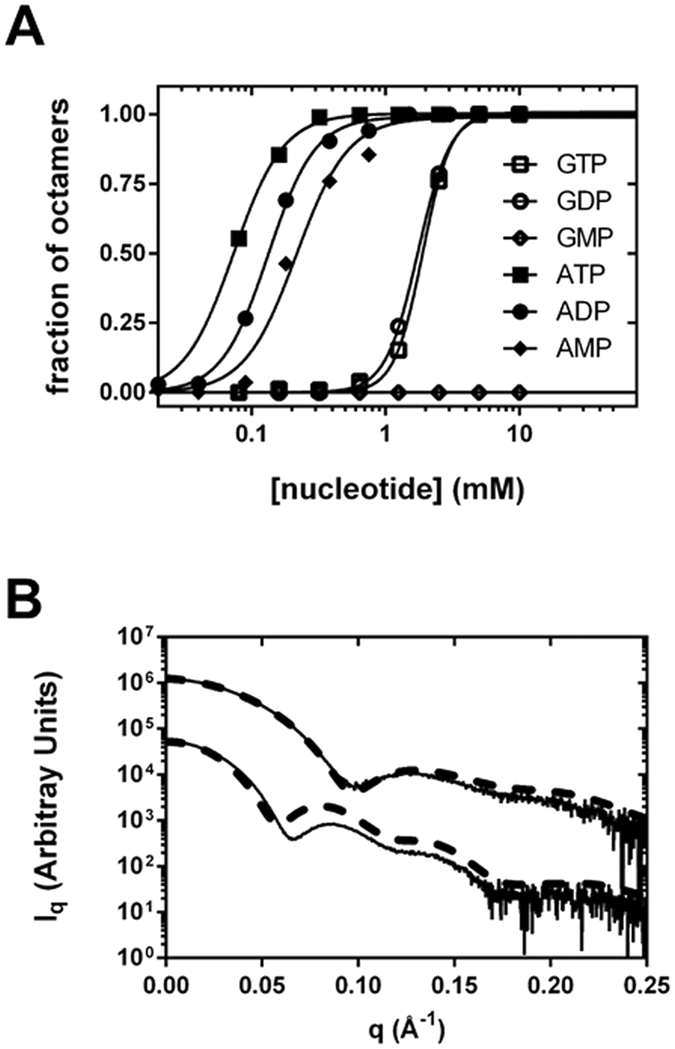
Figure 1
Figure 1
Guanine and adenine nucleotides induce octamers of AgIMPDH with different conformations. (A) Fractions of octamers/tetramers of AgIMPDH in solution (4 mg mL−1) at different nucleotide concentrations, as determined by SAXS experiments. (B) SAXS profiles of AgIMPDH in in the presence of 5 mM GDP (upper continuos line) and 3 mM ATP (botton continuos line). Identical results were obtained for GTP and GDP, as well as for ATP, ADP and AMP (not all curves are shown here to facilitate visualization). The thick dashed lines show the theoretical SAXS profiles calculated from the crystallographic structures fitted to the experimental ones. The SAXS profiles have been conveniently displaced along the y-axis to facilitate visualization.
Figure 2
Figure 2
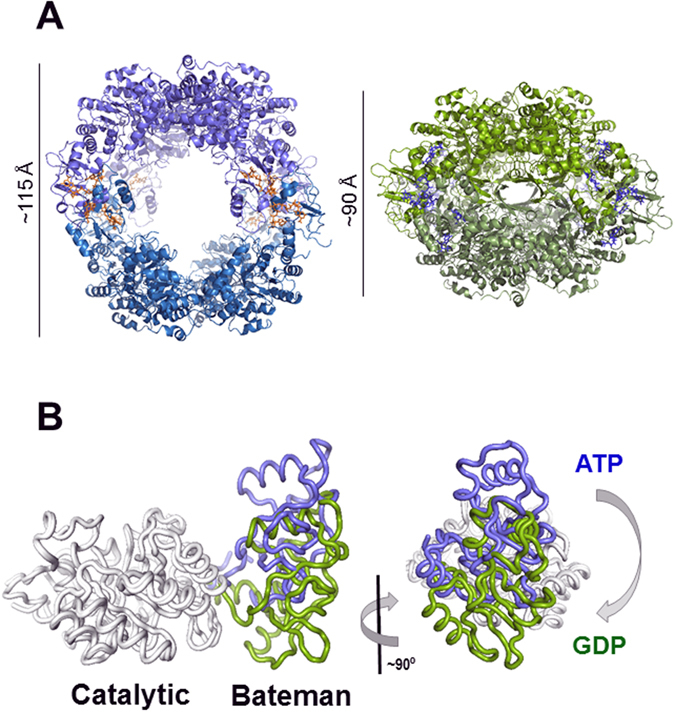
The conformational switch of AgIMPDH. (A) High-resolution structures of AgIMPDH in complex with ATP (left panel in blue cartoons) and GDP (right panel in green cartoons). ATP and GDP molecules are shown in orange and blue sticks, respectively. (B) Ribbon representation of monomers of AgIMPDH bound to ATP (blue) or GDP (green), with the catalytic domain superimposed.
Figure 3
Figure 3
The Bateman domain of AgIMPDH binds two ATP molecules. Close-up view of the ATP1 (A) and ATP2 (B) bound to the canonical nucleotide binding sites of the Bateman domain of AgIMPDH. AgIMPDH protein is represented in blue semi-transparent cartoons with key interacting residues and ATP molecules shown in sticks. The Mg+2 ion is shown as a magenta sphere. In (A) the adjacent monomer and the side chain of residue Gln170’ are shown in green cartoon and sticks, respectively. Key interactions are represented as magenta dashes. The grey mesh around the nucleotides and the Mg+2 ion represents the ommit 2mFo − DFc electron density map contoured at the 1σ level.
Figure 4
Figure 4
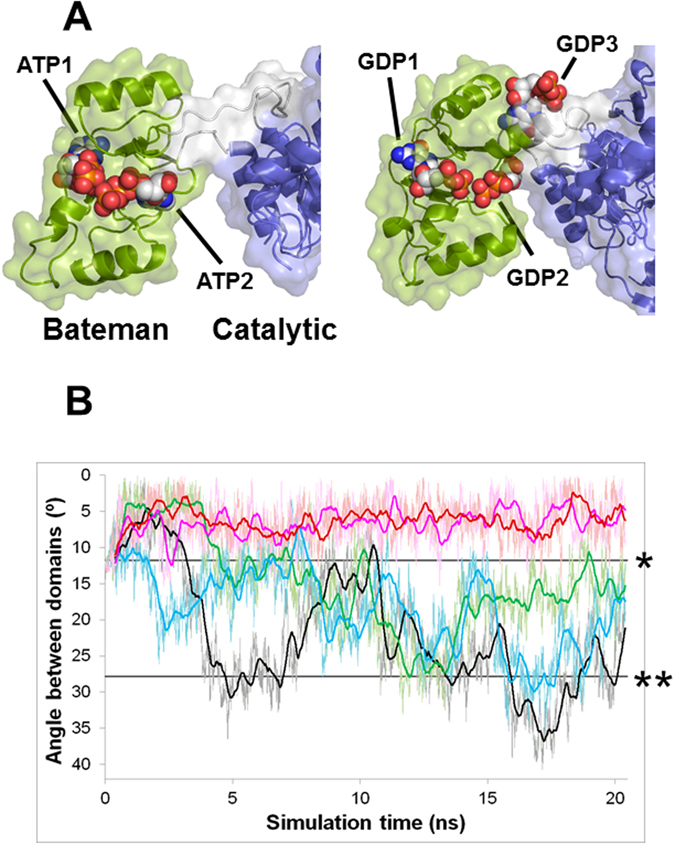
GDP2 and GDP3 staple the catalytic and Bateman domains into a fixed inhibited conformation. (A) Cartoon and surface representation of a monomer of AgIMPDH-ATP (left) and AgIMPDH-GDP (right). Nucleotide atoms are shown as spheres. The catalytic domain is coloured in blue, the Bateman domain in green and the hinge bending residues (linkers) in grey. (B) Angle formed between the mass centers of the catalytic, linker and Bateman domains of a monomer of AgIMPDH bound to different nucleotides during the molecular dynamics computer simulations. Black: APO, blue: GDP1/GDP2, green: ATP1/ATP2, pink ATP1/GDP2/GDP3, and brown: GDP1/GDP2/GDP3. The thin lines show the raw data and the smoother thick lines are the mobile mean of the angle along 20 structures. The straight black lines marked with one or two asterisks indicate the angles formed in the structures of AgIMPDH-GDP (starting structure for all simulations) and AgIMPDH-ATP, respectively.
Figure 5
Figure 5
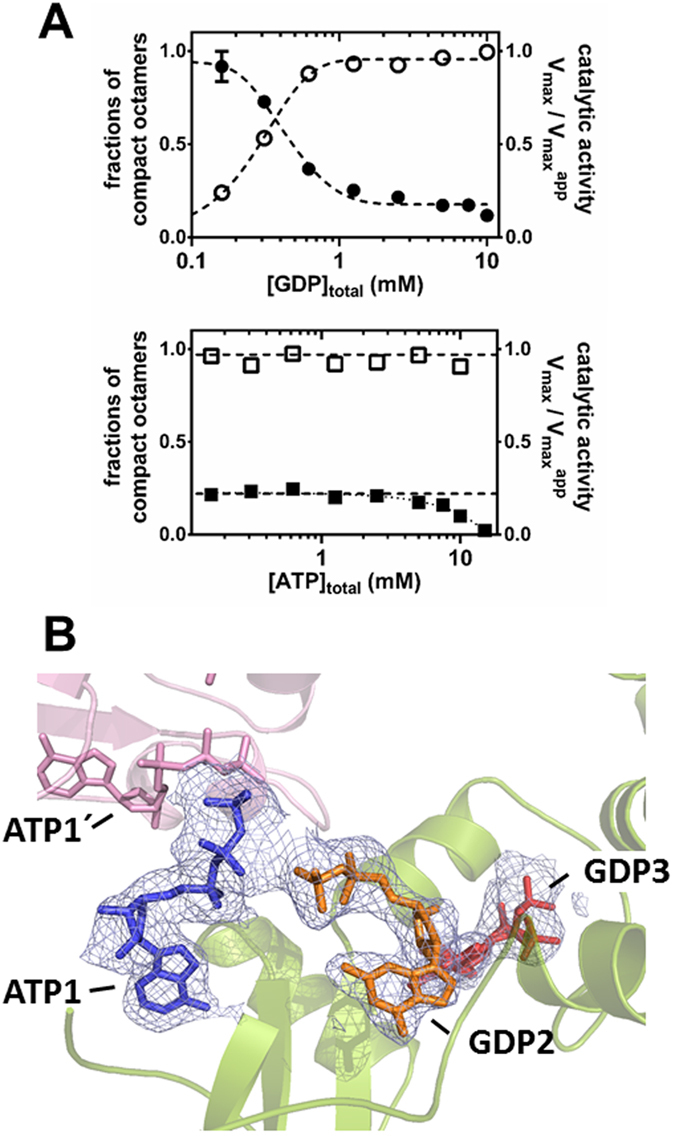
The conformational switch of AgIMPDH is unidirectional. (A) Plots representing the fraction of compact octamers (empty symbols) and the catalytic activity (filled symbols) versus nucleotide concentration. Upper panel: 3 mM ATP fixed versus increasing concentrations of GDP. Lower panel: 5 mM GDP fixed versus increasing concentrations of ATP. Data points represent the mean value and the standard errors. At the fixed concentrations of ATP (3 mM) and GDP (5 mM) used for these experiments, all AgIMPDH remained as octamers with no detectable fraction of tetramers, as determined by SAXS. (B) Close-up view of the nucleotides bound to the Bateman domain in the structure AgIMPDH-ATP/GDP. The protein is represented in green cartoons and the nucleotides in coloured sticks (ATP1 in blue, GDP2 in orange, and GDP3 in red). The interacting Bateman domain form the other tetramer is shown in light pink. The grey mesh around the nucleotides represents the ommit 2mFo − DFc electron density map contoured at the 1σ level.

References

    1. Jayaram HN, Cooney DA, Grusch M, Krupitza G. Consequences of IMP dehydrogenase inhibition, and its relationship to cancer and apoptosis. Curr Med Chem. 1999;6:561–74. - PubMed
    1. Braun-Sand SB, Peetz M. Inosine monophosphate dehydrogenase as a target for antiviral, anticancer, antimicrobial and immunosuppressive therapeutics. Future Med Chem. 2010;2:81–92. doi: 10.4155/fmc.09.147. - DOI - PubMed
    1. Hedstrom L. IMP dehydrogenase: structure, mechanism, and inhibition. Chemical reviews. 2009;109:2903–2928. doi: 10.1021/cr900021w. - DOI - PMC - PubMed
    1. Labesse G, et al. MgATP Regulates Allostery and Fiber Formation in IMPDHs. Structure (London, England: 1993) 2013;21:975–985. doi: 10.1016/j.str.2013.03.011. - DOI - PubMed
    1. Buey RM, et al. Guanine nucleotide binding to the Bateman domain mediates the allosteric inhibition of eukaryotic IMP dehydrogenases. Nat Commun. 2015;6:8923. doi: 10.1038/ncomms9923. - DOI - PMC - PubMed

Publication types

MeSH terms

LinkOut - more resources