. 2017 Jun 1;7(1):2597.
doi: 10.1038/s41598-017-02354-3.

Diacylglycerol Kinase alpha is Involved in the Vitamin E-Induced Amelioration of Diabetic Nephropathy in Mice

Affiliations

Diacylglycerol Kinase alpha is Involved in the Vitamin E-Induced Amelioration of Diabetic Nephropathy in Mice

Daiki Hayashi et al. Sci Rep. .

Abstract

Diabetic nephropathy (DN) is one of vascular complications of diabetes and is caused by abnormal protein kinase C activation as a result of increased diacylglycerol (DG) production in diabetic hyperglycaemia. Diacylglycerol kinase (DGK) converts DG into phosphatidic acid. Therefore, it is expected that the activation of DGK would ameliorate DN. Indeed, it has been reported that vitamin E (VtE) ameliorates DN in rat by activating DGK, and we recently reported that VtE specifically activates DGKα isoform in vitro. However, whether DGKα is involved in the VtE-induced amelioration of DN in vivo remains unknown. Therefore, we investigated the VtE-induced amelioration of DN in wild-type (DGKα+/+) and DGKα-deficient (DGKα-/-) mice in which diabetes was induced by streptozocin. Several symptoms of DN were ameliorated by VtE treatment in the DGKα+/+ mice but not in the DGKα-/- mice. Moreover, transmission electron microscopy of glomeruli and immunofluorescent staining of glomerular epithelial cells (podocytes) indicated that VtE ameliorates podocyte pathology and prevents podocyte loss in the DGKα+/+ mice but not in the DGKα-/- mice. We showed that VtE can ameliorate DN in mice and that DGKα is involved in the VtE-induced amelioration of DN in vivo, suggesting that DGKα is an attractive therapeutic target for DN.


Conflict of interest statement

The authors declare that they have no competing interests.

Figures
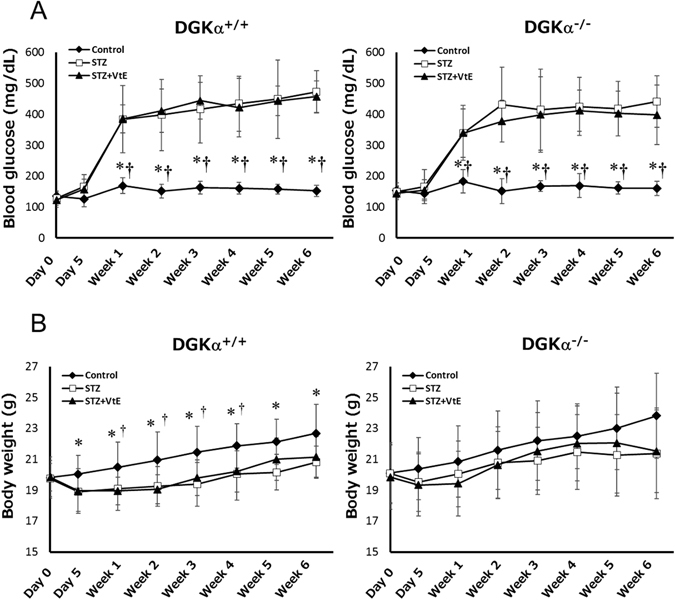
Figure 1
Figure 1
Changes in blood glucose levels and body weight. The blood glucose levels (A) and body weight (B) of the mice in each group were measured before and after STZ administration (day 0 and day 5), and every week thereafter until 6 weeks. Number of the mice in each group: DGKα+/+ Control: n = 12~18, STZ: n = 13~20, STZ + VtE: n = 8~11, DGKα−/− Control: n = 12~18, STZ: n = 12~19, STZ + VtE: n = 9~11. *P < 0.01 vs. STZ; P < 0.01 vs. STZ + VtE.
Figure 2
Figure 2
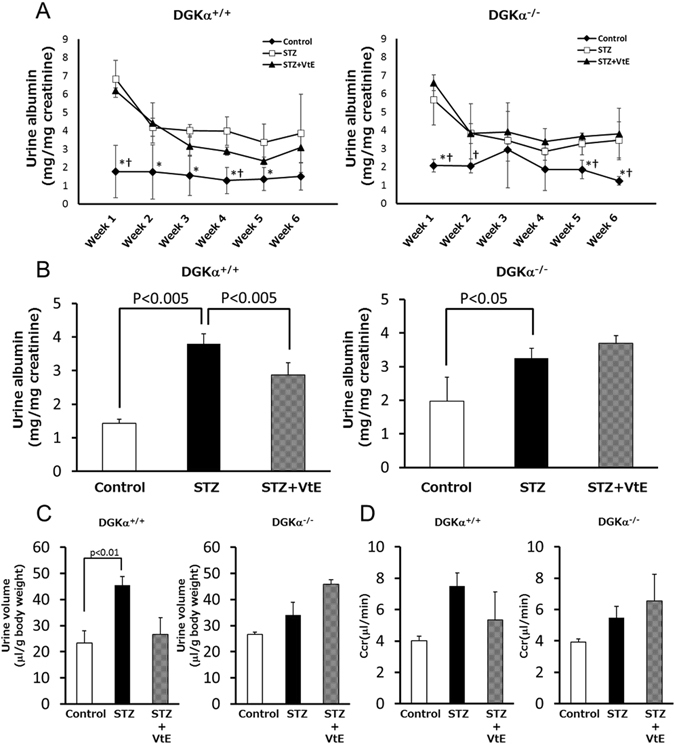
Indicators of diabetic nephropathy. (A) Urine albumin levels were measured in each group of mice from weeks 1 to 6. (B) The mean amount of urine albumin from weeks 3 to 6. Urine albumin levels were normalized to urine creatinine levels. (C) Urine volume was measured for each group of mice using metabolic cages. The bar graphs show data for urine volume at 5 weeks. (D) Creatinine clearance (CCr) of mice at 1 week was calculated from the concentrations of urine and plasma creatinine. *P < 0.05 vs. STZ; P < 0.05 vs. STZ + VtE.
Figure 3
Figure 3
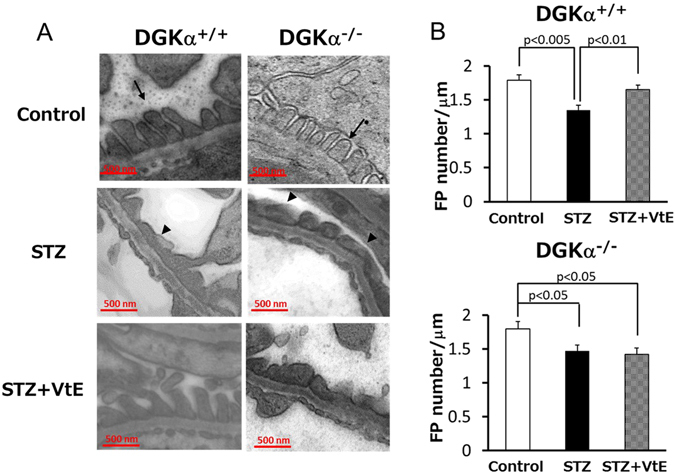
Transmission electron microscopy of podocyte morphology. (A) Transmission electron microscopy (TEM) images of glomeruli from mice at 6 weeks after STZ administration. The arrow points to a normal FP, and the arrowhead points to a broadened FP. (B) The number of FPs in the TEM images was counted, and the number was normalized to the GBM length.
Figure 4
Figure 4
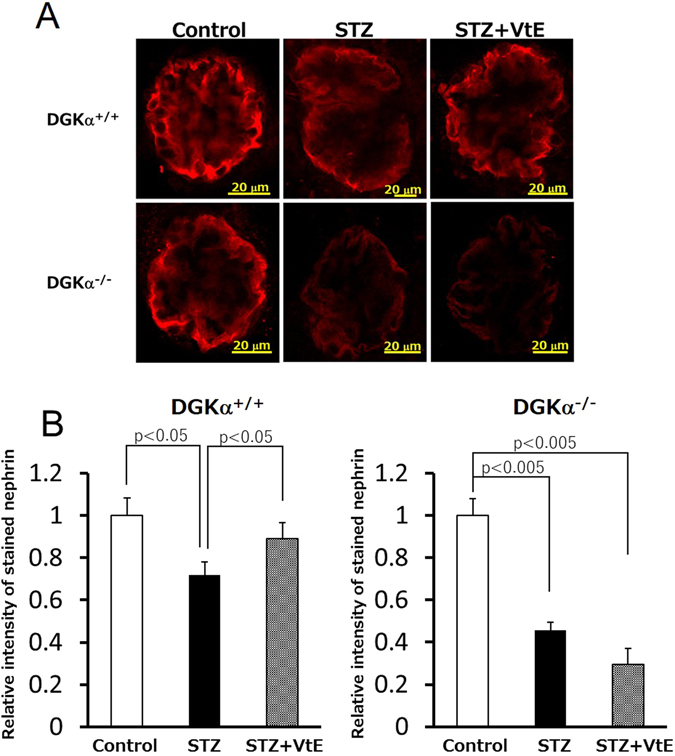
Evaluation of podocyte loss by immunofluorescent staining of nephrin. The kidneys of mice were removed at 6 weeks after STZ administration and were sectioned. We performed immunofluorescent staining of these sections using an anti-nephrin antibody. The nephrin staining (red) was observed using confocal laser microscopy (A), and the intensity of stained nephrin was analysed Image J (B).

References

    1. Berne C. The metabolism of lipids in mouse pancreatic islets, The biosynthesis of triacylglycerols and phospholipids. Biochem. J. 1975;152:667–673. doi: 10.1042/bj1520667. - DOI - PMC - PubMed
    1. Dunlop ME, Larkins RG. Pancreatic islets synthesize phospholipids de novo from glucose via acyl-dihydroxyacetone phosphate. Biochem. Biophys. Res. Commun. 1985;132:467–473. doi: 10.1016/0006-291X(85)91157-X. - DOI - PubMed
    1. Craven AP, Davidson CM, DeRubertis FR. Increase in diacylglycerol mass in isolated glomeruli by glucose from de novo synthesis of glycerolipids. Diabetes. 1990;47:667–674. doi: 10.2337/diab.39.6.667. - DOI - PubMed
    1. Koya D, King GL. Protein kinase C activation and the development of diabetic complications. Diabetes. 1998;47:859–866. doi: 10.2337/diabetes.47.6.859. - DOI - PubMed
    1. Williams B, Gallacher B, Patel H, Orme C. Glucose-induced protein kinase C activation regulates vascular permeability factor mRNA expression and peptide production by human vascular smooth muscle cells in vitro. Diabetes. 1997;46:1497–1503. doi: 10.2337/diab.46.9.1497. - DOI - PubMed

Publication types