Review
. 2017 May 18:8:817.
doi: 10.3389/fpsyg.2017.00817. eCollection 2017.

Inertial Sensors to Assess Gait Quality in Patients with Neurological Disorders: A Systematic Review of Technical and Analytical Challenges

Affiliations
Review

Inertial Sensors to Assess Gait Quality in Patients with Neurological Disorders: A Systematic Review of Technical and Analytical Challenges

Aliénor Vienne et al. Front Psychol. .

Abstract

Gait disorders are major causes of falls in patients with neurological diseases. Understanding these disorders allows prevention and better insights into underlying diseases. InertiaLocoGraphy (ILG) -the quantification of gait by using inertial measurement units (IMUs) -shows great potential to address this public health challenge, but protocols vary widely and normative values of gait parameters are still unavailable. This systematic review critically compares ILG protocols, questions features extracted from inertial signals and proposes a semeiological analysis of clinimetric characteristics for use in neurological clinical routine. For this systematic review, PubMed, Cochrane and EMBASE were searched for articles assessing gait quality by using IMUs that were published from January 1, 2014 to August 31, 2016. ILG was used to assess gait in a wide range of neurological disorders - including Parkinson disease, mild cognitive impairment, Alzheimer disease, cerebral palsy, and cerebellar atrophy - as well as in the faller or frail older population and in people presenting rheumatological pathologies. However, results have not yet been driving changes in clinical practice. One reason could be that studies mainly aimed at comparing pathological gait to healthy gait, but there is stronger need for semiological descriptions of gait perturbation, severity or prognostic assessment. Furthermore, protocols used to assess gait using IMUs are too many. Likely, outcomes are highly heterogeneous and difficult to compare across large panels of studies. Therefore, homogenization is needed to foster the use of ILG to assess gait quality in neurological routine practice. The pros and cons of each protocol are emphasized so that a compromise can be reached. As well, analysis of seven complementary clinical criteria (springiness, sturdiness, smoothness, steadiness, stability, symmetry, synchronization) is advocated.

Keywords: accelerometer; gait analysis; gait disorders; inertial measurement unit; wearable inertial sensors.


Figures
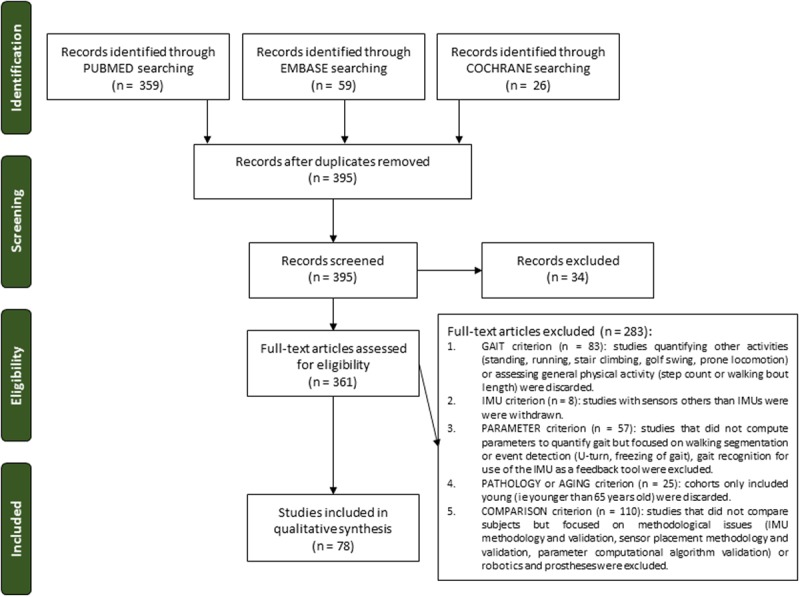
FIGURE 1
FIGURE 1
PRISMA flow chart illustrating the study selection process resulting in 78 articles included in the review. IMU, inertial measurement units.
FIGURE 2
FIGURE 2
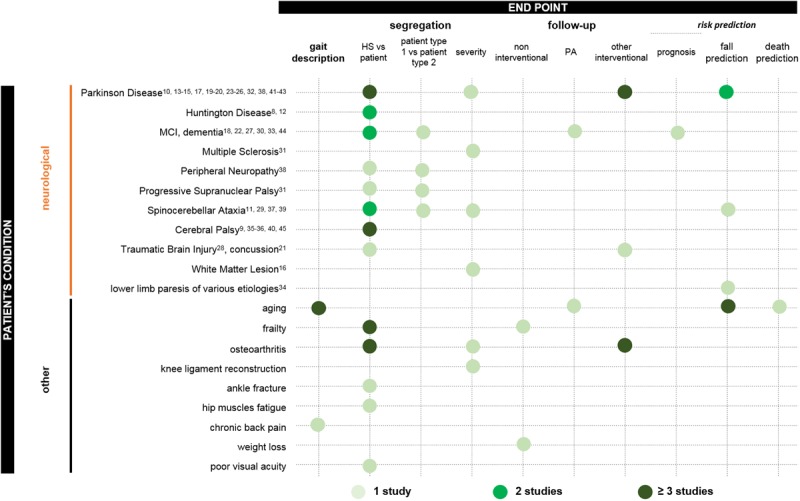
Pathologies assessed in the included studies and gait analysis in patient care. Dot colors specify the number of studies that addressed the issue. See figures for precise definition of colors.
FIGURE 3
FIGURE 3
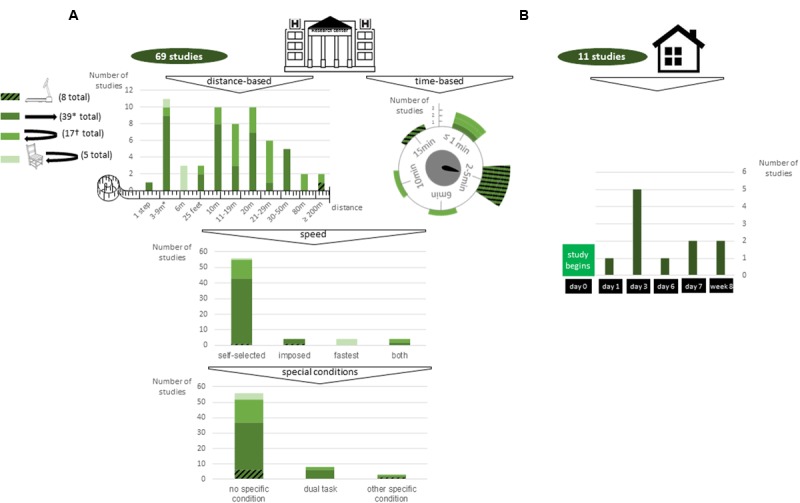
Methods for gait assessment in (A) laboratory and clinical settings and (B) ambulatory settings. Striped green: treadmill walking; dark green: unlevelled surface without U-turn; emerald green: unlevelled surface with U-turn; light green: stand up from a chair and unlevelled surface with U-turn. 2 studies were time-based but time limit was not specified; 1 study included 3 types of floor (flat floor, 8% and 20% slopes); 1 study included a trial with an obstacle. 1 study analyzed only a large U-turn (circle and square turn).
FIGURE 4
FIGURE 4
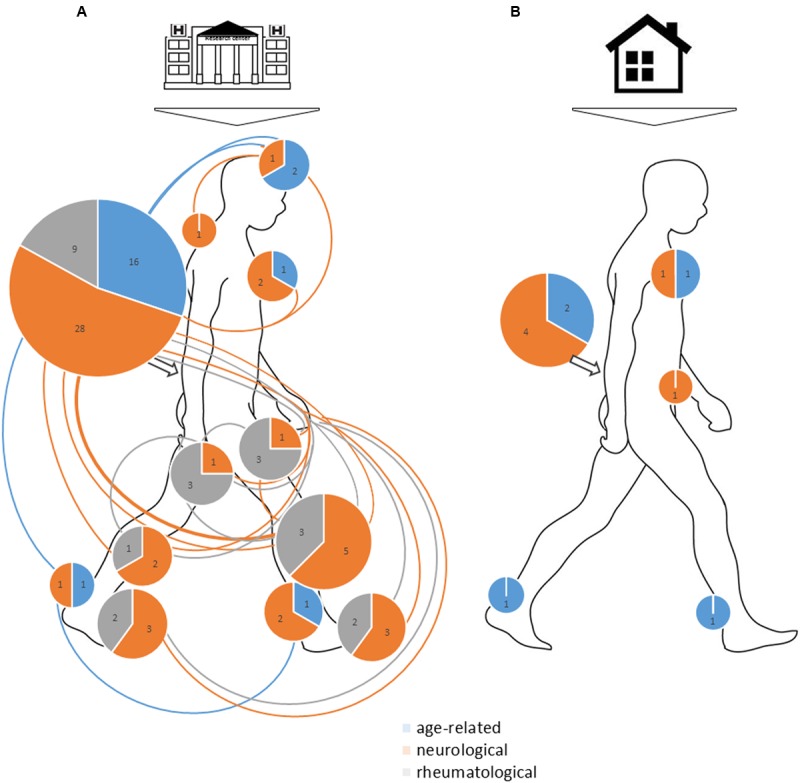
Overview of sensor position in (A) laboratory or clinical settings and (B) ambulatory settings. The size of the circles represents the total number of studies (neurological, age-related, rheumatological, others). Numbers in the circles represent the number of studies for each of these four specialties. For sensor position, one line joining several body parts represents one study using sensors attached to these body parts. When sensor was attached to a foot, ankle or thigh unilaterally, we added one study point on the right side and none on the left side.
FIGURE 5
FIGURE 5
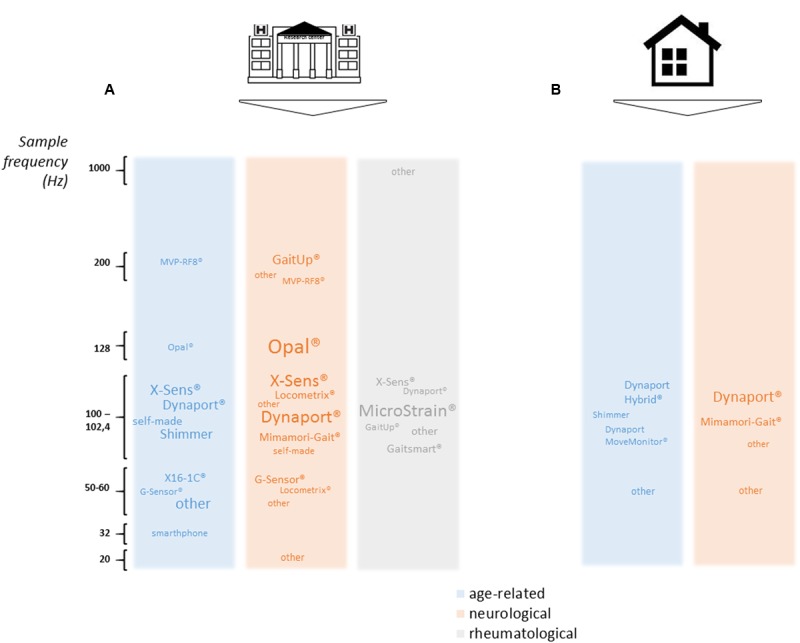
Overview of main sensors used as a function of frequencies in (A) laboratory or clinical settings and (B) ambulatory settings.
FIGURE 6
FIGURE 6
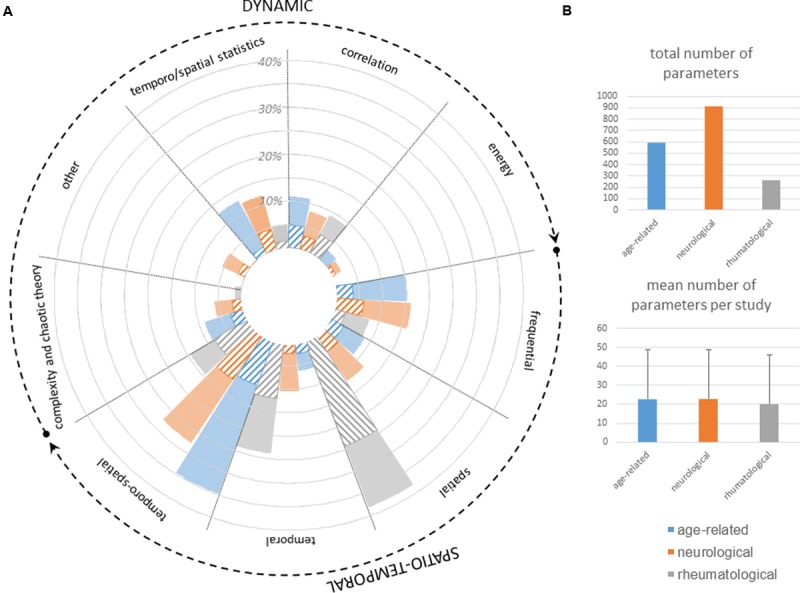
Analysis used to compute gait features of neurologic patients as well as rheumatologic and gerontologic patients for comparison. (A) Fully colored slices represent the percentage of total number of parameters computed in studies from the specialty (neurology, rheumatology, age-related) by using the method specified on top of the slice. Striped slices represent the percentage of parameters computed in studies from the specialty (neurology, rheumatology, age-related) that could discriminate between two cohorts in at least one study. (B) Total number of parameters (including all studies) and mean number per study computed in studies from the specialty (neurology, rheumatology, age-related).

References

    1. Andrzejewski K. L., Dowling A. V., Stamler D., Felong T. J., Harris D. A., Wong C.et al. (2016). Wearable sensors in huntington disease: a pilot study. J. Huntington’s Dis. 5 199–206. 10.3233/JHD-160197 - DOI - PubMed
    1. Barrois R. P., Ricard D., Oudre L., Tlili L., Provost C., Vienne A., et al. (2017). Observational study of 180° turning strategies using inertial measurement units and fall risk in post-stroke hemiparetic patients. Front. Neurol. 8:194 10.3389/fneur.2017.00194 - DOI - PMC - PubMed
    1. Beauchet O., Annweiler C., Lecordroch Y., Allali G., Dubost V., Herrmann F. R., et al. (2009). Walking speed-related changes in stride time variability: effects of decreased speed. J. Neuroeng. Rehabil. 6:32 10.1186/1743-0003-6-32 - DOI - PMC - PubMed
    1. Bloem B. R., Marinus J., Almeida Q., Dibble L., Nieuwboer A., Post B., et al. (2016). Measurement instruments to assess posture, gait, and balance in Parkinson’s Disease: critique and recommendations. Mov. Disord. 31 1342–1355. 10.1002/mds.26572 - DOI - PubMed
    1. Bragge T., Lyytinen T., Hakkarainen M., Vartiainen P., Liikavainio T., Karjalainen P. A., et al. (2014). Lower impulsive loadings following intensive weight loss after bariatric surgery in level and stair walking: a preliminary study. Knee 21 534–540. 10.1016/j.knee.2013.11.012 - DOI - PubMed