


Lactic Acid Bacteria and Bifidobacteria with Potential to Design Natural Biofunctional Health-Promoting Dairy Foods
- PMID: 28572792
- PMCID: PMC5435742
- DOI: 10.3389/fmicb.2017.00846
Lactic Acid Bacteria and Bifidobacteria with Potential to Design Natural Biofunctional Health-Promoting Dairy Foods
Abstract
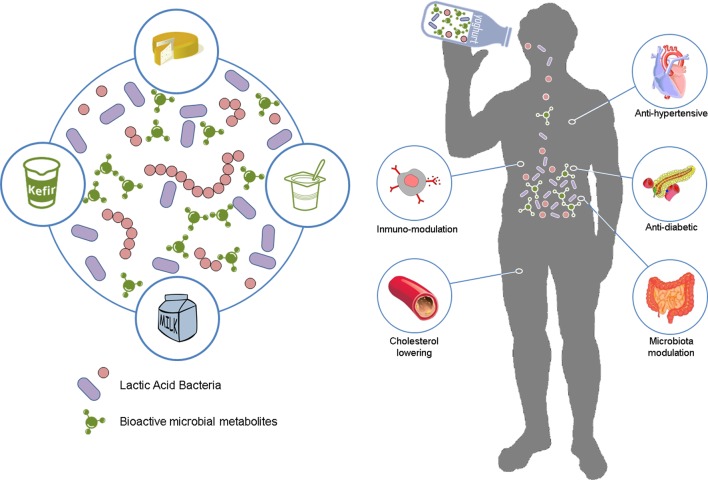
Consumer interest in healthy lifestyle and health-promoting natural products is a major driving force for the increasing global demand of biofunctional dairy foods. A number of commercial sources sell synthetic formulations of bioactive substances for use as dietary supplements. However, the bioactive-enrichment of health-oriented foods by naturally occurring microorganisms during dairy fermentation is in increased demand. While participating in milk fermentation, lactic acid bacteria can be exploited in situ as microbial sources for naturally enriching dairy products with a broad range of bioactive components that may cover different health aspects. Several of these bioactive metabolites are industrially and economically important, as they are claimed to exert diverse health-promoting activities on the consumer, such as anti-hypertensive, anti-inflammatory, and anti-diabetic, anti-oxidative, immune-modulatory, anti-cholesterolemic, or microbiome modulation. This review aims at discussing the potential of these health-supporting bacteria as starter or adjunct cultures for the elaboration of dairy foods with a broad spectrum of new functional properties and added value.
Keywords: bifidobacteria; bioactive; biofunctional food; health; lactic acid bacteria; probiotic.
Figures
References
-
- Ahmed Z., Wang Y., Cheng Q., Imran M. (2010). Lactobacillus acidophilus bacteriocin, from production to their application: an overview. Afr. J. Biotechnol. 9 2843–2850.
-
- Aragon-Alegro L. C., Alarcon-Alegro J. H., Cardarelli H. R., Chiu M. C., Saad S. M. (2007). Potentially probiotic and synbiotic chocolate mousse. LWT Food Sci. Technol. 40 669–675. 10.1016/j.lwt.2006.02.020 - DOI
-
- Araujo E. A., dos Santos Pires A. C., Pinto M. S., Jan G., Carvalho A. F. (2012). Probiotics in Dairy Fermented Products. Rijeja: Intech, 129–148.
Publication types
LinkOut - more resources
Full Text Sources
Other Literature Sources
Molecular Biology Databases
Miscellaneous
