


Prognostic significance of LINE-1 hypomethylation in oropharyngeal squamous cell carcinoma
- PMID: 28572862
- PMCID: PMC5450111
- DOI: 10.1186/s13148-017-0357-z
Prognostic significance of LINE-1 hypomethylation in oropharyngeal squamous cell carcinoma
Abstract
Background: Inclusion of new biomarkers to improve a personalized treatment approach for oropharyngeal squamous cell carcinoma (OPSCC) is urgently needed. Hypomethylation of the Long interspersed nucleotide element-1 (LINE-1) repetitive elements, a widely accepted surrogate of overall genomic DNA methylation content, was found to be associated with a poor prognosis in several cancers. At present, no studies have investigated the influence of LINE-1 methylation levels on OPSCC relapse. The main goal of this study was the evaluation of the prognostic value of LINE-1 methylation status in predicting early tumor relapse in locally advanced OPSCC.
Methods: We retrospectively reviewed a cohort of 77 patients with stage III-IVB OPSCC. Methylation of LINE-1 repetitive sequences was evaluated by real-time quantitative methylation-specific PCR in formalin-fixed paraffin-embedded tissues. The prognostic relevance of LINE-1 methylation was assessed by comparing patients who relapsed within 2 years from the end of treatment (cases) with those who did not (controls). Results were validated in an independent cohort of 33 patients with OPSCC.
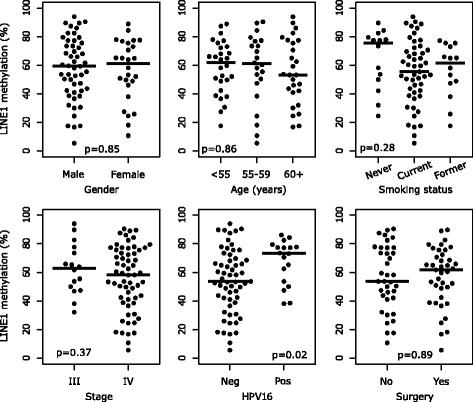
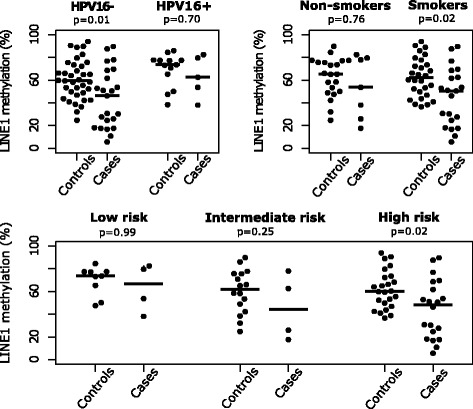
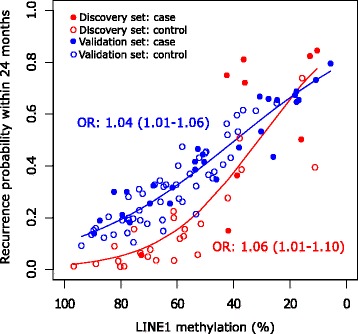
Results: With respect to early OPSCC relapse, the mean LINE-1 methylation level was significantly lower in relapsed cases than in control group (p < 0.01). Interestingly, LINE-1 methylation was lower in relapsed cases than in controls in both HPV16-negative and HPV16-positive OPSCC patients, even if statistical significance was reached only for the former group (p = 0.01). LINE-1 methylation levels were also significantly reduced in relapsed cases with respect to the controls in OPSCC current smokers (p = 0.02). Consistently, in HPV16-negative current smokers, OPSCC relapse was significantly associated with decreased levels of LINE-1 methylation (p = 0.02). Using logistic regression model, we found that patients with hypomethylated LINE-1 were associated with a 3.5 higher risk of early relapse than hypermethylated ones (OR = 3.51; 95% CI 1.03-12.00). Adjustment for potential confounders did not substantially change the risk magnitude. Results from the validation cohort confirmed the lower LINE-1 methylation in patients who early relapsed compared to relapse-free patients.
Conclusions: LINE-1 hypomethylation is associated with higher risk of early relapse in stage III-IVB OPSCC. Further validation in a prospective study is needed for its application in daily clinical practice.
Keywords: DNA methylation; HPV; LINE-1; Oropharyngeal squamous cell carcinoma.
Figures
References
-
- Lupato V, Holzinger D, Hofler D, Menegaldo A, Giorgi Rossi P, Del Mistro A, Da Mosto MC, Pawlita M, Boscolo-Rizzo P. Prevalence and Determinants of oral human papillomavirus infection in 500 young adults from Italy. PLoS One. 2017;12(1):e0170091. doi: 10.1371/journal.pone.0170091. - DOI - PMC - PubMed
Publication types
MeSH terms
LinkOut - more resources
Full Text Sources
Other Literature Sources
