


Sex differences in the associations between vagal reactivity and oppositional defiant disorder symptoms
- PMID: 28573761
- PMCID: PMC5575540
- DOI: 10.1111/jcpp.12750
Sex differences in the associations between vagal reactivity and oppositional defiant disorder symptoms
Abstract
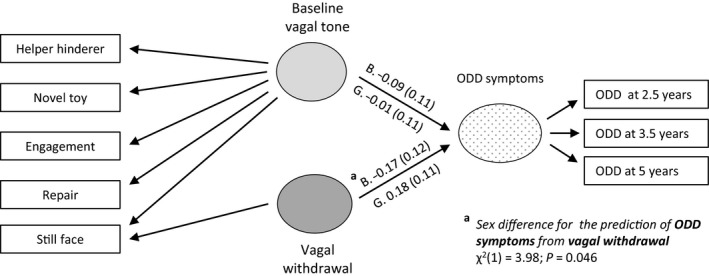
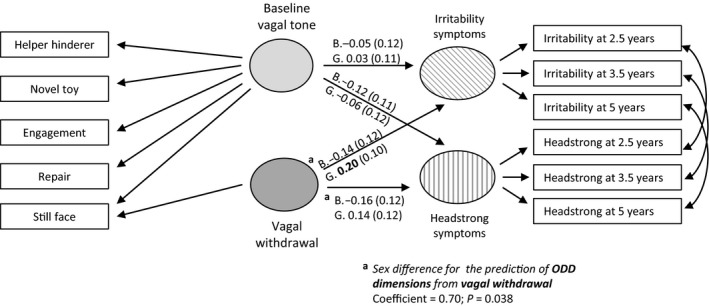
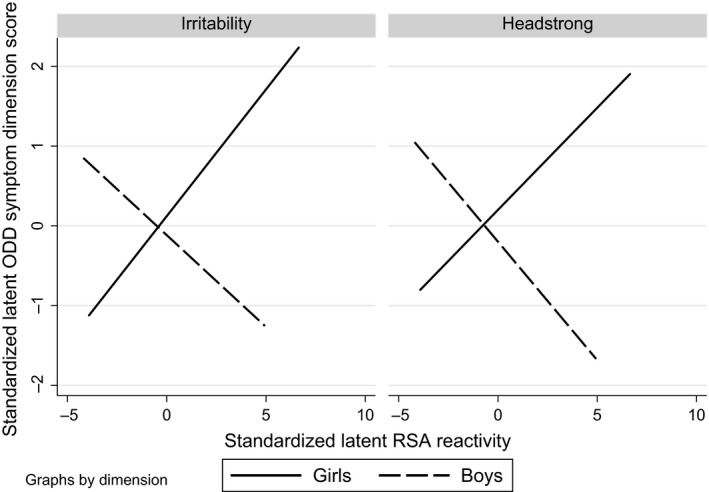
Background: Vagal reactivity to stress in children has been associated with future psychiatric outcomes. However, results have been mixed possibly because these effects are in opposite direction in boys and girls. These sex differences are relevant in the context of development of psychopathology, whereby the rates of psychiatric disorders differ by sex. In this study, we aimed to examine the association between vagal reactivity, assessed as a reduction in respiratory sinus arrhythmia (RSA) in response to a challenge, and the development of future oppositional defiant disorder (ODD) symptoms in boys and girls. In addition, we examine the specific associations with ODD symptom dimensions, named irritability and headstrong. We hypothesized that increased vagal reactivity was associated with increased ODD symptoms in girls and a reduction in ODD symptoms in boys.
Methods: Participants were members of the Wirral Child Health and Development Study, a prospective epidemiological longitudinal study of 1,233 first-time mothers recruited at 20 weeks' gestation. RSA during four nonstressful and one stressful (still-face) procedures was assessed when children were aged 29 weeks in a sample stratified by adversity (n = 270). Maternal reports of ODD symptoms were collected when children were 2.5 years old (n = 253), 3.5 years old (n = 826), and 5 years old (n = 770). Structural equation modeling (SEM) was employed to test our hypotheses.
Results: There was a significant sex difference in the prediction of ODD symptoms due to the opposite directionality in which increasing vagal reactivity was associated with an increase in ODD symptoms in girls and a reduction of ODD symptoms in boys. This Sex by Vagal reactivity interaction was common for both ODD dimensions, with no sex by dimension-specific associations.
Conclusions: Physiological reactivity to a stressful situation predicts differently ODD symptoms in boys and girls very early in life, with no difference across irritability and headstrong components. Findings are discussed in the context of the several mechanisms involved on the later development of distinct psychiatric disorders in boys and girls.
Keywords: Vagal reactivity; headstrong; irritability; oppositional defiant disorder; sex differences.
© 2017 The Authors. Journal of Child Psychology and Psychiatry published by John Wiley & Sons Ltd on behalf of Association for Child and Adolescent Mental Health.
Figures
References
-
- Achenbach, T.M. , & Rescorla, L.A. (2000). Manual for the ASEBA preschool forms and profiles. Burlington, VT: University of Vermont, Research Center for Children, Youth, and Families.
-
- Angold, A. , & Rutter, M. (1992). Effects of age and pubertal status on depression in a large clinical sample. Development and Psychopathology, 4, 5–28.
-
- Bornstein, M.H. , & Suess, P.E. (2000). Child and mother cardiac vagal tone: Continuity, stability, and concordance across the first 5 years. Developmental Psychology, 36, 54–65. - PubMed
-
- Bradley, R.H. , & Corwyn, R.F. (2002). Socioeconomic status and child development. Annual Review of Psychology, 53, 371–399. - PubMed
-
- Brennan, P.A. , Hammen, C. , Andersen, M.J. , Bor, W. , Najman, J.M. , & Williams, G.M. (2000). Chronicity, severity, and timing of maternal depressive symptoms: Relationships with child outcomes at age 5. Developmental Psychology, 36, 759–766. - PubMed
MeSH terms
Grants and funding
LinkOut - more resources
Full Text Sources
Other Literature Sources
Medical
