Review
. 2017 Dec;174(24):4637-4650.
doi: 10.1111/bph.13894. Epub 2017 Jul 7.

Rationale for targeting the Wnt signalling modulator Dickkopf-1 for oncology

Affiliations
Review

Rationale for targeting the Wnt signalling modulator Dickkopf-1 for oncology

Michael H Kagey et al. Br J Pharmacol. 2017 Dec.

Abstract

Wnt signalling is a fundamental pathway involved in embryonic development and adult tissue homeostasis. Mutations in the pathway frequently lead to developmental defects and cancer. As such, therapeutic intervention of this pathway has generated tremendous interest. Dickkopf-1 (DKK1) is a secreted inhibitor of β-catenin-dependent Wnt signalling and was originally characterized as a tumour suppressor based on the prevailing view that Wnt signalling promotes cancer pathogenesis. However, DKK1 appears to increase tumour growth and metastasis in preclinical models and its elevated expression correlates with a poor prognosis in a range of cancers, indicating that DKK1 has more complex cellular and biological functions than originally appreciated. Here, we review current evidence for the cancer-promoting activity of DKK1 and recent insights into the effects of DKK1 on signalling pathways in both cancer and immune cells. We discuss the rationale and promise of targeting DKK1 for oncology.

Linked articles: This article is part of a themed section on WNT Signalling: Mechanisms and Therapeutic Opportunities. To view the other articles in this section visit http://onlinelibrary.wiley.com/doi/10.1111/bph.v174.24/issuetoc.


Figures

Figure 1
Figure 1
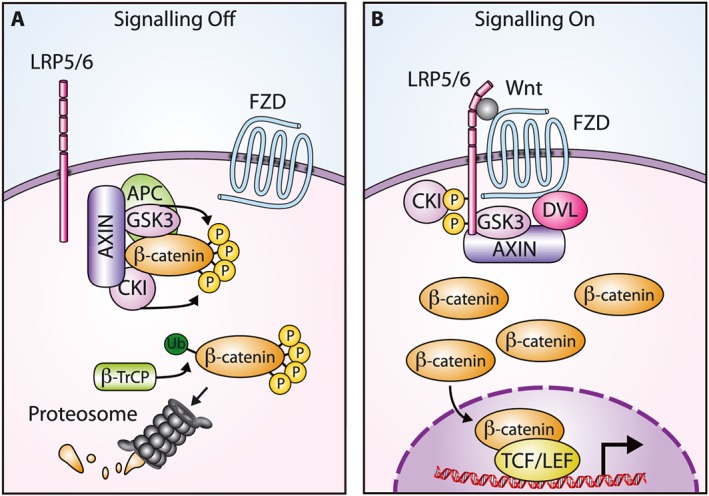
Overview of β‐catenin‐dependent Wnt signalling. (A) In the absence of Wnt, β‐catenin is bound by the ‘destruction’ complex and phosphorylated by GSK3 and casein kinase I (CKI). Phosphorylation results in targeting for ubiquitin‐mediated degradation. (B) Wnt binding to a FZD receptor and the LRP5/6 co‐receptor disrupts the ‘destruction’ complex and stabilizes β‐catenin. The β‐catenin protein translocates to the nucleus, interacts with T‐cell factor/lymphoid enhancer factor (TCF/LEF) family transcription factors and activates a Wnt‐responsive transcriptional programme. β‐TrCP, β‐transducin repeat containing protein; DVL, Dishevelled.
Figure 2
Figure 2
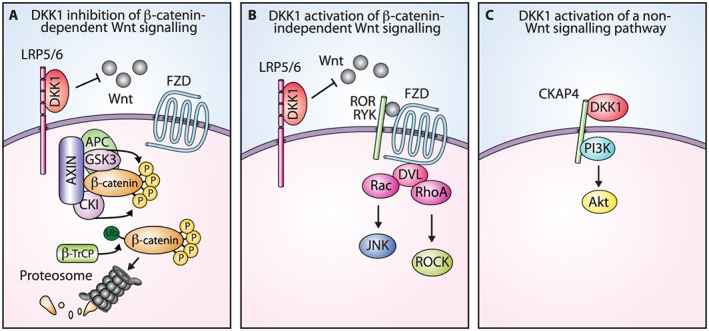
DKK1 regulation of signalling pathways. (A) DKK1 inhibition of β‐catenin‐dependent Wnt signalling. DKK1 inhibits β‐catenin‐dependent Wnt signalling by binding to the LRP5/6 co‐receptor and blocking Wnt binding, which results in β‐catenin degradation. (B) Model of DKK1 activation of β‐catenin‐independent Wnt signalling. DKK1 binding to the LRP5/6 co‐receptor shifts Wnt and the FZD receptor to β‐catenin‐independent signalling pathways. A simplified version of the β‐catenin‐independent Wnt/PCP pathway is shown as an example. (C) DKK1 activation of a non‐Wnt signalling pathway. DKK1 binds to the CKAP4 receptor and activates PI3K/Akt signalling. GSK3, glycogen synthase kinase 3; CKI, casein kinase I; β‐TrCP, β‐transducin repeat containing protein; RYK, receptor‐like tyrosine kinase; DVL, Dishevelled; ROCK, Rho‐associated protein kinase.
Figure 3
Figure 3
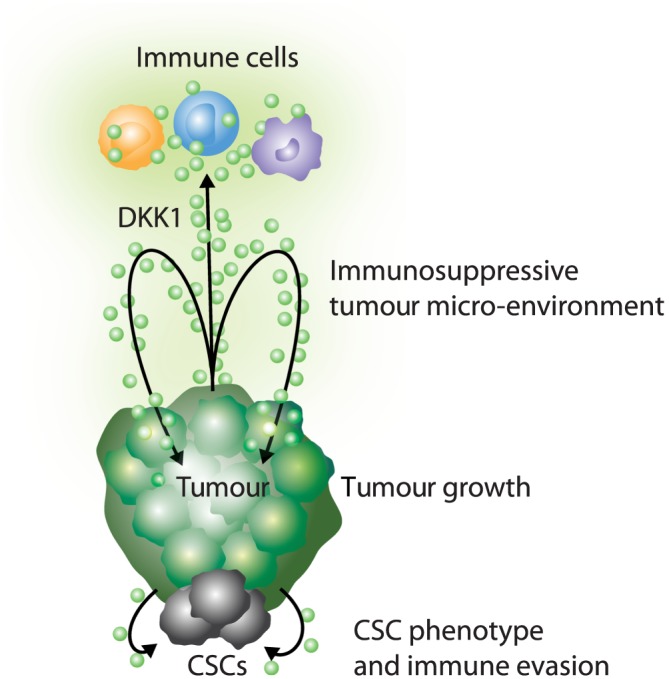
Model for DKK1 cancer‐promoting activity. DKK1 signals to tumour cells and immune cells, resulting in an immunosuppressive tumour micro‐environment, tumour growth, metastasis, a cancer stem cell (CSC) phenotype and immune evasion.

References

    1. Aguilera O, Fraga MF, Ballestar E, Paz MF, Herranz M, Espada J et al. (2006). Epigenetic inactivation of the Wnt antagonist DICKKOPF‐1 (DKK‐1) gene in human colorectal cancer. Oncogene 25: 4116–4121. - PubMed
    1. Aguilera O, Gonzalez‐Sancho JM, Zazo S, Rincon R, Fernandez AF, Tapia O et al. (2015). Nuclear DICKKOPF‐1 as a biomarker of chemoresistance and poor clinical outcome in colorectal cancer. Oncotarget 6: 5903–5917. - PMC - PubMed
    1. Ahn VE, Chu ML, Choi HJ, Tran D, Abo A, Weis WI (2011). Structural basis of Wnt signaling inhibition by Dickkopf binding to LRP5/6. Dev Cell 21: 862–873. - PMC - PubMed
    1. Alexander SPH, Davenport AP, Kelly E, Marrion N, Peters JA, Benson HE et al. (2015a). The Concise Guide to PHARMACOLOGY 2015/16: G protein‐coupled receptors. Br J Pharmacol 172: 5744–5869. - PMC - PubMed
    1. Alexander SPH, Fabbro D, Kelly E, Marrion N, Peters JA, Benson HE et al. (2015b). The Concise Guide to PHARMACOLOGY 2015/16: Catalytic receptors. Br J Pharmacol 172: 5979–6023. - PMC - PubMed

MeSH terms

Substances