Response to Antenatal Cholecalciferol Supplementation Is Associated With Common Vitamin D-Related Genetic Variants
- PMID: 28575224
- PMCID: PMC5546866
- DOI: 10.1210/jc.2017-00682
Response to Antenatal Cholecalciferol Supplementation Is Associated With Common Vitamin D-Related Genetic Variants
Abstract
Context: Single-nucleotide polymorphisms (SNPs) in genes related to vitamin D metabolism have been associated with serum 25-hydroxyvitamin D [25(OH)D] concentration, but these relationships have not been examined following antenatal cholecalciferol supplementation.
Objective: To determine whether SNPs in DHCR7, CYP2R1, CYP24A1, and GC are associated with the response to gestational cholecalciferol supplementation.
Design: Within-randomization group analysis of the Maternal Vitamin D Osteoporosis Study trial of antenatal cholecalciferol supplementation.
Setting: Hospital antenatal clinics.
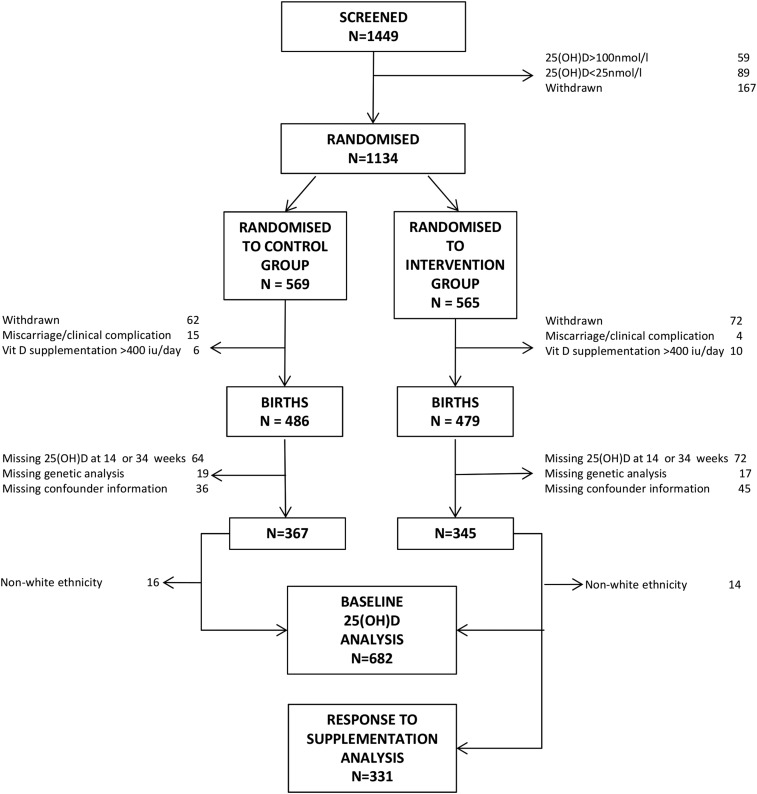
Participants: In total, 682 women of white ethnicity (351 placebo, 331 cholecalciferol) were included. SNPs at rs12785878 (DHCR7), rs10741657 (CYP2R1), rs6013897 (CYP24A1), and rs2282679 (GC) were genotyped.
Interventions: 1000 IU/d cholecalciferol from 14 weeks of gestation until delivery.
Main outcome measure: 25(OH)D at randomization and 34 weeks of gestation were measured in a single batch (Liaison; Diasorin, Dartford, UK). Associations between 25(OH)D and the SNPs were assessed by linear regression using an additive model [β represents the change in 25(OH)D per additional common allele].
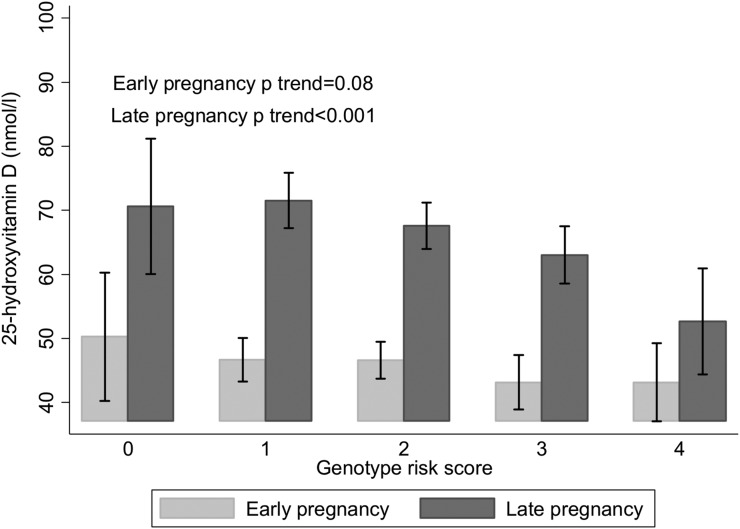
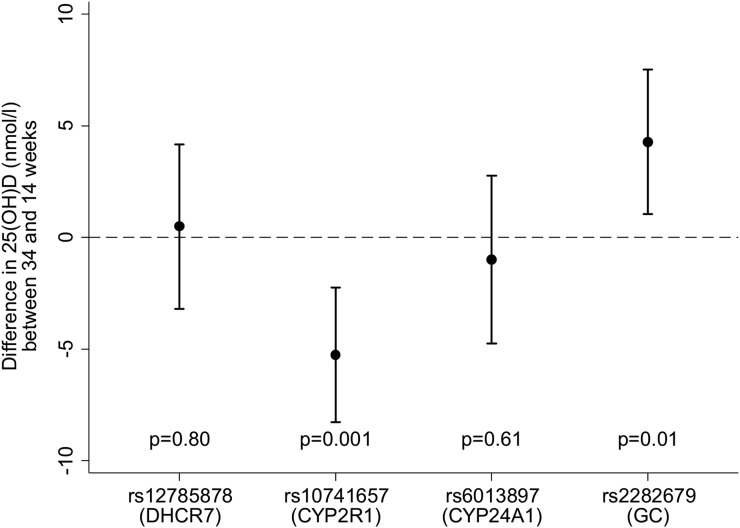
Results: Only rs12785878 (DHCR7) was associated with baseline 25(OH)D [β = 3.1 nmol/L; 95% confidence interval (CI), 1.0 to 5.2 nmol/L; P < 0.004]. In contrast, rs10741657 (CYP2R1) (β = -5.2 nmol/L; 95% CI, -8.2 to -2.2 nmol/L; P = 0.001) and rs2282679 (GC) (β = 4.2 nmol/L; 95% CI, 0.9 to 7.5 nmol/L; P = 0.01) were associated with achieved 25(OH)D status following supplementation, whereas rs12785878 and rs6013897 (CYP24A1) were not.
Conclusions: Genetic variation in DHCR7, which encodes 7-dehyrocholesterol reductase in the epidermal vitamin D biosynthesis pathway, appears to modify baseline 25(OH)D. In contrast, the response to antenatal cholecalciferol supplementation was associated with SNPs in CYP2R1, which may alter 25-hydroxylase activity, and GC, which may affect vitamin D binding protein synthesis or metabolite affinity.
Copyright © 2017 Endocrine Society
Figures
Comment in
-
Letter to the Editor: Genetics and Vitamin D Supplementation in Pregnancy.J Clin Endocrinol Metab. 2017 Sep 1;102(9):3563-3564. doi: 10.1210/jc.2017-01318. J Clin Endocrinol Metab. 2017. PMID: 28911161 No abstract available.
-
Response to Letter: Genetics and Vitamin D Supplementation in Pregnancy.J Clin Endocrinol Metab. 2017 Sep 1;102(9):3565-3566. doi: 10.1210/jc.2017-01406. J Clin Endocrinol Metab. 2017. PMID: 28911164 Free PMC article. No abstract available.
References
-
- National Institute for Health and Clinical Excellence. Antenatal care (NICE Clinical Guideline 62). Available at: www.guidance.nice.org.uk/cg622010. Accessed September 2016.
-
- Paxton GA, Teale GR, Nowson CA, Mason RS, McGrath JJ, Thompson MJ, Siafarikas A, Rodda CP, Munns CF; Australian and New Zealand Bone and Mineral Society; Osteoporosis Australia . Vitamin D and health in pregnancy, infants, children and adolescents in Australia and New Zealand: a position statement. Med J Aust. 2013;198(3):142–143. - PubMed
-
- Holick MF, Binkley NC, Bischoff-Ferrari HA, Gordon CM, Hanley DA, Heaney RP, Murad MH, Weaver CM; Endocrine Society . Evaluation, treatment, and prevention of vitamin D deficiency: an Endocrine Society clinical practice guideline. J Clin Endocrinol Metab. 2011;96(7):1911–1930. - PubMed
-
- Javaid MK, Crozier SR, Harvey NC, Gale CR, Dennison EM, Boucher BJ, Arden NK, Godfrey KM, Cooper C; Princess Anne Hospital Study Group . Maternal vitamin D status during pregnancy and childhood bone mass at age 9 years: a longitudinal study. Lancet. 2006;367(9504):36–43. - PubMed
Publication types
MeSH terms
Substances
Associated data
Grants and funding
- 17702/VAC_/Versus Arthritis/United Kingdom
- MC_UP_A620_1015/MRC_/Medical Research Council/United Kingdom
- 21231/VAC_/Versus Arthritis/United Kingdom
- MC_UU_12011/2/MRC_/Medical Research Council/United Kingdom
- 21231/ARC_/Arthritis Research UK/United Kingdom
- 201222/Z/16/Z/WT_/Wellcome Trust/United Kingdom
- MC_U147585819/MRC_/Medical Research Council/United Kingdom
- MC_UP_A620_1014/MRC_/Medical Research Council/United Kingdom
- MC_U147574218/MRC_/Medical Research Council/United Kingdom
- HTA/10/33/04/DH_/Department of Health/United Kingdom
- MC_UU_12011/4/MRC_/Medical Research Council/United Kingdom
- MC_U147585824/MRC_/Medical Research Council/United Kingdom
- MC_U147585827/MRC_/Medical Research Council/United Kingdom
- 4050502589/MRC_/Medical Research Council/United Kingdom
- MC_U105960371/MRC_/Medical Research Council/United Kingdom
- 17702/ARC_/Arthritis Research UK/United Kingdom
- 201268/Z/16/Z/WT_/Wellcome Trust/United Kingdom
- 10/33/04/DH_/Department of Health/United Kingdom
- MC_UU_12011/1/MRC_/Medical Research Council/United Kingdom
LinkOut - more resources
Full Text Sources
Other Literature Sources
Medical
Miscellaneous