


Remote management of heart failure using implantable electronic devices
- PMID: 28575235
- PMCID: PMC5837548
- DOI: 10.1093/eurheartj/ehx227
Remote management of heart failure using implantable electronic devices
Abstract
Aims: Remote management of heart failure using implantable electronic devices (REM-HF) aimed to assess the clinical and cost-effectiveness of remote monitoring (RM) of heart failure in patients with cardiac implanted electronic devices (CIEDs).
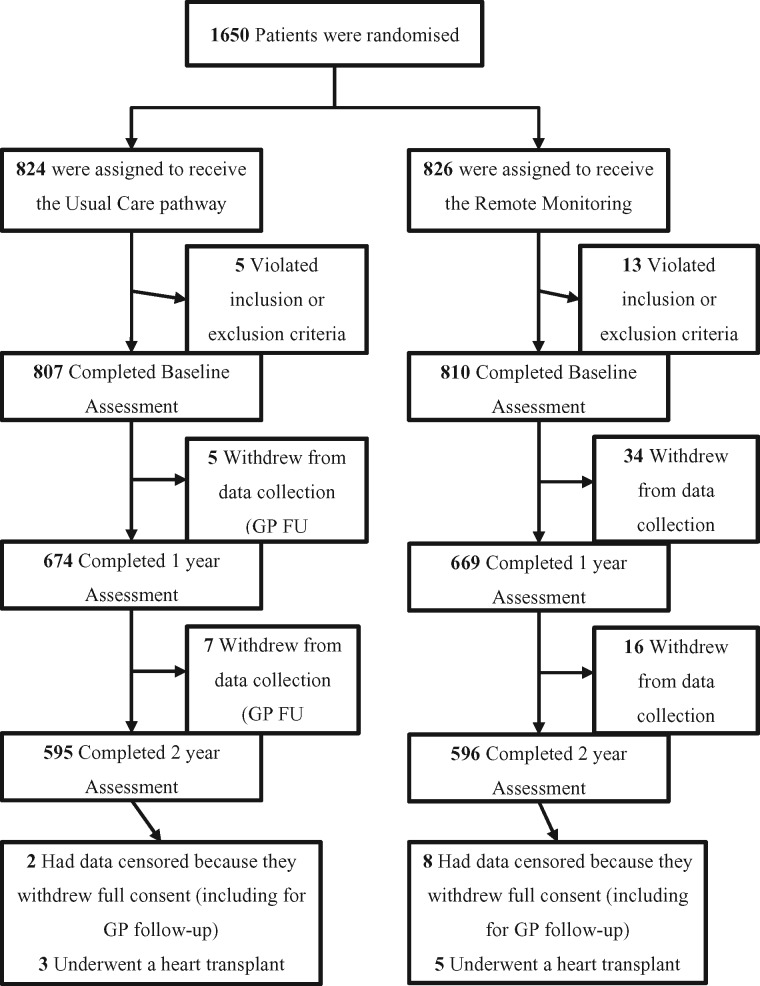
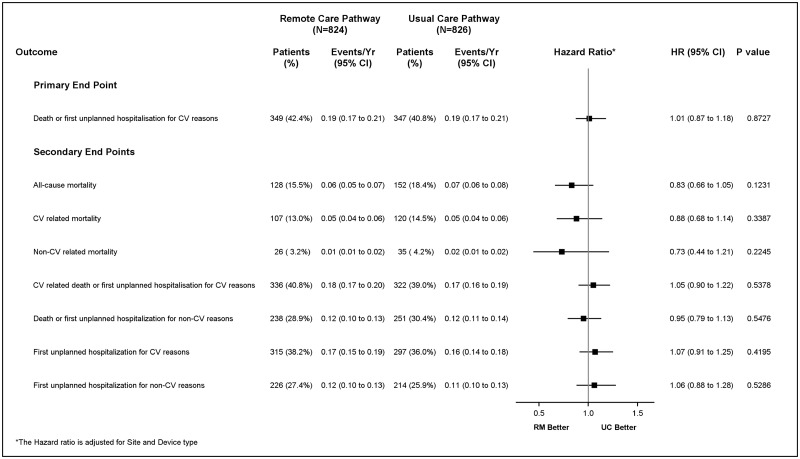
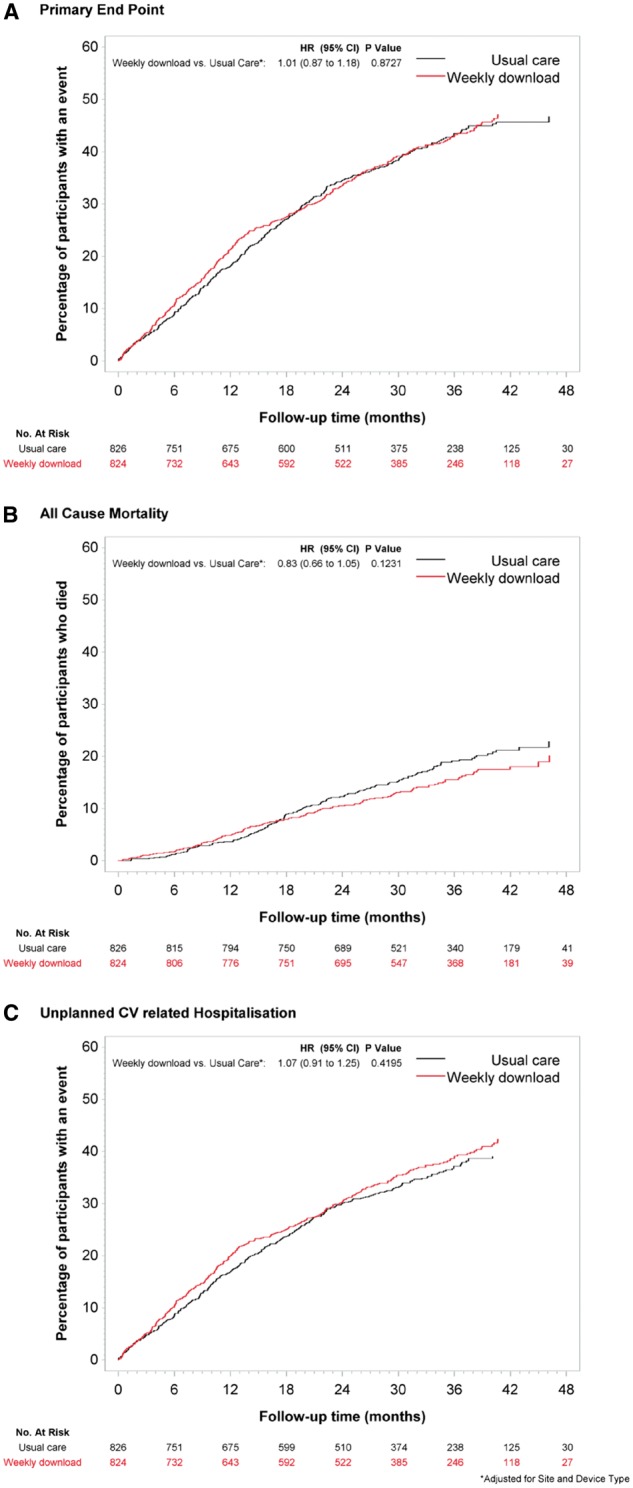
Methods and results: Between 29 September 2011 and 31 March 2014, we randomly assigned 1650 patients with heart failure and a CIED to active RM or usual care (UC). The active RM pathway included formalized remote follow-up protocols, and UC was standard practice in nine recruiting centres in England. The primary endpoint in the time to event analysis was the 1st event of death from any cause or unplanned hospitalization for cardiovascular reasons. Secondary endpoints included death from any cause, death from cardiovascular reasons, death from cardiovascular reasons and unplanned cardiovascular hospitalization, unplanned cardiovascular hospitalization, and unplanned hospitalization. REM-HF is registered with ISRCTN (96536028). The mean age of the population was 70 years (range 23-98); 86% were male. Patients were followed for a median of 2.8 years (range 0-4.3 years) completing on 31 January 2016. Patient adherence was high with a drop out of 4.3% over the course of the study. The incidence of the primary endpoint did not differ significantly between active RM and UC groups, which occurred in 42.4 and 40.8% of patients, respectively [hazard ratio 1.01; 95% confidence interval (CI) 0.87-1.18; P = 0.87]. There were no significant differences between the two groups with respect to any of the secondary endpoints or the time to the primary endpoint components.
Conclusion: Among patients with heart failure and a CIED, RM using weekly downloads and a formalized follow up approach does not improve outcomes.
Keywords: Heart failure; Implantable devices; Remote monitoring.
© The Author 2017. Published by Oxford University Press on behalf of the European Society of Cardiology.
Figures
Comment in
-
Making sense of remote monitoring studies in heart failure.Eur Heart J. 2017 Aug 7;38(30):2361-2363. doi: 10.1093/eurheartj/ehx293. Eur Heart J. 2017. PMID: 28633379 No abstract available.
References
-
- Gheorghiade M, Vaduganathan M, Fonarow GC, Bonow RO.. Rehospitalisation for heart failure: problems and perspectives. J Am Coll Cardiol 2013;61:391–403. - PubMed
-
- Maggioni AP, Dahlström U, Filippatos G, Chioncel O, Crespo Leiro M, Drozdz J, Fruhwald F, Gullestad L, Logeart D, Fabbri G, Urso R, Metra M, Parissis J, Persson H, Ponikowski P, Rauchhaus M, Voors AA, Nielsen OW, Zannad F, Tavazzi L; Heart Failure Association of the European Society of Cardiology (HFA) . EURObservational research programme: regional differences and 1-year follow-up results of the Heart Failure Pilot Survey (ESC-Pilot). Eur J Heart Fail 2013; 15:808–817. - PubMed
-
- Small RS. Integrating device-based monitoring into clinical practice: insights from a large heart failure clinic. Am J Cardiol 2007;21:17G–22G. - PubMed
-
- Morgan JM, Dimitrov BD, Gill J, Kitt S, Ng GA, McComb JM, Raftery J, Roderick P, Seed A, Williams SG, Witte KK, Wright DJ, Yao GL, Cowie MR.. Rationale and study design of the REM-HF study: remote management of heart failure using implanted devices and formalised follow-up procedures. Eur J Heart Fail 2014;16:1039–1045. - PubMed
Publication types
MeSH terms
Grants and funding
LinkOut - more resources
Full Text Sources
Other Literature Sources
Medical
Research Materials
Miscellaneous
