


Long-term exposure to road traffic noise, ambient air pollution, and cardiovascular risk factors in the HUNT and lifelines cohorts
- PMID: 28575405
- PMCID: PMC5837618
- DOI: 10.1093/eurheartj/ehx263
Long-term exposure to road traffic noise, ambient air pollution, and cardiovascular risk factors in the HUNT and lifelines cohorts
Abstract
Aims: Blood biochemistry may provide information on associations between road traffic noise, air pollution, and cardiovascular disease risk. We evaluated this in two large European cohorts (HUNT3, Lifelines).
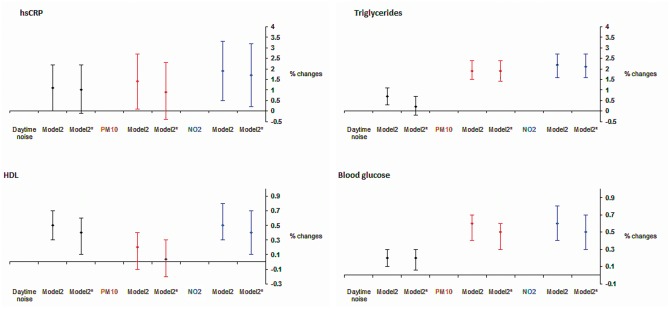
Methods and results: Road traffic noise exposure was modelled for 2009 using a simplified version of the Common Noise Assessment Methods in Europe (CNOSSOS-EU). Annual ambient air pollution (PM10, NO2) at residence was estimated for 2007 using a Land Use Regression model. The statistical platform DataSHIELD was used to pool data from 144 082 participants aged ≥20 years to enable individual-level analysis. Generalized linear models were fitted to assess cross-sectional associations between pollutants and high-sensitivity C-reactive protein (hsCRP), blood lipids and for (Lifelines only) fasting blood glucose, for samples taken during recruitment in 2006-2013. Pooling both cohorts, an inter-quartile range (IQR) higher day-time noise (5.1 dB(A)) was associated with 1.1% [95% confidence interval (95% CI: 0.02-2.2%)] higher hsCRP, 0.7% (95% CI: 0.3-1.1%) higher triglycerides, and 0.5% (95% CI: 0.3-0.7%) higher high-density lipoprotein (HDL); only the association with HDL was robust to adjustment for air pollution. An IQR higher PM10 (2.0 µg/m3) or NO2 (7.4 µg/m3) was associated with higher triglycerides (1.9%, 95% CI: 1.5-2.4% and 2.2%, 95% CI: 1.6-2.7%), independent of adjustment for noise. Additionally for NO2, a significant association with hsCRP (1.9%, 95% CI: 0.5-3.3%) was seen. In Lifelines, an IQR higher noise (4.2 dB(A)) and PM10 (2.4 µg/m3) was associated with 0.2% (95% CI: 0.1-0.3%) and 0.6% (95% CI: 0.4-0.7%) higher fasting glucose respectively, with both remaining robust to adjustment for air/noise pollution.
Conclusion: Long-term exposures to road traffic noise and ambient air pollution were associated with blood biochemistry, providing a possible link between road traffic noise/air pollution and cardio-metabolic disease risk.
Keywords: Air pollution; Blood glucose; Blood lipids; Systemic inflammation; Traffic noise.
Published on behalf of the European Society of Cardiology. All rights reserved. © The Author 2017. For permissions, please email: journals.permissions@oup.com.
Figures
Comment in
-
Environmental stressors and cardiovascular disease: the evidence is growing.Eur Heart J. 2017 Aug 1;38(29):2297-2299. doi: 10.1093/eurheartj/ehx306. Eur Heart J. 2017. PMID: 28641401 No abstract available.
References
-
- Brook RD, Rajagopalan S, Pope CA III, Brook JR, Bhatnagar A, Diez-Roux AV, Holguin F, Hong Y, Luepker RV, Mittleman MA, Peters A, Siscovick D, Smith SC Jr, Whitsel L, Kaufman JD; American Heart Association Council on Epidemiology and Prevention, Council on the Kidney in Cardiovascular Disease, and Council on Nutrition, Physical Activity and Metabolism. Particulate matter air pollution and cardiovascular disease: an update to the scientific statement from the American Heart Association. Circulation 2010;121:2331–2378. - PubMed
-
- Babisch W. Updated exposure-response relationship between road traffic noise and coronary heart diseases: a meta-analysis. Noise Health 2014;16:1–9. - PubMed
-
- Brindley DN, McCann BS, Niaura R, Stoney CM, Suarez EC.. Stress and lipoprotein metabolism: modulators and mechanisms. Metabolism 1993;42:3–15. - PubMed
Publication types
MeSH terms
Substances
Grants and funding
LinkOut - more resources
Full Text Sources
Other Literature Sources
Medical
Research Materials
Miscellaneous
