. 2017 Jun 1;100(6):907-925.
doi: 10.1016/j.ajhg.2017.05.006.

YY1 Haploinsufficiency Causes an Intellectual Disability Syndrome Featuring Transcriptional and Chromatin Dysfunction

Affiliations

YY1 Haploinsufficiency Causes an Intellectual Disability Syndrome Featuring Transcriptional and Chromatin Dysfunction

Michele Gabriele et al. Am J Hum Genet. .

Abstract

Yin and yang 1 (YY1) is a well-known zinc-finger transcription factor with crucial roles in normal development and malignancy. YY1 acts both as a repressor and as an activator of gene expression. We have identified 23 individuals with de novo mutations or deletions of YY1 and phenotypic features that define a syndrome of cognitive impairment, behavioral alterations, intrauterine growth restriction, feeding problems, and various congenital malformations. Our combined clinical and molecular data define "YY1 syndrome" as a haploinsufficiency syndrome. Through immunoprecipitation of YY1-bound chromatin from affected individuals' cells with antibodies recognizing both ends of the protein, we show that YY1 deletions and missense mutations lead to a global loss of YY1 binding with a preferential retention at high-occupancy sites. Finally, we uncover a widespread loss of H3K27 acetylation in particular on the YY1-bound enhancers, underscoring a crucial role for YY1 in enhancer regulation. Collectively, these results define a clinical syndrome caused by haploinsufficiency of YY1 through dysregulation of key transcriptional regulators.

Keywords: H3K27Ac; YY1; chromatin; enhancer; epigenetics; haploinsufficiency; intellectual disability; neurodevelopment; syndrome; transcription factor.


Figures

Figure 1
Figure 1
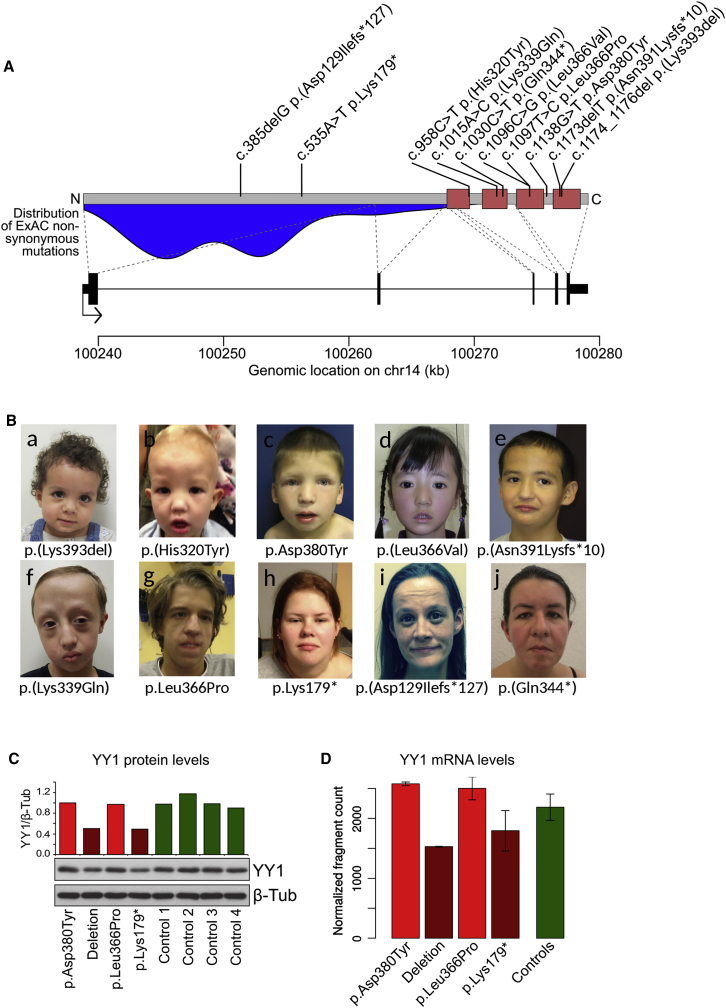
Description of the Cohort (A) YY1 locus, including the location of the mutations identified in this study (top) and the (smoothed) frequency of non-pathogenic (missense) mutations in the ExAC Browser (in blue, bottom). (B) Frontal photographs sorted by age of individuals with YY1 mutations (a–j). Recurrent facial dysmorphism includes facial asymmetry, a broad forehead, fullness of the upper eyelids, and an upper lip shaped like a Gingko leaf. Each individual or his or her parents provided informed consent for the publication of these photographs. (C and D) YY1 levels in affected individuals’ LCLs as measured by western blot (C; the y axis indicates the ratio to β-tubulin, normalized on the first sample) and RNA-seq (D). In (D), each bar represents the mean across two samples for the probands and nine samples for the control individuals; error bars indicate standard deviation.
Figure 2
Figure 2
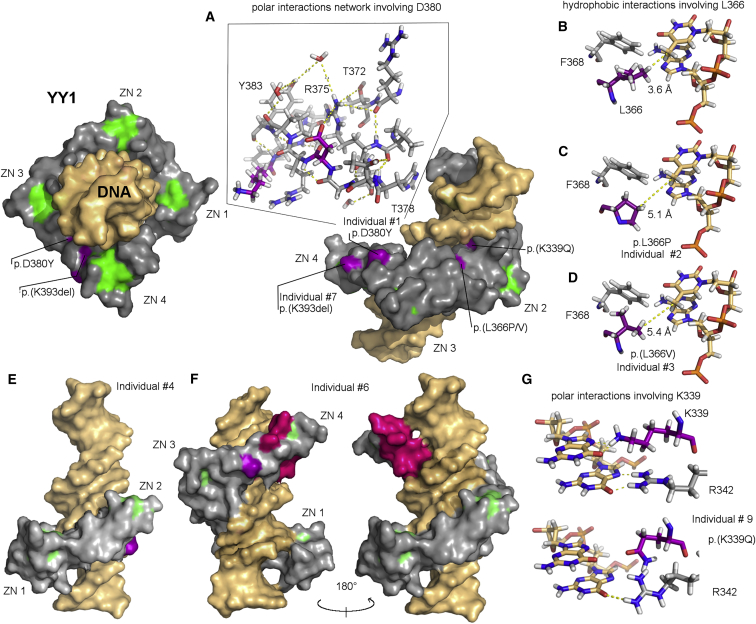
YY1 Variants on the 3D Structure of the Protein’s DNA Binding Domain The 3D structure of wild-type YY1’s C-terminal zinc-finger (ZN) domain is represented as a gray surface surrounding DNA, represented in gold. ZN coordination regions are reported in light green, and missense mutated amino acid residues are reported in violet. (A) Residues involved in polar interactions with D380 are reported in gray sticks. Hydrogen bonds are represented as yellow dashes. (B–D) Nucleotides interacting with residues L366 and F368 are reported in sticks. Distances between L366 (B), or its variants in individuals 2 (C) and 3 (D), and the closest nucleotides are reported with yellow dashes. (E) Putative structure of the truncated form of YY1 in proband 4 is reported through depiction of its electrostatic surface. (F) C-terminal portion of YY1 affected by proband 6 (variant in pink). The structure of the DNA-YY1 complex is reported from two opposite observation sides to highlight (1) its importance for ZN coordination in the fourth ZN and (2) its role in DNA binding. (G) Nucleotides interacting with K339 and R342 are reported in sticks. Polar interactions are reported with yellow dashes.
Figure 3
Figure 3
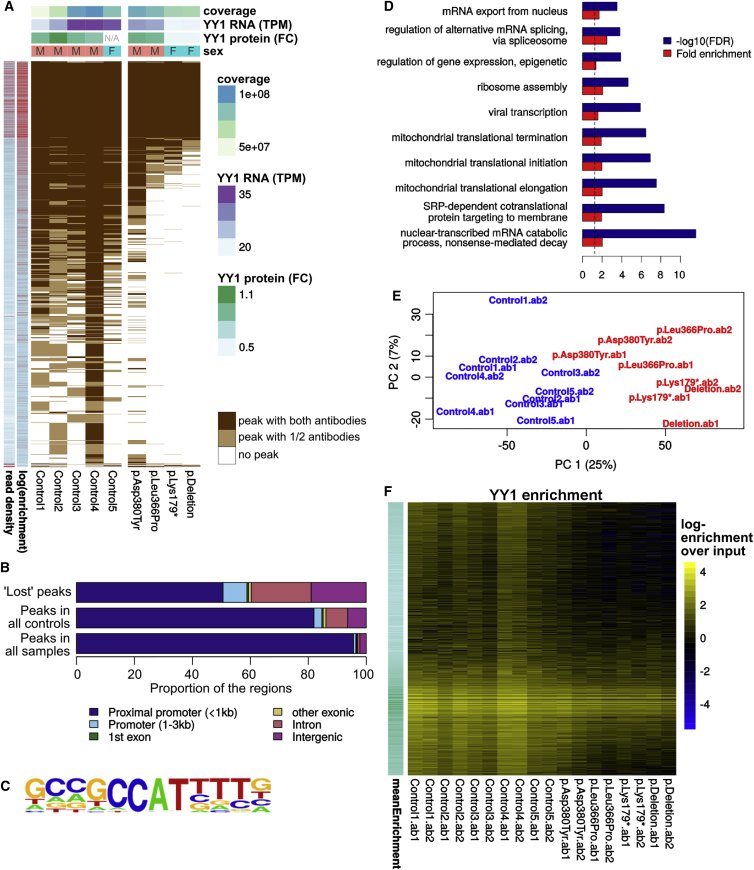
ChIP-Seq for YY1 in LCLs Derived from Affected Individuals (A) Overlap between the peaks detected in each sample and each antibody. Each horizontal line represents a peak, shown in white if it was undetected in a sample, in light brown if it was detected in only one of the two IPs, and in dark brown if it was detected with both antibodies. Above are shown the sex of each LCL line, the YY1 mRNA expression and protein levels, and the coverage of the corresponding ChIP-seq experiments. TPM stands for transcripts per million, and FC stands for fold change in relation to the control samples. In red on the left are shown the average log-transformed read density and log enrichment for each peak. (B) Distribution of conserved and “lost” YY1 peaks across genomic features. (C) Dominant YY1 DNA-binding motif identified. (D) Top most-specific Gene Ontology (GO) enrichments of the YY1 target genes. (E) Principal-component analysis of the log-transformed enrichments over the input across the union of YY1-enriched regions. (F) YY1 enrichment over input across the different IPs (columns) and enriched regions (rows).
Figure 4
Figure 4
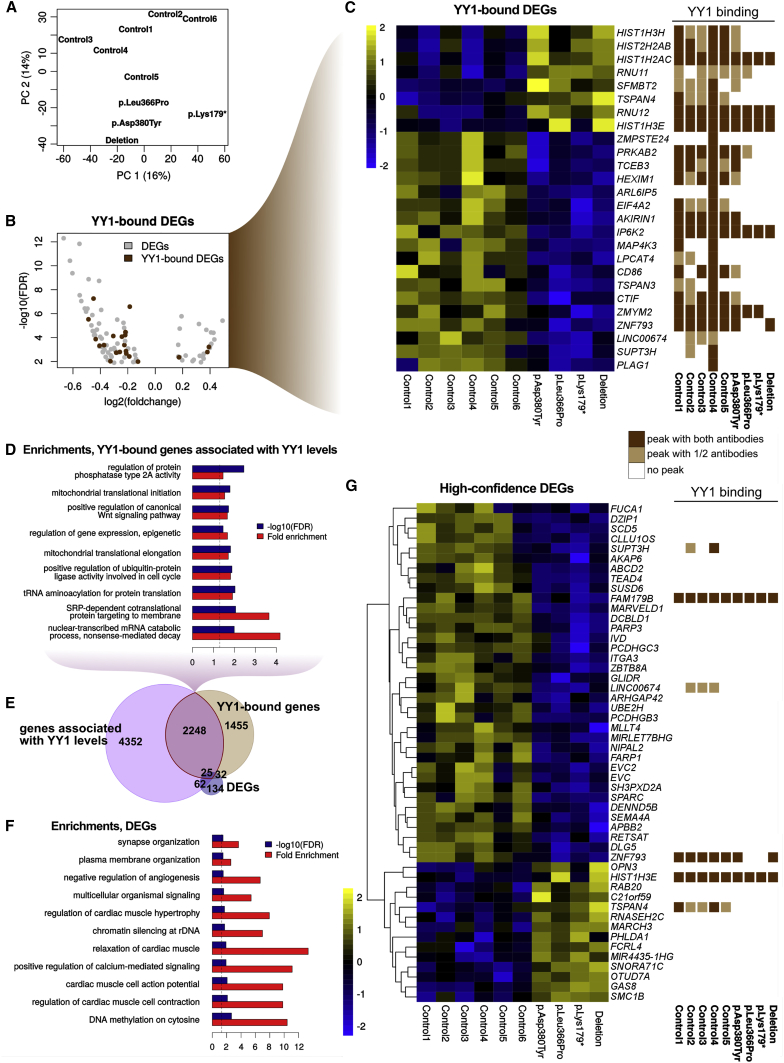
Transcriptional Impact of the YY1 Mutation (A) Principal-component analysis of the RNA-seq dataset. (B) Volcano plot of the differentially expressed genes (DEGs) highlights YY1-bound genes. (C) Expression of YY1-bound DEGs (left), along with the detected YY1 peaks at their TSS (right). (D) Top most-specific GO enrichments of the YY1-bound genes that show a significant association with YY1 mRNA levels across HapMap LCLs. (E) Overlap between the DEGs and YY1-bound and YY1-associated genes. (F) Top most-specific GO enrichments of all DEGs. (G) Expression of high-confidence DEGs (consistently dysregulated in the meta-analysis with the HapMap LCLs), along with eventual YY1 bindings at their TSS. In (C) and (G), expression is shown as Z scores of log-transformed normalized counts, and YY1 binding is indicated in light brown if it was detected in only one of the two IPs and in dark brown if it was detected with both antibodies.
Figure 5
Figure 5
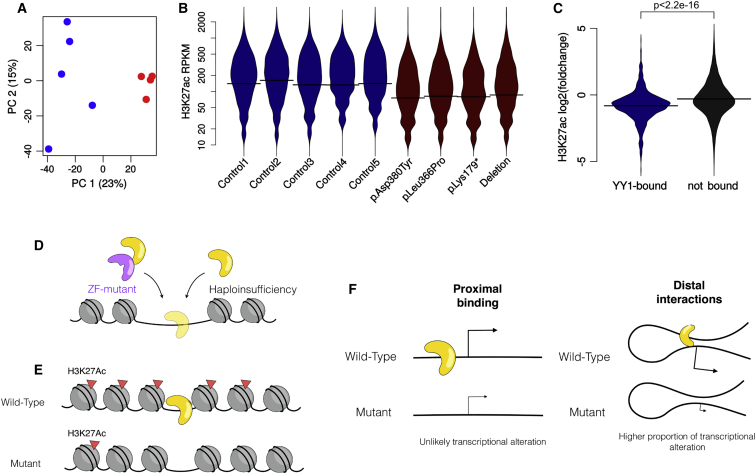
YY1 Haploinsufficiency Results in Enhancer Dysregulation (A) Principal-component analysis of the H3K27ac read-count distribution across all enriched regions segregates proband from control samples (probands in red and controls in blue). (B) Distribution of H3K27ac read densities at YY1-bound enhancers shows a marked reduction in probands. RPKM stands for reads per kilobase pair per million reads mapped. (C) Preferential loss of H3K27ac at YY1-bound versus non-YY1-bound enhancers. The p value is the result of a two-tailed t-test. (D–F) Schematic representation of our key findings: YY1 haploinsufficiency and variants in the zinc-finger domain both result in a global loss of YY1 binding (D), associated with loss of H3K27ac (E); only a minority of differentially bound genes are differentially expressed, and the proportion is significantly higher for distal YY1 bindings (F).

References

    1. Vissers L.E.L.M., de Ligt J., Gilissen C., Janssen I., Steehouwer M., de Vries P., van Lier B., Arts P., Wieskamp N., del Rosario M. A de novo paradigm for mental retardation. Nat. Genet. 2010;42:1109–1112. - PubMed
    1. Shi Y., Seto E., Chang L.S., Shenk T. Transcriptional repression by YY1, a human GLI-Krüppel-related protein, and relief of repression by adenovirus E1A protein. Cell. 1991;67:377–388. - PubMed
    1. Park K., Atchison M.L. Isolation of a candidate repressor/activator, NF-E1 (YY-1, delta), that binds to the immunoglobulin kappa 3′ enhancer and the immunoglobulin heavy-chain mu E1 site. Proc. Natl. Acad. Sci. USA. 1991;88:9804–9808. - PMC - PubMed
    1. Hariharan N., Kelley D.E., Perry R.P. Delta, a transcription factor that binds to downstream elements in several polymerase II promoters, is a functionally versatile zinc finger protein. Proc. Natl. Acad. Sci. USA. 1991;88:9799–9803. - PMC - PubMed
    1. Woo C.J., Kharchenko P.V., Daheron L., Park P.J., Kingston R.E. A region of the human HOXD cluster that confers polycomb-group responsiveness. Cell. 2010;140:99–110. - PMC - PubMed

MeSH terms