


Themes and variations in gene regulation by extracytoplasmic function (ECF) sigma factors
- PMID: 28575802
- PMCID: PMC5534382
- DOI: 10.1016/j.mib.2017.05.004
Themes and variations in gene regulation by extracytoplasmic function (ECF) sigma factors
Abstract
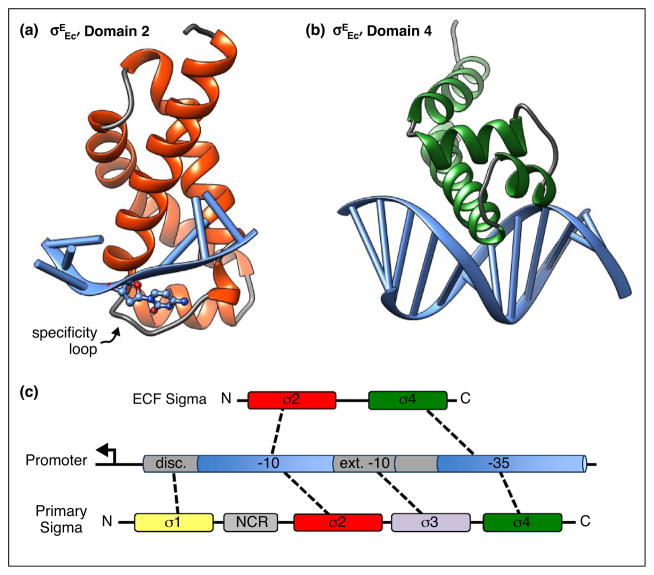
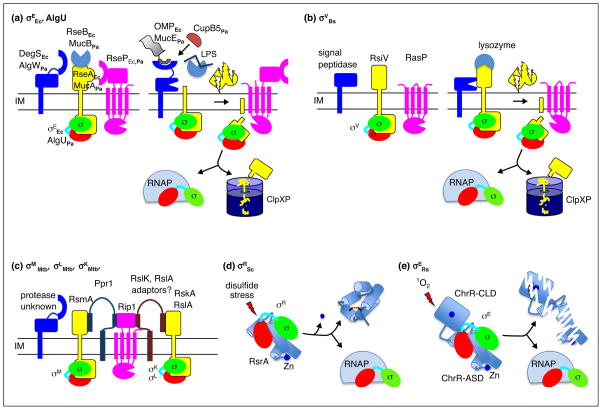
The ECF sigma family was identified 23 years ago as a distinct group of σ70-like factors. ECF sigma factors have since emerged as a major form of bacterial signal transduction that can be grouped into over 50 phylogenetically distinct subfamilies. Advances in our understanding of these sigma factors and the signaling pathways governing their activity have elucidated conserved features as well as aspects that have evolved over time. All ECF sigma factors are predicted to share a common streamlined domain structure and mode of promoter interaction. The activity of most ECF sigma factors is controlled by an anti-sigma factor. The nature of the anti-sigma factor and the activating signaling pathways appear to be conserved within ECF families, while considerable diversity exists between different families.
Copyright © 2017 Elsevier Ltd. All rights reserved.
Figures
References
-
- Buttner MJ, Smith AM, Bibb MJ. At least three different RNA polymerase holoenzymes direct transcription of the agarase gene (dagA) of Streptomyces coelicolor A3(2) Cell. 1988;52:599–607. - PubMed
-
- Erickson JW, Gross CA. Identification of the sigma E subunit of Escherichia coli RNA polymerase: a second alternate sigma factor involved in high-temperature gene expression. Genes Dev. 1989;3:1462–1471. - PubMed
Publication types
MeSH terms
Substances
Grants and funding
LinkOut - more resources
Full Text Sources
Other Literature Sources
