


The relationship between tumor markers and pulmonary embolism in lung cancer
- PMID: 28575869
- PMCID: PMC5522295
- DOI: 10.18632/oncotarget.17916
The relationship between tumor markers and pulmonary embolism in lung cancer
Abstract
Background: Tumor markers (TMs) and D-Dimer are both hallmarks of severity and prognosis of lung cancer. Tumor markers could be related to pulmonary embolism (PE) in lung cancer.
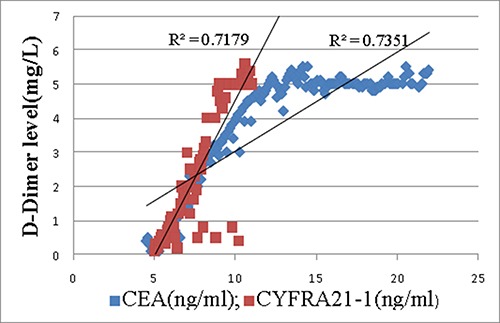
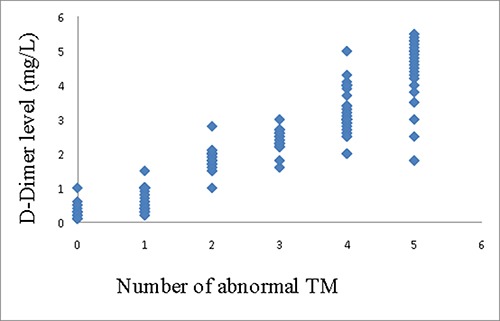
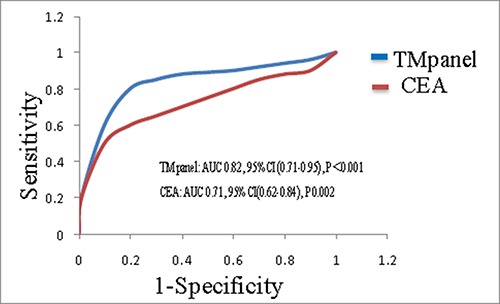
Results: The number of abnormal tumor markers of lung cancer patients with pulmonary embolism (3.9 ± 1.1vs1.6 ± 0.6,P 0.005) was more than that in patients without pulmonary embolism. TMs panel (P trend < 0.001), CEA (R2 0.735, P0.003) and CYFRA21-1 (R2 0.718, P0.005) were positively correlated with D-Dimer in patients with pulmonary embolism. The multivariate logistic regression analysis showed that, for tumor markers, TMs panel (OR5.98, P < 0.001) had the strongest correlation with pulmonary embolism. The AUC (area under curve) of TMs panel and CEA were 0.82 [95%CI (0.71-0.95), P < 0.001] and 0.71 [95%CI (0.62-0.84), P 0.002] by ROC (receiver operating characteristic) curve analysis, respectively.
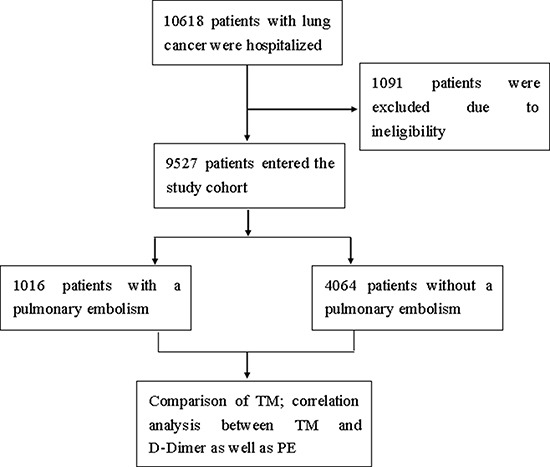
Materials and methods: Tumor markers were compared between lung cancer patients complicated with pulmonary embolism and those without pulmonary embolism Then the correlation between each tumor marker as well as panel of combined TMs and D-Dimer as well as pulmonary embolism were analyzed for patients with pulmonary embolism.
Conclusions: There is a relationship between tumor markers and pulmonary embolism in patients with lung cancer. The panel of combined tumor markers is a valuable diagnostic marker for pulmonary embolism in lung cancer.
Keywords: CEA; lung cancer; panel of combined tumor markers; pulmonary embolism; tumor markers.
Conflict of interest statement
The authors report no funding or conflicts of interest in this work.
Figures
References
-
- Konstantinides SV, Torbicki A, Agnelli G, Danchin N, Fitzmaurice D, Galie N, Gibbs JS, Huisman MV, Humbert M, Kucher N, Lang I, Lankeit M, Lekakis J. ESC Guidelines on the diagnosis and management of acute pulmonary embolism. Eur Heart J. 2014;2014;35:3033–3069. doi: 10.1093/eurheartj/ehu283. - DOI - PubMed
Publication types
MeSH terms
Substances
LinkOut - more resources
Full Text Sources
Other Literature Sources
Medical
